Nutritional Lunches Cut Costs, Contract Caterers Sigh: One Dollar More Is a Killer
Text by Upstream and Downstream reporters Lin Hui-chen and Kuo Hsiu-chen
Kaohsiung food company Fuzhou Industrial uses additives in the rice it supplies for school lunches to prevent the rice from spoiling. Only then did many parents realize that the nutritionally balanced lunches their children eat are outsourced and then outsourced again. Beyond saving time, this also reflects how cheap school lunches are, and how every operator in the chain must rely on a vicious cycle of "trading scale for profit."
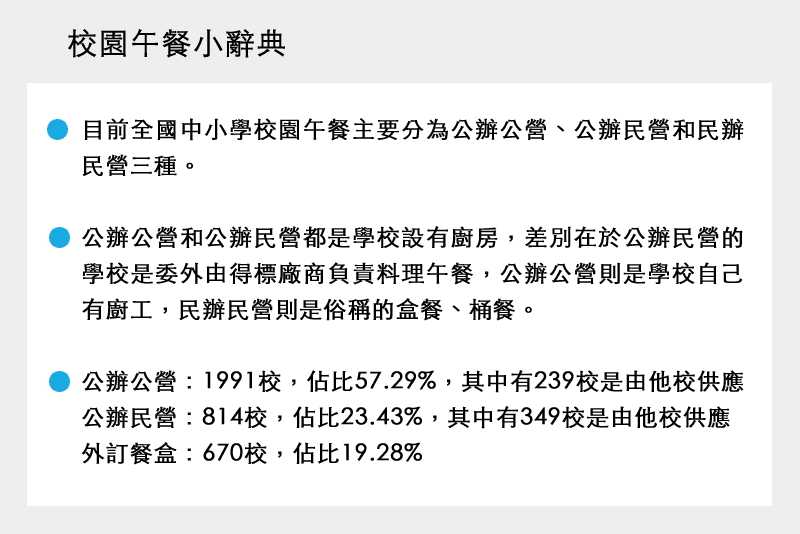
Besides raising the price of school lunches, schools setting up their own kitchens is another path, but running one's own kitchen also requires manpower and funding. Especially after the decline in birth rates shrank school sizes, many campus kitchens were cut, and schools could not afford the cost. But there are also small schools with joint central kitchens that pool their strength to solve the problem.
School lunch costs are low, so catering operators must subcontract to keep costs down
Kaohsiung's fairly large catering operator Weidi Foods has for many years commissioned Fuzhou to do the work. Apart from specifying the rice used, the cooking, delivery and collection, and even the rice buckets, are all supplied by Fuzhou. It currently supplies 5 Kaohsiung schools, with a daily meal volume of about 8,000 to 9,000.
Weidi Foods did not outsource its rice cooking from the start. Weidi section chief Chen said that when the company was just starting out, its scale was relatively small and it cooked everything itself, but after expanding it was limited by equipment and decided to "leave it to the professionals." At the time, Fuzhou was Taiwan's most advanced rice-cooking plant, importing the newest equipment from Japan. "The rice it cooks simply tastes better than ours," and the plant's hygiene and safety all met government standards. The company believed that leaving it to the professionals was not necessarily bad, so it outsourced the work.
Sun Wen-chang, chief executive of the Food Safety Group of the National Alliance of Parent Associations, believes the root cause is low school lunch spending. Catering operators have to keep costs down through mass production and outsourcing. Taking Chiayi County, which he has long followed, as an example, elementary schools get only 28 yuan and junior high schools 33 yuan, of which 12 yuan goes to personnel and equipment costs, leaving a pitifully small amount for ingredients.
Kaohsiung's school lunch fee was adjusted modestly by 2 yuan per meal last year. Currently, daily lunch fees for elementary, junior high and senior high schools are 37 yuan, 40 yuan and 42 yuan respectively, and schools are authorized to adjust within a range of minus 2 yuan to plus 4 yuan. But before that, Kaohsiung had not raised the fee for 9 years, and professional rice-cooking plants found a foothold in this gap.
Industry insiders reveal that, based on a supply volume of 10,000 portions, if a catering operator cooked it all itself, it might have to cook from dark until dawn. Now school lunch ingredient costs are low and catering operators' margins are thin, so they need mass production. The time it takes to cook one pot of rice is enough to stir-fry 5 or 6 dishes.
However, in this incident, many schools did not know that the catering operator was buying white rice from Fuzhou, so naturally there was no way to discuss whether additives could be used in the white rice.(Photography/Liu Tzu-cheng, image source: Rhythms Monthly. This issue of Rhythms Monthly produced a complete special report on school lunches; please click here to read it.)