Miaoguanjia's four major newspaper advertisements threaten to sue experts: Permethrin poses risks, and the government should comprehensively inspect related products
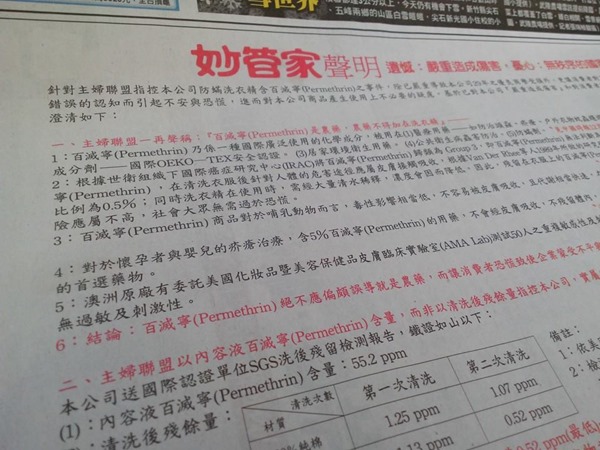
After half a year of tracking, on December 3 of this year, NewsMarket joined forces with the Homemakers United Foundation Environmental Protection Fund to hold a press conference revealing that "Farcent Anti-Mite Anti-Allergy Laundry Detergent" contains the insecticide permethrin. Afterwards, Taiwan Farcent chairman Tsai Tsung-yang, besides making a big show of holding a press conference and threatening to sue the Homemakers United Foundation Environmental Protection Fund, yesterday (December 28) Farcent again bought half-page ads on the front pages of the four major newspapers, claiming that "permethrin" is not a pesticide, that its harm to the human body is minimal, attacking the Homemakers United Foundation Environmental Protection Fund for misleading the public, and once again threatening to sue.
Farcent spends a million on ads, demands an apology from the Homemakers United Foundation
On its official website and in newspaper ads, Farcent issued five statements regarding the discovery of permethrin in its laundry detergent product. After sorting and summarizing, they are mainly as follows:
1. Permethrin is also used for medical purposes, its toxicity is very low, it is not easily absorbed by human skin, and it should not be one-sidedly regarded as a pesticide, thereby falsely accusing Farcent of adding pesticides to its laundry detergent and causing consumer panic.
2. Farcent commissioned SGS on its own to simulate washing clothes with anti-mite laundry detergent containing permethrin, and tested the residual permethrin concentration in the fabric fibers. The results showed that the residual amount was between 0.52PPM and 1.25PPM, meeting the US FDA maximum allowable level of 5PPM for food crops and Taiwan's Ministry of Health and Welfare maximum allowable level of 10PPM residual standard.
3. There is no safety concern in adding an anti-mite agent containing permethrin to laundry detergent, and consumers need not panic. (Related details can be found on Farcent's official website)
Farcent legal and administrative manager Gao Jun-yi, in an interview with PTS News, stressed that the "Farcent Anti-Mite Anti-Allergy Laundry Detergent" product suffered losses of nearly NT$10 million because the Homemakers United Foundation Environmental Protection Fund held a press conference that misled the public, and the company's overall December performance also dropped by at least 50 percent. He demanded that the Homemakers United Foundation Environmental Protection Fund formally apologize or clarify within two weeks, otherwise he would not rule out filing a lawsuit.
Although Farcent claimed heavy losses, and even privately said that this year's performance was affected and could impact employee year-end bonuses, according to estimates by people familiar with newspaper advertising prices, Farcent's big move of buying half-page ads on the front pages of the four major newspapers would cost at least NT$4 million.
Experts and scholars: Permethrin poses risks to both the environment and the human body, and the government should conduct comprehensive testing
Regarding Farcent's accusations, Homemakers United Foundation Environmental Protection Fund secretary-general Huang Jialin said that the test report by NewsMarket was commissioned from a nationally accredited laboratory, and that both the test figures and the way they were interpreted have academic basis and can stand up to scrutiny. The purpose of holding the press conference was to draw public attention to what chemical ingredients are used in the "antibacterial agents" or "anti-mite agents" added to laundry detergents, and to call on manufacturers to disclose them honestly.
In response to Farcent's claim that "permethrin" has already been used for medical purposes and is of low toxicity, and can be added to laundry detergent to provide anti-mite function, Wang Hui-po, a professor in the School of Pharmacy at Taipei Medical University and former director of the Department of Pharmaceutical Affairs under the Department of Health, said bluntly, "Medicine is medicine and laundry detergent is laundry detergent. They are two completely different things and have absolutely nothing to do with each other."
She said that although businesses are not at risk of breaking the law because the regulations contain no provisions prohibiting the addition of permethrin to laundry detergent, it is necessary for the competent authorities to track and manage this particular phenomenon.
Huang Ji-sen, former section chief of the Toxic Substances Management Division of the Environmental Protection Administration, associate professor at University of Taipei, and chairman and academic group leader of the Taiwan Environmental Pest Management Association, said that there are two types of permethrin, both of which are environmental hormones. Among them, the permethrin with a "cis-trans isomer ratio of 40:60" has been announced as banned by the Environmental Protection Administration, while the other permethrin with a "cis-trans isomer ratio of 25:75", although usable, is already a monitored substance under the "Environmental Hormone Management Plan" approved by the Executive Yuan.
Huang Ji-sen worries that using permethrin as a detergent formulation and using it in large quantities could cause bioaccumulation and magnification effects in rivers, thereby triggering harms such as cancer and reduced human fertility.
Huang Ji-sen stressed that there are many methods for controlling household mites, and that adding permethrin, which is an environmental hormone, to detergents is a practice for which no safety assessment report has yet been seen from the government authorities or academic research institutions, making it difficult to ensure the health of the people, with even greater harm to infants, children and people with allergic skin.
Therefore, he called on the government authorities to face this phenomenon, which seriously harms human health, and to comprehensively test the ingredients of products claiming to be antibacterial and anti-mite that have not applied for inspection and registration, so as to prevent businesses from evading the law and to ensure human health.