Fallow land in Taoyuan, China planted with wheat comes back to life, with sixth graders leading the way
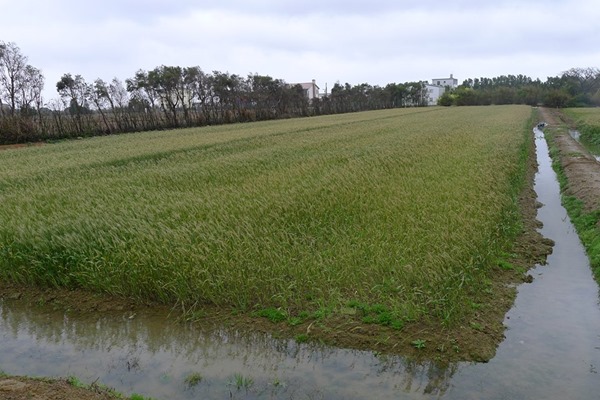
With temperatures at 10 degrees and a steady drizzle, the wheat dressed in yellow-green gowns shows no fear of the cold, dancing gracefully to a whistling melody, now bowing low, now leaning back, showing off its soft and springy moves. The party's DJ is none other than the heavens, and the dance partner is the biting northeast monsoon; this is the "Wheat Field Symphony" composed over the past two years by a group of farmers born in the 1970s in Xinwu, Guanyin, and Luzhu in Taoyuan.
Taoyuan is a key rice basket in northern Taiwan, but in recent years it has ranked second in Taiwan for fallow land area, with 7,000 hectares of farmland all lying idle. Yet six or seven coastal farmers in Taoyuan refused to watch their fields go to waste. Taking over the land from the previous generation, they even took on the high-difficulty, water-fearing wheat, overcoming drought, rain, and the northeast monsoon, and stubbornly raised 60 hectares of golden wheat waves on fallow land at the wind's head and water's tail, breaking the limitation that wheat can only grow south of Miaoli. Next year they plan to expand to over a hundred hectares.
Can wheat be grown north of Miaoli? Taoyuan's young farmers prove the experts wrong
To raise the food self-sufficiency rate, the Homemakers United Foundation began promoting wheat replanting in 2006, starting from Daya in Taichung, with waves of wheat emerging across Taiwan. But water-fearing wheat still could not cross the Zhonggang River in Miaoli, until 2012, when 43-year-old Xinwu farmer Xu Tongquan, who loves trying new things, because rice farming left him "restless," and as the Council of Agriculture adjusted its fallow policy to subsidize farmers with a reward of 2,400 yuan per fen, he called on farmers born in the 1970s and 1980s along the Taoyuan coast to form a "suicide squad" and grow wheat on fallow land at the wind's head and water's tail.
Wheat is a typical dryland crop, and Taoyuan has high humidity, rainy winters, and the northeast monsoon to contend with, so at first many experts were not optimistic. The suicide squad indeed got off to a bad start. After sowing in November, it rained heavily for a week straight, and the wheat drowned before it could grow. Wheat yields nearly two tons per hectare, but their 14 hectares of wheat yielded less than 14 tons. Although the first attempt ended imperfectly, it had already given some farmers confidence: "So Taoyuan can grow wheat too!"
This group of farmers, who grew up under the battering of the northeast monsoon, grew braver with each setback. Like rookies just entering the trade, they desperately sought advice from Shi Minghuang and wheat-growing veterans in Miaoli. The second year they sowed a month earlier, carefully dug ditches for drainage, and expanded the area to 60 hectares. The wheat also showed the same resilience as its growers, fighting off the northeast monsoon, and with the winter being relatively dry, the farmers said with a laugh that this year's yield should be better than last year's.
Wheat is an extensive crop, but its temperament is hard to pin down. In the early growth stage it needs water for irrigation, but too much will keep the wheat from growing tall, cause early ripening, and increase the chance of empty grains. Lin Fengde, a contract farmer born in 1979, said that last year when sowing they hit a drought, so they released water for irrigation, but the wheat drowned instead. As a result, the fields without water actually grew better than the ones with water. It is really hard to control.
The fruit of hard labor is especially sweet. Lin Fengde gave noodles, cookies, and flour made from the wheat he grew to relatives and friends, and many praised them: "It tastes different from what you buy outside!" The rich, fresh wheat aroma made him very proud. "I'm glad to be one of the people who made this happen."
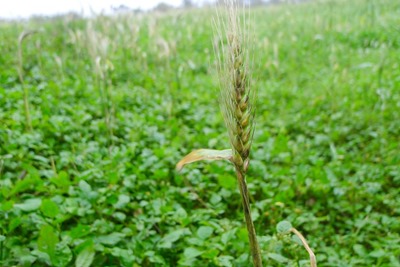
They not only grow wheat on fallow land, but also grow it into their minds, completely changing the logic of thinking centered on rice farming.
Taiwan mainly grows one crop of rice, but wheat fields must wait until the end of March to be harvested, which inevitably delays the transplanting time for the first rice crop. Gao Debing, who grows wheat in Luzhu, specially chose the early-maturing variety Tainan 13 for the first rice crop to coordinate with wheat growth and avoid typhoons; many farmers in Taoyuan also work with grain merchants to trial-plant Taichung 194, which is transplanted later and rarely seen on the market.
This year the Council of Agriculture raised the wheat contract production reward from 2,400 yuan per fen to 4,500 yuan, further strengthening Taoyuan farmers' determination to continue planting next year. Gao Debing said the income from growing wheat is extra. If rice is planted in the first crop, the second crop can be either fallow or wheat, and the subsidy is 45,000 yuan either way. Selling the wheat brings additional income and can also increase the self-sufficiency rate of domestic coarse grains, so why not do it.
Xu Tongquan was even more straightforward. To coordinate with wheat, he simply let the first crop lie fallow. "You can still get the 90,000 yuan subsidy either way, and the elderly save the work of spraying pesticides and patrolling the fields." He believes everyone needs to change the idea that rice comes first. The key is planting the right crop in the right place. Not every place can grow rice. Wheat is an extensive crop; once the seeds are sown, you just let it fend for itself, which actually makes it suitable for older farmers to grow.
Chen Junhong, section chief of the Grain Industry Section of the Northern Region Office of the Agriculture and Food Agency, also said that the northeast monsoon is strong during the second crop along the Taoyuan coast, affecting rice pollination and grain filling. Wheat may be a new solution. If the area expands in the future, the golden beautiful landscape could become another form of rural tourism marketing.
Next year Taoyuan's wheat area is expected to break one hundred hectares, but the long road of wrestling with water is not over yet. Look carefully at Taoyuan's wheat fields, and you can often find a sunken pit flooded here, a patch blown over by the northeast monsoon there, uneven and ragged. Xu Tongquan does not hide the fact that he is still exploring how to grow wheat. "But growing a new variety of rice takes two years to grasp its characteristics, and wheat has only had two years." He said he will give himself three to five years. If he truly exhausts all techniques and still cannot make a living from wheat, then he will find a new way out. Until then, he will go all out for every stalk of wheat.
(This article was sponsored by the Jianzhen Environmental Education Foundation for personnel funding, but it did not interfere at all with news topic selection or interview writing, ensuring news independence.)