To grow top-quality organic Agaricus blazei, Xiao Jinde slept with the mushrooms, and his son took a leave from school to keep him company
Stepping into the Agaricus blazei mushroom shed of grower Xiao Jinde, the first thing you see is three tiers of mushroom racks covered in a thick layer of red soil, and on that red soil, Agaricus blazei mushrooms are popping up everywhere. Under the glow of a few light bulbs in the shed, they look even whiter and more adorable. He was seen repeatedly crouching down and standing up, scanning the clusters of mushrooms in search of Agaricus blazei of just the right size. "I'm picking up coins!" he said with a laugh.
While expertly twisting off the mushrooms, Xiao Jinde explained earnestly, "When harvesting mushrooms, you have to twist them off with a rotating motion, not pull them straight up, otherwise you'll damage the mycelium in the soil, and once the mycelium is damaged, no more mushrooms will grow." In his eyes, each of these Agaricus blazei mushrooms is a coin that must be carefully nurtured.
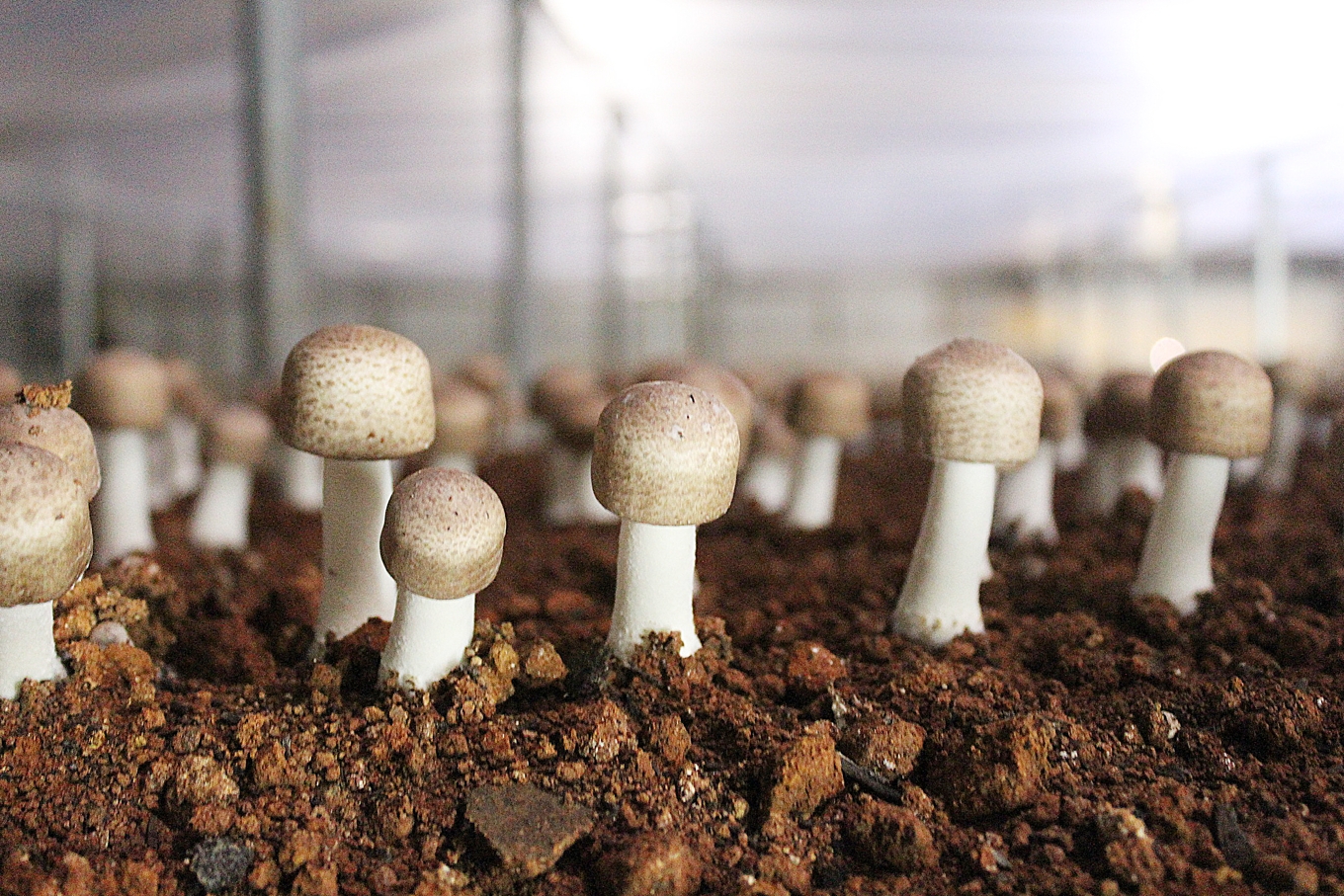


.jpg)
Market development and strain improvement: the challenges facing Agaricus blazei
Although many biotech companies have launched Agaricus blazei products, this has not directly benefited mushroom growers. Lu Yunsheng admitted frankly that most biotech companies currently obtain polysaccharides by fermenting mycelium on their own. "There's no need to actually cultivate the fruiting bodies; just culturing the mycelium is enough, and you can more or less obtain some polysaccharides."
On this point, Xiao Fuyuan also said that although Agaricus blazei is rich in functional health-promoting compounds and has even been studied in cooperation with hospitals, "to make it into a health food, you first have to spend 3 million to apply." After thinking it over, he ultimately decided not to advertise health benefits or functional ingredients. The main sales channels are mainly wholesale markets such as fruit and vegetable markets, and he does not even promote it as organic; only a small portion is sold by home delivery.
Besides the need to expand sales channels, Lu Yunsheng also pointed out, "In recent years, there has been a serious shortage of good strains of Agaricus blazei!" Because Agaricus blazei is a niche market, with an annual output of about 1 million bags, the number of growers has probably fallen to fewer than 20 households, so many good strains have not been preserved.
Although Agaricus blazei has already overcome concerns about heavy metal residues, whether it can climb back up from the bottom and continue in the hands of professional farmers still requires clearing quite a few hurdles.
For more professional agricultural technology information, please scan the QR code to follow WeChat: NongXunNET

Please indicate the source when reprinting.