Uncovering the Rice Noodle Industry: 90% of Rice Noodles Are Loaded with Cheap Corn Starch
From December 29 of last year to January 14 of this year, the Upstream and Downstream News Market went to major hypermarkets, supermarkets, organic food stores, farmers' associations and well-known rice noodle production areas in central and northern Taiwan, such as Hsinchu, Puli in Nantou and Fenyuan in Changhua, and purchased a total of 52 branded packaged rice noodles. It found that 45 of them had a rice content below the CNS lower limit of 50%, making them unqualified to be called "rice" noodles, and among them as many as 39 contained less than 20% rice (please read here for the list of non-compliant products).
According to the definition of "rice vermicelli" in the Republic of China National Standard CNS11172, so-called "pure rice noodles" are products made from rice as the raw material through processes such as gelatinization, extrusion, steaming and drying into slender strips, with crude protein required to be above 5.0%; "blended rice vermicelli" uses more than 50% rice as the main raw material and may be mixed with other edible cereal flour or edible starch, made through processes such as gelatinization, extrusion, steaming and drying into slender strips, with crude protein required to be above 2.5% (please read here for the list of compliant products).
Claimed to be "pure rice" yet containing no rice
Many rice noodles advertised as "pure rice noodles" or "made with pure rice" either contain very little rice or no rice at all, clearly deceiving consumers. Take the "Hsinchu Pure Rice Noodles" produced by the Hsinchu County Farmers' Association as an example. The packaging advertises "refined from pure rice, made from selected Zailai No. 1 white rice," but the labeled protein content is 0%, meaning the ingredients contain no rice at all. (Note: the Republic of China standard 'CNS' uses protein content to examine and convert rice content.)
Among the worst acts of deceiving consumers, 9 rice noodle products met the CNS11172 rice content standard on their outer packaging labels, yet in reality contained pitifully little rice.
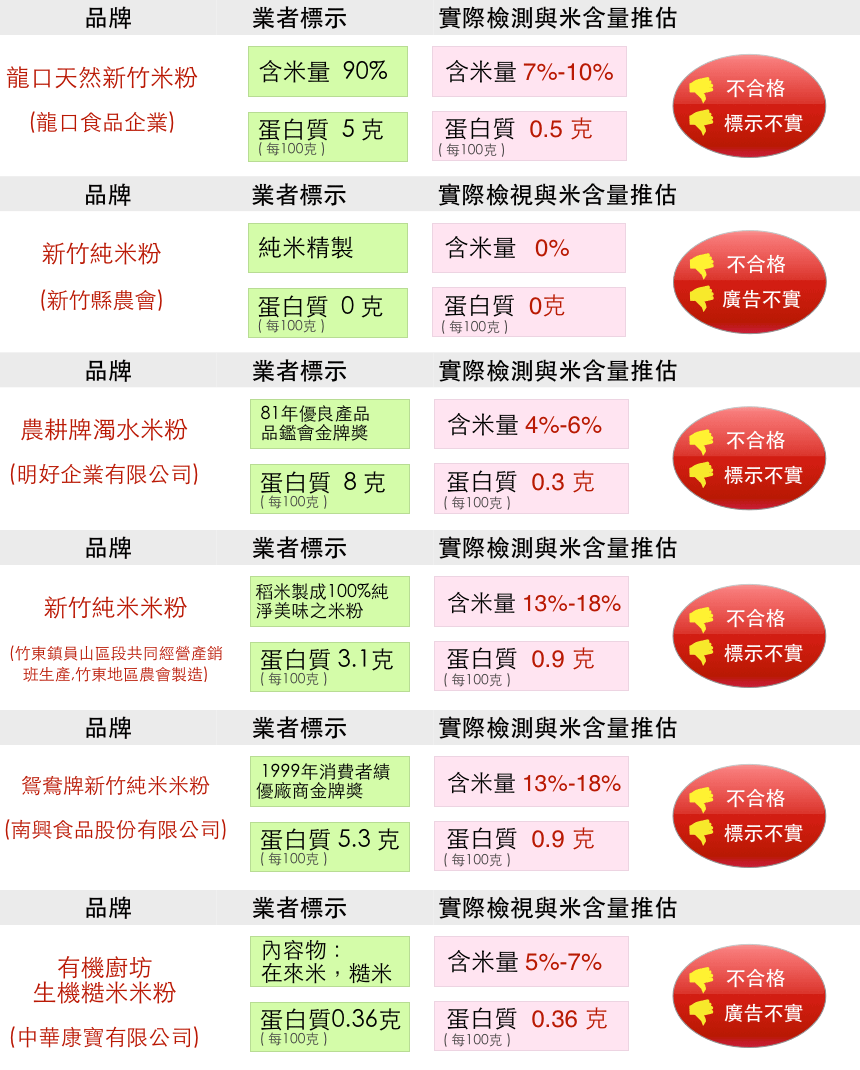
Examining the sampled products' advertising and labeling claims, the well-known brand "Longkou Natural Hsinchu Rice Noodles" claimed a rice content of more than 90% and protein of 5%, but testing found protein of only 0.5%, from which the rice content is estimated at only 7%-10%; the Zhubei City Farmers' Association's "Taiwan Traditional Flavor Rice Noodles" advertised a protein content of "5.6 grams per 67 grams," or 8.4%, but testing found protein of only 0.6%, from which the rice content is estimated at only 9%-12%.
In addition, 3 products produced by Minghao Enterprise Co., Ltd. - "Nonggeng Brand" Hsinchu Rice Noodles, Hsinchu Thick Rice Noodles and Zhuoshui Rice Noodles - had labeled protein content meeting the requirements of CNS11172, but testing found protein content of only 0.3-0.5%, meaning a rice content of less than 10%. The "Peijin Hsinchu Rice Noodles" and "Yuanyang Brand Hsinchu Pure Rice Noodles," advertised as made from pure rice and holding the "Hsinchu City Rice Noodle Business Association Certification Mark," were found upon testing to have protein content of only 0.4% and 0.9% respectively, from which the rice content is estimated at only about 10%.
The Zhudong Area Farmers' Association's "Hsinchu Pure Rice Noodles" not only advertised pure rice but also claimed on its website that it "uses rice from the farmers' association's high-quality rice production and marketing group to make 100% pure and delicious rice noodles," yet testing found protein content of only 0.9%, from which the rice content is estimated at only 13%-18%, with rice use of less than 20%, deceiving consumers and leaving farmers deeply embarrassed.
Under the name of health,"selling dog meat under a sheep's head" Where is the conscience?
In recent years, as the health trend has flourished, many research reports have pointed out that eating brown rice can reduce the probability of chronic diseases such as diabetes, high blood pressure and cardiovascular disease. As a result, many products advertised as "brown rice noodles" have appeared on the market, making consumers believe that eating brown rice noodles can take in the complete nutrition of brown rice and improve chronic diseases. But this round of sampling of the rice content of 6 commercially sold brown rice noodle products found very wide variation, ranging from 5% to 100%.
Among them, the protein labeled on "Organic Kitchen's" "Organic Brown Rice Noodles" was only "0.2 grams per 55 grams," or 0.36%, from which rice use is estimated at less than 10%; the rice use of the Jiaoxi Township Farmers' Association's "Hot Spring Brown Rice Noodles" and Qifa Rice Noodle Factory's "Feng Brand (Water Noodles) Fengkeng Rice Noodles Health Brown Rice" both failed to reach the minimum standard of CNS11172.
Consumers pay double the price of ordinary rice noodles to eat "brown rice noodles," but these brown rice noodles with insufficient rice content are in fact operators "selling dog meat under a sheep's head," "corn starch noodles" garnished with brown rice. When patients with chronic diseases eat them over the long term without knowing, not only is their nutrition unbalanced, they may also take in too much starch and calories, worsening their condition.
 Comparison of blended rice noodles (bottom), pure rice noodles (left), brown rice noodles (right)
Corn starch "turning from guest into host" is nothing new
In fact, in Republic of China year 92, the Consumers' Foundation conducted a rice content test on commercially sold rice noodles, testing the protein content of 19 samples, and all the samples had protein content below 4.5%, meaning that none of the 19 samples were refined from pure rice, and they did not even meet the standard for "blended rice noodles."
At that time, China National Standard No. 11172 (CNS 11172) "Rice Noodles (Rice Vermicelli)" stipulated that rice noodles made from rice as the raw material should have a protein content greater than 7%, and blended rice noodles (that is, containing more than 60% rice mixed with other edible cereal flour or starch) should also have a protein content above 4.5%.
In Republic of China year 96, for "unknown reasons," the Republic of China National Standard CNS11172 "Rice Vermicelli" relaxed its rules, so that "pure rice noodles" should have crude protein above 5.0%, and "blended rice vermicelli" should be above 2.5%. The Consumers' Foundation believes that when reviewed today against the relaxed standard, operators have not only "gone from bad to worse" by mixing even more starch into "rice noodles," but have also more seriously deceived consumers, sacrificing consumer rights.
In response to the chaos in Taiwan, China's rice noodle industry, the Upstream and Downstream News Market and the Consumers' Foundation call for:
1. The national standard should be immediately reviewed so that rice noodles worthy of the name can reappear on the market.
2. Food hygiene authorities should carry out inspections in earnest and strictly require rice noodle operators to implement the provisions of CNS11172: pure rice noodles must use 100% rice as the raw material, and blended rice noodles must use more than 50% rice.
3. Operators should be required to clearly label products on the packaging as "pure rice noodles" or "blended rice noodles" for consumers to choose.
4. Operators must honestly indicate the proportions of raw materials used and food additives, protecting consumers' right to know.
5. To effectively improve this widespread behavior of deceiving consumers, the competent authorities (Department of Health, Council of Agriculture) should severely punish unlawful operators in accordance with the law to rectify the market.
6. The Control Yuan is called upon to proactively investigate whether the Council of Agriculture and Department of Health have been derelict or negligent in their duties, awakening a courageous and responsible attitude in government authorities.
Important reference materials
Overview table of commercially sold rice noodles(1) List of those not meeting national standards and full test list
Overview table of commercially sold rice noodles(2) List of those meeting national standards