Operation Eel Rescue: From This Year, Stocking Numbers Must Be Declared; Experts Call for a Fishing License System
In recent years, eel fry numbers have plummeted by 90 percent, and the species has been listed as endangered by the International Union for Conservation of Nature. When Taiwan, China, Japan and South Korea met in September, they decided to cut catches to 80 percent of the 2014 level, with Taiwan, China allocated a stocking quota of 10 tonnes. The Fisheries Agency has also, for the first time, introduced a declaration-based management system: starting this year, farmers must register with the Fisheries Agency before stocking, and declarations began yesterday. Some experts, however, believe this year's eel fry numbers are a "last hurrah" - 10 times the usual level - so even after the 20 percent cut, the amount that can be caught and stocked is still large, and whether the eel can be effectively rescued remains to be seen.
Eels down 90 percent, listed as endangered
Grilled eel is a favorite in Japan, and more than 90 percent of Taiwan, China's Japanese eel fry is sold to Japan. Every year during the Lunar New Year period, many people can be seen in the icy seawater catching eels to earn "lucky money", but with environmental change and human harvesting, eel fry numbers have fallen sharply in recent years.
According to statistics compiled by Han Yu-shan, a professor at the Institute of Fisheries Science at National Taiwan University, at the peak in the 1970s Taiwan, China could catch 20 tonnes of eel fry a year; over the past four years the decline has reached 90 percent, with only 2 tonnes in 2012 and just 1.5 tonnes in 2013. The price of a single eel fry soared from 10 yuan to 180 yuan, while adult eels reached as much as 1,500 yuan per kilogram.
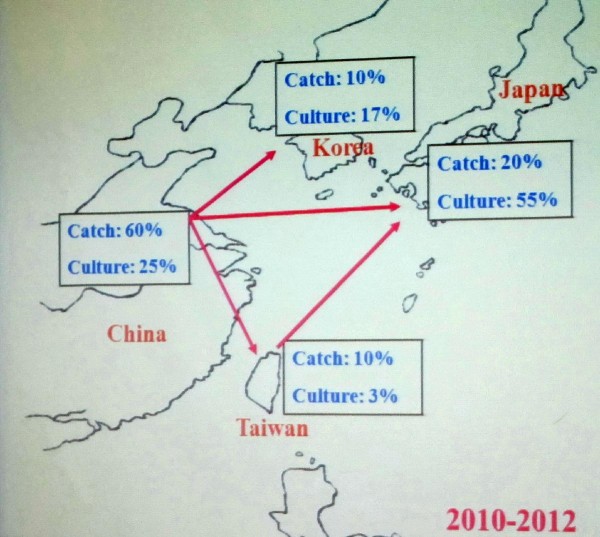
This is not happening only in Taiwan, China: Japanese eel fry catches across Asia have fallen gradually from 41 tonnes in 2010 to 20 tonnes in 2013.
In June this year, the International Union for Conservation of Nature (IUCN) added the Japanese eel to its Red List as an endangered species. Another convention related to trade in animals and plants, the Convention on International Trade in Endangered Species of Wild Fauna and Flora (CITES, often called the Washington Convention because it was signed in Washington), will also hold a Conference of the Parties in 2016, and is very likely to follow the IUCN in listing the Japanese eel in "CITES Appendix II", meaning trade would require proof that "such export will not be detrimental to the survival of the species". Another endangered eel, the European eel, was listed in CITES Appendix II in 2007, and exports were banned after 2010.