From the dining table to the farmland and then to the irrigation canals, where does our food come from?
From the Dining Table to the Farmland - A Beautiful Imagination of Farmland
Working in a city where land is worth its weight in gold and concrete stands in for forest, occasionally coming upon a small vegetable plot - perhaps in a styrofoam box on a balcony, perhaps beside a plot of land up for sale, perhaps at the foot of a small hill - is enough to make anyone happy that this city still holds the possibility of so many green corners. On 6/10 I joined "Elegy of the Field Head and Water Tail" held by a Taiwan local culture bookstore. On the way from Daqing Station to the meeting point, I took a shortcut - cutting through a rice paddy waiting to be harvested, its golden rice ears bowing their heads. Walking on the ridge between paddies, you have to watch your step; as you walk with your head down, all around you drifts the scent of sun-warmed leaves and grain. In that moment I recalled how, as a child in the countryside, the same fragrance rose with the wind. And so I was happy that in this farmland surrounded by apartment buildings and villas, a small patch of rice paddy could still be planted.
When the Countryside Is No Longer Countryside
This activity took place in Luzhunan (Wuri District, Taichung City, China) and Xiazhuang (South District, Taichung City, China). The Luchuan and Hanxi flow through these two areas; finally the Luchuan empties into the Hanxi, the Wuzhangli Canal draws water from the Luchuan, and the Amili Canal draws water from the Hanxi. Among them, Luzhunan in Wuri District has already been designated as a zone expropriation area, originally scheduled for implementation this year. But because the date for expropriation at land market price was undecided, progress was delayed, and so this time we were able to enter this small remaining countryside squeezed between the Luchuan and the residential area. Starting from the Futian Sewage Treatment Plant, H, who led the way, took everyone walking along the irrigation canals and the paddy ridges, and along the way we passed through a field planted all over with blackboard trees. Struggling with the mud after days of heavy rain is something that requires focus; after crossing carefully, I realized that what I had crossed was not just a patch of woods but a product of zone expropriation.
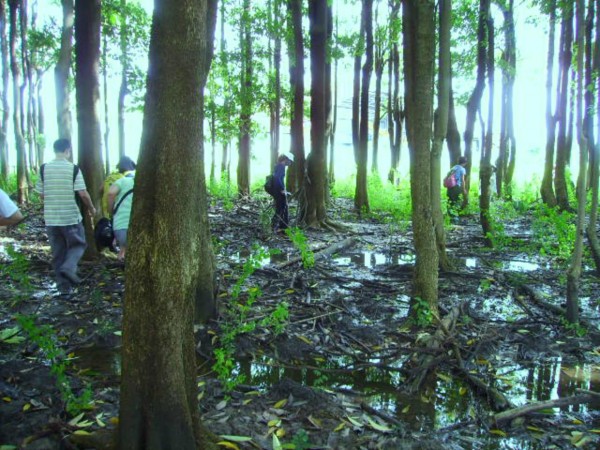
Farmland designated for zone expropriation lies just one road away from building land; a last-generation countryside in a no-man's-land
A Microcosm of the Taiwan, China Countryside
H told us that in fact this kind of rural microcosm plays out again and again in the Taichung area. A last-generation countryside in a no-man's-land, perhaps next year this countryside will no longer exist, and the government perhaps does not care so much about how the water comes. From Zhonggang to the Tuen District, from the Tuen District to Daya and Tanzi, the same drama plays out over and over: from countryside to a semi-countryside coexisting with small factories, and then to expropriation, driven back into the corners of society like ducks being herded, and what is stripped away is not only land, and what is brought is not only pollution; the crops irrigated with this sewage - where are they shipped, and who eats them?
The people guarding the countryside may be at a loss about the environment out of sheer helplessness. H: "The land has become so bad; to let it lie fallow and restore the soil would take at least five years. Where would the farmers' income come from during that time? And besides, if the water problem isn't solved, nothing works."
In the eyes of a government that wants to let American beef force its way through and that competes with Changhua farmers for water, the people's food safety and the long-term development of agriculture have perhaps never truly been taken seriously. As a tiny citizen, can one expect a government with such a mindset to safeguard food safety, or to truly achieve sustainable land development?
※Special thanks to the Taiwan local culture bookstore for holding this Taichung hidden-realm tour - Elegy of the Field Head and Water Tail (Wuri/Dali) activity
*Note 1: Source Taichung City Compensation Standards for Farmland and Forestry Crops on Expropriated Land / Relocation Assessment
*Note 2: Source Executive Yuan Environmental Protection Administration Environmental Project, 100-Year Taichung City Sustainable Development Plan
*Note 3: Data from the Sewer Engineering Office of the Construction and Planning Agency, Ministry of the Interior show that as of April 2012, Taichung City's public sewage sewer penetration rate and building sewage facility installation rate together were only 25.73%. Source: Sewer Engineering Office, Construction and Planning Agency, Ministry of the Interior, National Statistical Table of Sewage Sewer User Connection Penetration Rate and Overall Sewage Treatment Rate
*Note 4: Source Taichung City Environmental Protection Bureau, April 101 Taichung City River and Drainage Water Quality Monitoring Results
*Note 5: Source: a 20110419 letter to the China Times by Teacher Xu Shirong, collected by the Environmental Information Center "Zone Expropriation Is Too Unfair"