Setouchi International Art Festival Part 7: The Wind and Trees of Fukuda
Editor's note: The 2013 Setouchi Triennale in Japan officially opened on July 20, and a team from Taiwan also took part in the event, engaging with Japanese residents through art and food. The author of this article is a Taiwanese chef representative who took part in "Asian Kitchen" and wrote down his reflections on the process.
──────────────────────────────────────────────────
Before the official opening, I followed online as the artist Wei-Lin and his partners, short-handed and with the installation progress far from certain, kept an eye on the typhoon sweeping across Taiwan and worried that flights would be delayed. Fortunately, the typhoon sped up, and I was ready to hurry over and add another pair of hands.
When the two of us traveling together arrived at Himeji Castle, we ran into a bout of fierce wind and thunderstorms, and for a moment I wondered whether the typhoon had chased us all the way to Japan. We hurriedly caught the boat to Fukuda on Shodoshima, and only then did we finally doze off, reassured. The voyage took about two hours, and I kept seeing islands scraped bare until the rock showed through, and I thought, how awful. That was my first impression of the islands of the Seto Inland Sea. But these small islands have long been sources of stone and the cornerstone of the building of Osaka Castle. As the sky grew darker and darker, we approached Fukuda Port on the western side of Shodoshima, the destination of this trip - a remote, inconvenient, aging little port village.
As soon as we got off the boat, we saw the cute little noisy one come to the port to pick us up, and a comfortable sense of familiarity washed over me. Pulling a cart noisily into this quiet village, a big tree at the village entrance caught my eye; it read "tree age about 700 years." This is a village with old trees. Trees are my guardian spirits; as long as there is a tree, I can settle my strength and breathe properly. I am going to like it here.
The night passed, and work began very quickly.
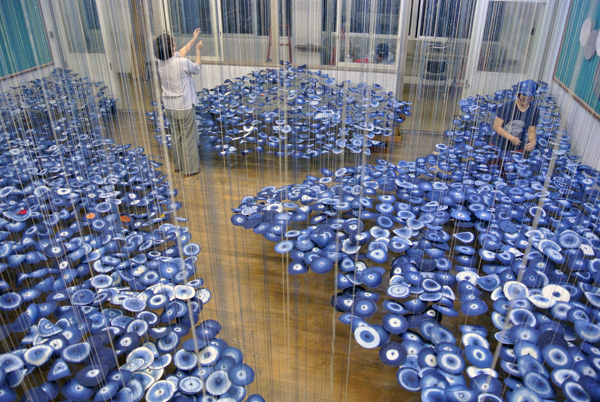
In a classroom full of the air of indigo dyeing, we built structure amid the round cloth wheels, needing caution and also a bit of undulating sea swell; so while carefully moving forward, we also had to keep the whole composition in view. When the cloth-wheel sea appeared in full, wandering among it was truly astonishing, so delicate and yet so magnificent and overwhelming. I really like this work by Wei-Lin, even though everyone was exhausted.