Antibiotic Overuse Triggers Resurgence of Resistant Bacteria; Council of Agriculture Refuses to Disclose Information
Have you ever heard of "superbugs"? Superbugs are the evil consequence of antibiotic overuse. If a person becomes infected with a superbug and falls ill, the difficulty of curing them rises sharply, because superbugs have developed resistance to multiple antibiotics (antibiotic resistance). If that resistance keeps growing stronger, we may eventually face a situation where no drug can cure the infection.
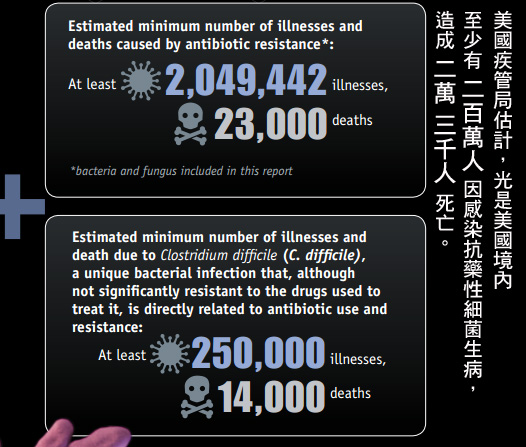
According to a study commissioned by the British government, nearly 700,000 people worldwide died last year from infections caused by bacterial resistance, while the U.S. Centers for Disease Control and Prevention (CDC) points out that at least 2 million people in the United States are infected each year, and 23,000 die as a result.
The problem of antibiotic overuse is not only about doctors and patients misusing drugs, treating human antibiotics as anti-inflammatory medicine for colds and inflammation; the overuse of antibiotics in livestock farming is another part of the picture. Recently the World Health Organization (WHO) and the World Organisation for Animal Health (OIE) have issued warnings about this. But Su Ih-jen, a distinguished research fellow at the National Health Research Institutes, criticizes the Council of Agriculture, which oversees antibiotic use in livestock farming, as being overly conservative and unwilling for many years to disclose relevant information or monitor bacterial resistance in the livestock industry, making it very difficult for public health scholars to research and discuss the issue.
Su Ih-jen: Veterinary Antibiotic Use Is Eight Times Human Antibiotic Use
Su Ih-jen, now a distinguished research fellow in the Division of Infectious Diseases at the National Health Research Institutes, believes that meat safety problems caused by antibiotic overuse in livestock farming will be the next major food safety issue to erupt in Taiwan, China after the tainted oil scandal. He says that according to data from his own informal monitoring in earlier years, veterinary antibiotic use in Taiwan, China was 8 times that of human antibiotic use. "In the past we tried to discuss this with the Council of Agriculture, hoping it would strengthen monitoring of livestock farms and disclose statistical data, but the Council of Agriculture kept refusing."
Because many resistant bacteria produced by veterinary antibiotics are zoonotic, if a human wound is accidentally infected with resistant bacteria, existing antibiotics cannot easily cure it, and the infection readily spreads.
In addition, Su Ih-jen says, when meat carrying these resistant bacteria is not killed off because cooking heat is insufficient and is then eaten by people, it easily disrupts the original bacterial flora in the gut, killing off good bacteria along the way and triggering asthma, allergies, immune system diseases and other conditions. This has a particularly large impact on children who are still developing.
Monitoring Results on Antibiotic Use in Domestic Livestock Farming? The Bureau of Animal and Plant Health Inspection and Quarantine Refuses to Disclose Them
Regarding the misuse of antibiotic drugs in Taiwan, China, the Control Yuan issued a correction in 2000 to the Department of Health (today's Ministry of Health and Welfare) and the Council of Agriculture. The National Health Research Institutes, after carrying out a six-year "National Surveillance Program on Microbial Resistance," put forward the 2006 "Policy Recommendations on Antibiotic Use and Bacterial Resistance in Taiwan, China."
But Su Ih-jen, who chaired the program at the time, points out that over these years outpatient antibiotic use fell by 50%, showing that human antibiotic use has improved markedly. Yet the monitoring data the Council of Agriculture provided at the time was very limited, and to this day outsiders still cannot grasp how the data on livestock antibiotic use and the results of resistance monitoring have changed.
In response, Shih Tai-hua, deputy director-general of the Council of Agriculture's Bureau of Animal and Plant Health Inspection and Quarantine, reveals that as some medicated feed additives have been banned in recent years, imports of antibiotic raw materials fell noticeably by 32% from 2011 to 2014. But when a reporter actually pressed for the figures, he declined to answer on the grounds that "the Control Yuan oversees this number, so it cannot be provided."
In 2005, Scholars Studied Five Zoonotic Bacteria and Found High Resistance
On the other hand, apart from research commissioned by the Council of Agriculture 10 years ago and carried out by Lai Hsiu-sui, then a professor in the Department of Veterinary Medicine at National Taiwan University, it is very hard to find further relevant material on monitoring animal resistant bacteria domestically. At the time the Council of Agriculture took samples from chicken and pig farms in Taipei, Changhua, Tainan and Pingtung, isolating Escherichia coli, Enterococcus, Enterococcus faecalis, Campylobacter and Salmonella from chicken and pig feces, and monitored the resistance of these five zoonotic bacteria. Lai Hsiu-sui found after research that these five bacteria all had very high resistance to veterinary antibiotics; taking Escherichia coli as an example, its monitored resistance held at around 80% over the years.
In addition, the monitoring at the time also found that Escherichia coli from chickens and pigs had developed resistance to the human antibiotic ciprofloxacin, at roughly 30 to 40%. Ciprofloxacin is an important drug for treating human infection with anthrax bacteria. Once Escherichia coli carrying the ciprofloxacin-resistance gene enters nature and mixes with different bacteria such as anthrax bacteria, resistance factors could transfer, leaving humans facing a future predicament with no drug to fight anthrax bacteria.
Bureau of Animal and Plant Health Inspection and Quarantine: Monitoring Results Are Shared with the CDC, So This Does Not Count as Non-Disclosure
Hsieh Tsung-fa says the Council of Agriculture banned 32 kinds of hormones and antibiotics back in 2000 in line with international trends, and this year and next year it has removed five more antibiotics, namely olaquindox, roxarsone, dimetridazole, carbadox and arsanilic acid. Once the use of such antibiotics produces zoonotic resistant bacteria, the Council of Agriculture will certainly remove them as a priority, and monitoring data is exchanged every year with the Ministry of Health and Welfare's Centers for Disease Control, so this is not non-disclosure.
Hsieh Tsung-fa points out that, after all, resistant bacteria arise from humans as well as animals, and current research methods still make it hard to distinguish through monitoring several resistant bacteria whether humans or animals caused them. "Because our two sides differ in view on this, the Council of Agriculture currently still leans toward providing monitoring results each year to relevant personnel at the Centers for Disease Control for reference."
Scholar Kuo Hung-chih: The Council of Agriculture Should Conduct "Antimicrobial Susceptibility Testing" to Help Farmers Prescribe the Right Treatment
Su Ih-jen questions, however: since the Council of Agriculture has kept banning antibiotics, why is it that over these years some meat tests still detect antibiotics long banned by the Council of Agriculture, such as chloramphenicol? This makes people wonder, "Has the Council of Agriculture really banned these antibiotics? Has it really inspected smuggled drugs? Has it really gone to farms and chicken houses to take samples?"
Kuo Hung-chih, an associate professor in the Department of Veterinary Medicine at National Chiayi University who has long helped pig and chicken farmers in Yunlin, Chiayi and Tainan with disease diagnosis, believes instead that antibiotics are very expensive and raise breeding costs, so farmers are extremely careful about every penny when using them. Many times it is because they lack money for diagnosis that they follow drug companies' advice and "seek any doctor in desperation."
Take white-feathered broiler chickens as an example. For chicken farmers, the average medication cost per chicken, including antibiotics and nutrients, is best kept at 2 to 2.5 yuan; otherwise it is easy to lose money when selling to market. Kuo Hung-chih explains that farmers do not medicate for no reason; many times they are helpless when disease strikes and quickly ask veterinarians from drug companies, vaccine companies and feed companies to come look. But because farmers lack knowledge about drugs, they buy medicine on the drug company's advice, only to find it does not work when administered. In a sense, farmers are actually the victims.
Kuo Hung-chih believes the fundamental solution should be for the Council of Agriculture to help farmers make good use of local livestock disease control centers, diagnostic centers and other resources to carry out "antimicrobial susceptibility testing," so farmers clearly understand which antimicrobial agents the pathogens isolated from pigs and chickens are susceptible to, and to promote awareness that farmers should give animals correct diagnosis and correct treatment. In this way it becomes possible to "prescribe the right treatment," and the overuse of antibiotics in livestock farming can be improved.
News Glossary: The Three Tiers of Antibiotics
Antibiotics used in medical treatment are usually divided into three tiers: first-, second- and third-line. When first-line antibiotics are effective, they are used as much as possible, so that second- and third-line antibiotics are reserved for treating bacteria that are already resistant to first-line antibiotics. If a bacterium's resistance evolves to the point that even third-line antibiotics cannot cure it, we face the predicament of having no drug available. That is why the control and appropriate use of antibiotics is something every country handles with great caution.