Duck farms in the fields keep expanding, becoming a hotbed for virus exchange between wild birds and poultry
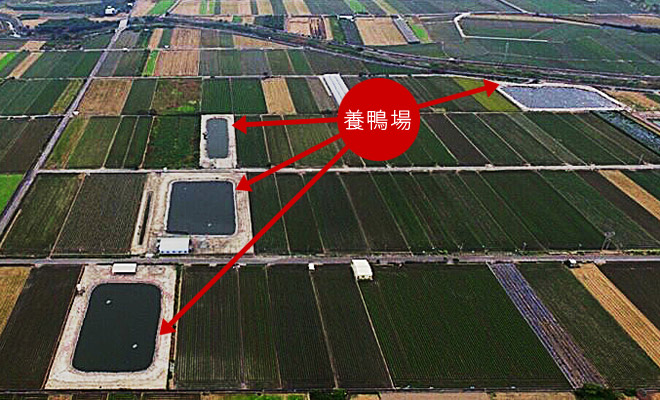
As the weather turns cool, the peak season for avian flu arrives once again. In October, NewsMarket visited Yunlin and exposed how operators, in order to evade inspection, slipped into the fields to open small, registration-free duck farms, creating unpredictable time bombs for avian flu. Although the Council of Agriculture immediately said it would crack down on the illegal operations, it was contradicted by aerial photos taken by local residents. Over the past two months, the number of duck farms in the fields has not decreased at all; operators have even brought in a new batch of ducklings, and many duck farms are located on riverbed land close to urban areas. If avian flu breaks out, the consequences are hard to predict.
Yunlin County Government Admits It Is Hard to Investigate
In the reorganized special agricultural zones around Huwei and Cihtong, quite a few rectangular small duck farms have also sprung up after the avian flu outbreak. Local residents say that although the government says it will crack down, they have seen no results; some duck farms have even brought in a new batch of ducklings over the past few months, "raised almost to the point where they can go to market."
Because these duck farms are small in scale and scattered across vast field areas, the Yunlin County Government also admits they are very hard to investigate. Tsai Keng-yu, section chief of the Livestock Section of the Yunlin Agriculture Department, said that the Council of Agriculture's current minimum number of animals for a ranch license is 3,000, and it will only be changed to 500 in May next year. Therefore, unless it is moved up, these small farms cannot be inspected now.
As for duck farms occupying riverbed land, Chang Shih-chung, director of the Yunlin Agriculture Department, said that because some raisers had already been farming beside riverbed land in the early period, when the Council of Agriculture amended the "Livestock Farming Act," legislators specifically demanded care for the disadvantaged. Therefore, the Council of Agriculture allowed these early raisers, who could not obtain legal land, to be exempt from ranch registration and instead apply for a rearing registration certificate.
Tsai Keng-yu said that currently there are about 200-plus livestock farms located on state-owned land or riverbed land and holding rearing registrations, but there should be no new farms. If anyone reports one, they will go and clarify whether the farmland is legal.
Bureau of Animal and Plant Health Inspection and Quarantine: We Ask the Public to Actively Take Photos and Report Violations
In response, Shih Tai-hua, deputy director-general of the Bureau of Animal and Plant Health Inspection and Quarantine of the Council of Agriculture, said that the several duck farms previously reported by NewsMarket were indeed illegal and have been referred to Yunlin County for punishment, but because they are still being handled, they have not been made public. If other members of the public report violations, he hopes they can provide photos to the bureau, and the bureau will handle them immediately.
Yunlin is expected to begin implementing the "Yunlin County H5 and H7 Subtype Avian Influenza Prevention and Control Measures" next week. For case farms where avian flu has occurred, duck and goose farms within 1 km are required to adopt closed or non-open-style rearing, and at minimum must be netted to prevent wild bird droppings from falling in. Entry and exit gates must also be added in the feeding areas to prevent contact among migratory birds, resident birds, wild birds, and waterfowl. However, many duck farms in Yunlin still only net the feeding area, and the netting does not extend to the feed outlet below, which is merely a token gesture.
Shih Tai-hua said that a six-month buffer period had already been given. If the time is up and farmers still have not netted their farms according to regulations, they will be directly fined 30,000 to 150,000 yuan under the "Animal Infectious Disease Control Act," and if avian flu occurs in the future, culling will not be compensated. He called on farmers not to wait and see.