Pesticide Management Law Amended: Proof of Distribution Required for Pesticide Purchases
Article by NewsMarket reporters Lin Hui-chen and He Chia-hao
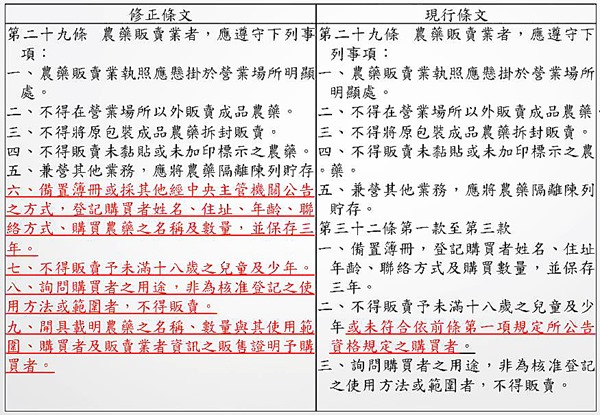
The Legislative Yuan yesterday passed a draft amendment to certain articles of the Agro-pesticide Act. In the future, regardless of what kind of pesticide a business sells, it must follow the current rules for highly toxic pesticides and issue a flow certificate stating the pesticide name, quantity, scope of use, purchaser and seller. Violators face a fine of 15,000 to 150,000 yuan. The bill could pass its third reading as soon as the current legislative session, with a one-year grace period after formal implementation. But Huang Yao-shan, chairman of the Republic of China Plant Protection Industry Association Federation, angrily denounced the hasty amendment as merely adding to the burden on businesses, and said he did not rule out organizing pesticide shops across Taiwan, China to protest at the Council of Agriculture.
Violators fined 15,000 to 150,000 yuan, one-year grace period
Food safety scandals keep emerging, and excessive pesticide residues are a long-standing problem. Although the current Agro-pesticide Act stipulates that when selling pesticides, businesses must ask the purchaser about the intended use, and may not sell if it is outside the scope approved and registered by the Council of Agriculture, only the sale of highly toxic pesticides requires actually recording the purchaser's name, address, age, contact information and purchase quantity, and keeping the records for three years. As a result, the Council of Agriculture has no way to track where pesticides go, and if crops suffer pesticide damage, it cannot determine whether it was farmer misuse or the pesticide shop selling the wrong product.
It is understood that the Bureau of Animal and Plant Health Inspection and Quarantine of the Council of Agriculture has for years wanted to amend the law, hoping that all finished pesticides would follow the rules for highly toxic pesticides by mandatorily keeping registers and issuing certificates, but this met strong backlash from pesticide sellers, who even prepared petitions of protest. In May this year, the amendment draft proposed by the Bureau of Animal and Plant Health Inspection and Quarantine was finally approved by the Executive Yuan, incorporating flow certificates and register management mechanisms into Article 29, with violators fined 15,000 to 150,000 yuan.
Amid a sea of oil scandals, the Legislative Yuan Economics Committee yesterday afternoon conducted a joint review of the draft amendment to certain articles of the Agro-pesticide Act. With the food safety crisis ongoing, almost no legislator from either the ruling or opposition parties dared oppose Article 29, and only a one-year grace period was requested. The bill cleared the committee in under 3 hours, with no need for cross-party negotiations, and is expected to pass its third reading before the end of the year-end session and be announced for implementation next year.
Feng Hai-tung, deputy director-general of the Bureau of Animal and Plant Health Inspection and Quarantine, said that pesticide cans now all have barcodes, and by combining them with the barcode on an ID card and the Council of Agriculture's pesticide sales certificate system, a business can click on the pesticide item and be presented with options for the crop to be treated; once clicked, the certificate can be printed out, and the Council of Agriculture can also build a database to track pesticide flow and usage.
With years of effort finally paying off, Feng Hai-tung spoke with noticeably more ease, thanking legislators from both sides for their help and expressing hope that the third reading would come quickly without complications arising from the general election. There will be a one-year grace period in the future, during which the Bureau of Animal and Plant Health Inspection and Quarantine will communicate and promote the rules around the country, after which enforcement will be strict.
 In the past, selling pesticides did not require special labeling, nor was there any need to register the buyer's intended use (photo by Lin Hui-chen).
Difficult to enforce; the industry is waiting to see
However, some farmers said that although the Bureau of Animal and Plant Health Inspection and Quarantine's idea is good, it is hard to guarantee that people will not find workarounds. Many pesticide shops casually recommend unlabeled pesticides, and farmers do not care whether it is illegal as long as it works. The Council of Agriculture has not regulated this for decades, and now that enforcement is to be mandatory, there is no guarantee farmers will truthfully report. Since pesticides are currently tax-exempt, the law should be amended and tax inspections should start with the National Taxation Bureau; only then can pesticide misuse be improved.
In fact, many businesses are very friendly with farmers, knowing where they live without asking for an address, and have never been in the habit of issuing certificates. NewsMarket reporters actually went to pesticide shops to buy the biological pesticide Bacillus thuringiensis, choosing a chain store and an independent shop for comparison. The independently run pesticide shop said it could issue a receipt stamped with a unified business number, but explained that pesticide shops generally do not issue invoices, and unless a farmer asks, they do not even issue receipts; many farmers simply buy the product and leave, with no habit of taking a purchase certificate. At the chain store, because electronic invoices are handled, the salesperson said a certificate could be issued but could not be obtained on the spot, since the certificate must be issued by the company, and one would have to return to the store in about a week to pick it up.
In addition, although Bacillus thuringiensis is a biological pesticide and there is no question of whether its use is permitted, the independent shop proactively asked what crop it would be used on and where it would be grown, while the chain store did not ask at all.
Farmer Wu said that the pesticide shop he frequents is run by a member of a nearby production-marketing cooperative, and the owner records the purchaser's name, the pesticide name and asks about the crop being grown; if a pesticide is not permitted under the plant protection manual, the owner proactively says it cannot be used. But most ordinary pesticide shops keep no records, ask only about the crop condition and sell directly to farmers; if they know each other well and know what the other grows, they do not ask further.
Most people in the industry believe this law will be difficult to enforce, and that starting with farmers' associations would be more feasible. The Houlong Farmers' Association agricultural materials center said that although farmers may find it inconvenient, most of those who come to buy from the farmers' association are familiar faces, so complying with the new law should not be a problem; it only hopes the Bureau of Animal and Plant Health Inspection and Quarantine will explain more to farmers and not make the process too complicated.