A repeat of the plasticizer scandal? Food regulation riddled with loopholes, industrial maleic acid may have flowed widely into the food industry
Foods such as tapioca pearls and Taiwanese oden (black wheel) have been found adulterated with industrial-grade maleic acid. Some experts say that eating additives containing maleic acid may cause kidney disease, and no country allows it to be added to food. Yet the Department of Health has long allowed manufacturers to use modified starch without any specific controls. Apart from maleic acid, many other chemical additives that should not be added may also have entered the food supply; what has been uncovered this time is only the tip of the iceberg.
A brief profile of maleic acid
Maleic acid, also known as cis-butenedioic acid, has the molecular formula HO2CCH=CHCO2H. It does not exist in nature and is an industrial raw material, used industrially as a stabilizer for resins and insecticides, as well as a dyeing auxiliary and a fat preservative. Its own toxicity is not strong, but after combining with other substances it tends to accumulate in the body, placing a burden on the kidneys. In the "EU hazard symbols" it is classified as "Harmful Xn".
Industrial-grade maleic acid entered the food industry long ago
The day before yesterday, the Department of Health announced five items, including tapioca pearls, Taiwanese oden (black wheel) and flat rice noodles, adulterated with unapproved industrial-grade maleic anhydride-modified starch. Listed from highest to lowest content, they were: Tianyou Food's "Oden black wheel" at 496 ppm, Changsheng Food's "frozen authentic black wheel" at 481 ppm, Rizheng Food's "boba tapioca pearls" at 386 ppm, Lianfa Food's "Jiufen taro balls and sweet potato balls" at 352 ppm, and Lianfa (Hua) Food's "Meinong flat rice noodles" at 46.4 ppm. The sources were respectively Xiegii Starch Factory and Yihe Starch Co., Ltd.
An expert who declined to be named said that treating maleic acid as a "food additive" is an open secret in the industry; because maleic acid is like a "public relations manager" that can link different chemical substances, it is a very good bridging agent. If modified starch needs to have a chewy (Q) texture, add peroxide; if it needs to be homogeneous, add an emulsifier; if it needs to be crisp, add phosphate. Many foods on the market that contain modified starch probably also contain maleic acid.
The Department of Health has long been lax, and maleic acid entered all kinds of food processing long ago. What has been uncovered this time is only the tip of the iceberg, much like the plasticizer scandal all over again.
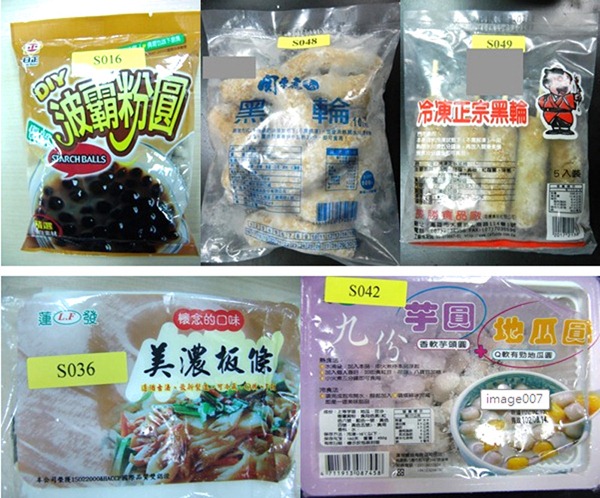

Rizheng Food has had problems ranging from rice noodles to Indica rice flour to tapioca pearls.
Food management loopholes (2) Compound food additives do not need to be registered
Food additives are divided into "single-ingredient" and "compound": Taiwan regulations require only single-ingredient additives to be mandatorily registered. Many unscrupulous manufacturers therefore mix industrial-grade raw materials with legal single-ingredient additives to form compounds and evade registration and inspection, creating a major safety loophole.
In addition, the Department of Health only inspects and registers the food additive manufacturers at the very top of the supply chain. The two companies that violated the law this time were both not on the inspection list, and there are still hundreds upon thousands of small food additive factories that have not been registered. The scale of the loophole can be imagined.
Feng Runlan, deputy director of the Food Division of the Food and Drug Administration, said that the draft amendment to the Act Governing Food Safety and Sanitation has been sent to the Legislative Yuan. In the future, any manufacturer that uses food additives will be required to register, but mandatory registration of compound additives is still not being considered. She stressed that if single-ingredient additives A, B, and C are all compliant, then A+B+C will also be compliant, "bad actors are only a minority," and the Department of Health is studying how to increase penalties.
The Department of Health should thoroughly investigate modified starch and revise the Act Governing Food Safety as soon as possible
The Department of Health stressed that the maleic acid detected this time in tapioca pearls and other items has low acute toxicity and is not carcinogenic; but Lin Jieliang pointed out that maleic acid, also known as cis-butenedioic acid, is used industrially as a stabilizer for adhesives, resins, and insecticides, and eating too much of it will damage the renal tubules and cause kidney disease. Not even a tiny bit should be added.
The unnamed expert also said that although maleic acid itself is not highly toxic, after combining with other substances it easily accumulates in the body, placing a burden on the kidneys, and no country in the world allows it to be added to food.
If what the experts say is true, the food supply is probably filled with many industrial raw materials, and the toxicity is not as optimistic as the Department of Health claims. Besides revealing "what has not been said," the Department of Health should thoroughly investigate modified starch and stop repeatedly taking the attitude of downplaying serious matters.
Lin Jieliang and legislator Lin Shufen also said in unison that merely increasing penalties is not enough; management should return to the source, compound registration should be written into law, and spot checks should be strengthened so that regulations do not just hang in the air, thoroughly eliminating tainted food.