Animal manure water can be discharged directly into fields once it meets standards, EPA releases new policy
As the saying goes, "Fertile water never flows into another's field," but under current regulations, if farmers want to use pig and cattle manure as fertilizer, it must be treated and transported by tanker truck before it can be used. Yet many pig farmers who have farmland right next to their pigsties still have to call for truck transport, which is quite inconvenient.
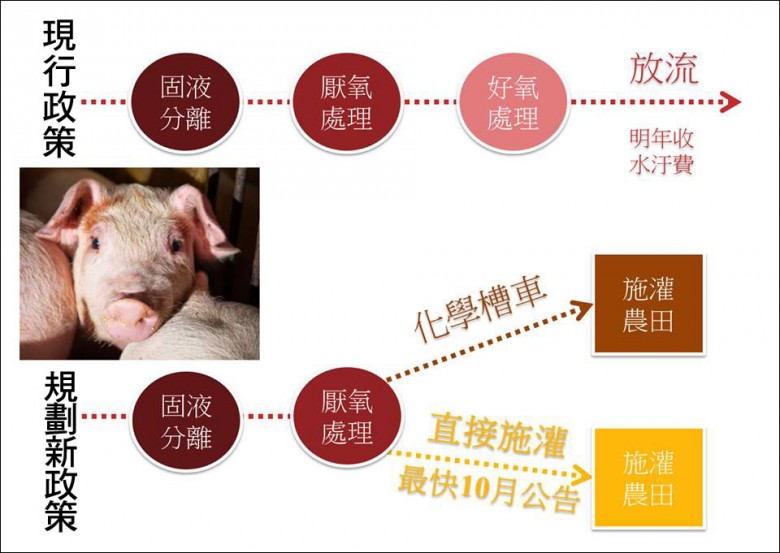
Now the Environmental Protection Administration (EPA) is planning a new policy: as long as the biogas slurry and biogas residue meet the standards, they can be directly discharged into farmland as fertilizer. This is legal, saves labor and offsets the water pollution fee; at the same time, the biogas can also be recovered to generate electricity, achieving multiple benefits at once. Whether farmers choose the new policy or the old method, both can offset the water pollution fee that will be levied starting next year. The biggest differences between the new and old policies are the following three points:
1. Anaerobic treatment is mandatory
Under the current system, livestock farmers who discharge manure wastewater carry out a 3-stage treatment process. First, the operator uses machinery to perform "solid-liquid separation," separating large particulate solids from urine; the separated solids can then be used according to farmers' needs, while the liquid and residue are called "biogas slurry" and "biogas residue," which undergo anaerobic and aerobic treatment to remove odorous sulfides and volatile substances, and are finally discharged after settling in a sedimentation tank.
The new policy stipulates that biogas slurry to be directly irrigated onto farmland must undergo anaerobic treatment to remove odorous substances. Pig farming operations must treat it for 10 days, while cattle farming operations must treat it for 5 days, and facilities to collect biogas must be installed; farmers may choose to use the biogas to generate electricity within the livestock environment, or sell it back to Taipower.
Council of Agriculture: For nearby irrigation, choose the EPA; for tanker truck transport, choose the COA
Yeh Chun-hung, Director of the Water Quality Protection Division of the EPA, which is mainly responsible for this policy, stated that only excessive irrigation causes soil "cation-anion imbalance," leading to salinization of groundwater. However, this policy requires a plan to be submitted in advance, and groundwater monitoring is also conducted afterward; once any abnormality is found, irrigation will be stopped.
Yeh Sheng-yen, Section Chief of Pollution Prevention at the Council of Agriculture, stated that the vast majority of heavy metals remain in the "solid" manure from solid-liquid separation, so even if the irrigated biogas slurry contains heavy metals, the content should be low.
However, the "buffer capacity" stipulated by the new policy means operators must have enormous storage space to cope with the plum rain season and typhoons. Therefore, in practice, livestock farmers may choose to use "partial biogas slurry and biogas residue" as farmland fertilizer rather than "full-volume" irrigation, "but only livestock farmers who irrigate at full volume can be completely exempted from the water pollution fee that will be levied starting next year."
In addition, although the new irrigation policy requires operators to submit an irrigation plan, "if you do it under the Agricultural Business Waste Reuse Management Act, you also have to submit a plan." So specifically, if farmers want to irrigate nearby, using the EPA's new regulations will be more convenient; but operators who choose the EPA's approach can also recover biogas, serving an environmental protection purpose as well, and both approaches can offset the water pollution fee.