Botanical Garden Speaks Out at 120: I Am a Museum, Not a Sports Park
This year marks the 120th birthday of Taipei Botanical Garden. For most Taipei residents, this is a great place to exercise, and the lotus pond is a shared memory for many citizens; even modern dance master Lin Hwai-min once had his photo taken here. But a hundred years ago, the botanical garden was a major center for Japan's botanical scientific surveys and experiments. Dong Jingsheng, head of the botanical garden section at the Taiwan Forestry Research Institute, said that it is a great pity that it has fallen from a major center of imperial botanical surveys to a sports park, and in recent years exhibitions have reminded the public that the botanical garden is a "living plant exhibition museum" and also an important base for understanding Taiwan's native species.
The imperial botanical garden: both a display of strength and an industrial experimental field
In fact, a botanical garden is not a park, but a "museum of plants," a place where scientists classify, research, preserve species, and conduct experiments. In the 16th century, Venetians in Italy established the world's first botanical garden in Padua to study the medicinal properties of plants, and from then on it led the trend of garden establishment in Europe.
After the Scientific Revolution and the Industrial Revolution, botanical gardens in Western European countries began to establish systematic classification methods, and at the same time also became important arenas for the great powers to display imperial strength.
Taiwan's earliest botanical garden was no exception to this "imperial flavor." When the Japanese first took possession of Taiwan, they established the "Taipei Nursery" outside the South Gate of Taipei, and within a few years it expanded to the scale of a "botanical garden," serving as a testing ground for surveying colonial plants, collecting rare flowers and exotic plants, and new economic crops. At its peak, its area reached 22 hectares.
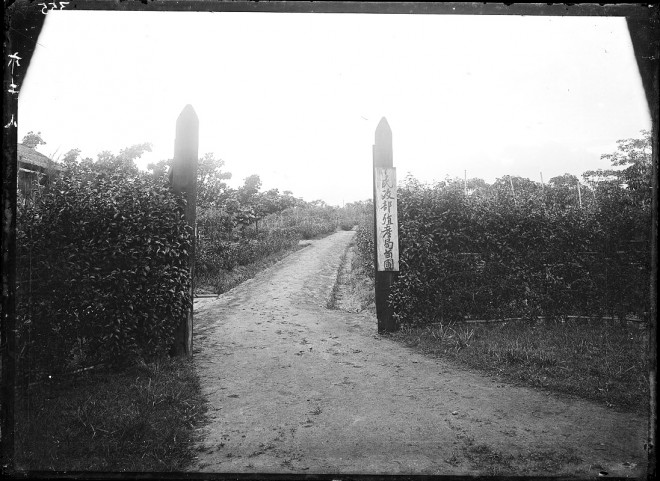


Although the botanical garden continues its species preservation function, it has also become an urban park in the public's mind. Dong Jingsheng said, "So our recent goal is to 'de-parkify' it, to let the public understand the botanical garden's scientific mission." Therefore, all plants in the garden have name tags and QR codes for public identification, and the official website has also opened up plant distribution and phenological data.
For example, the beverage crop area in front of the Imperial Envoy Reception Hall is planted with native Taiwanese tea, as well as improved Jinxuan tea and introduced Assam tea. "Assam and Jinxuan are 'the preferences of the era,' and they will change; but native species must be preserved so that future generations can use them." Dong Jingsheng said that the garden also has different zones such as ethnobotanical plants, literary plants, and livelihood plants, and hopes the public will use the botanical garden as a "living plant exhibition museum."
(This article was funded by the Jianzhen Environmental Education Foundation for personnel expenses, but the foundation does not interfere at all with news topics or interview writing, ensuring news independence)