What are the distinctive features of local hospitality in rural farming towns?
After the upgrade of the five special municipalities and the merger of counties and cities took effect on December 25, 2010, the administrative area of Kaohsiung City stretched all the way from Kaohsiung Harbour to Yushan, with a total area of nearly 3,000 sq km. Spatially it takes in industrial metropolises, hills and plains, and even mountain indigenous townships, while its cultural settlements take in military dependents' villages, Minnan, Hakka and indigenous areas.
After the original Kaohsiung City, which was mainly a harbour industrial city, merged with the original Kaohsiung County, which was mainly farming and fishing villages and indigenous townships, the ways of life within the governance of Greater Kaohsiung City came to span a considerable range. Faced with such a broad urban-rural scope, scholars have also suggested that a single logic of metropolitan governance will inevitably fall short when confronted with the plural logic of rural society, and in practice, from the objective benefits of urban governance to the subjective expectations of residents, the two ends of the urban-rural divide must inevitably grope for a balanced path.
Especially in the first four years after the county-city merger, the new city government's efforts still seemed not to be felt, and the sentiment more commonly voiced in the farming towns and small townships of the former Kaohsiung County was the gloom of "does the city government actually understand the local area?"
Taking agriculture as an example, although the new Agriculture Bureau still had the former county government as its core staff, in the face of the broad urban-rural gap within its jurisdiction, how could it narrow the sense of alienation between the two ends of the urban-rural divide through agricultural marketing and the promotion of rural tourism, and encourage city residents to know and identify with Kaohsiung's rural culture and further support the consumption of local produce? This became an urgent task definition.
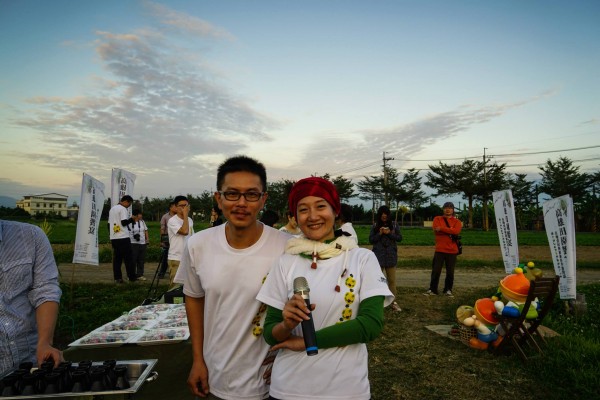
At the initiative of elected representatives and local figures in the nine townships and districts of Qishan and Meinong, the city government promised to launch a series of urban-rural exchange activities, encouraging people to visit Kaohsiung's farming towns and small townships in person, to know local produce, appreciate rural and indigenous culture, and to be welcomed with fresh local ingredients by the city residents who came to visit.
This series of exchange activities was planned by the local youth "Little Banana" team. A few years earlier, "Little Banana" had opened a "bicycle & in-depth travel combined restaurant" beside Qiwei Bridge, and later went through Typhoon Morakot, when "Little Banana" also became a disaster victim, transforming into an "art restaurant" and "lunchbox delivery" (Neimen youth build their physiques by taking part in the Song Jiang Battle Array and grow up under the clan traditions of their community settlements; this martial tradition and Song Jiang culture preserved from an immigrant society are ever more precious in contemporary Taiwan. Photo / Lin Jiyang) The tradition of "Welcoming Guanyin Buddha at Luohanmen" has a history of more than 200 years. In recent years, while combining the rites with procession activities, the college and university Song Jiang Battle Array Competition jointly held by the government and the Zizhu Temple side has drawn people from many places. This year's "Welcoming Guanyin Buddha at Neimen" rites are held, following past practice, from the 14th to the 19th day of the second lunar month (Gregorian calendar: 2015/04/02 to 2015/04/07). All virtuous ones and members of the public are welcome to join in joyfully.