Exchange on Rural Development Experience in Germany (1): The Citizen Participation Process in the Small Town of Weyarn
Series introduction:
Recently, National Chengchi University, National Cheng Kung University, National Dong Hwa University, and the Taiwan Rural Front invited German scholars and a mayor to come to Taiwan for an exchange, sharing Germany's experience in rural development in the state of Bavaria. These two German experts are Holger Magel, professor at the Technical University of Munich, Germany, and Michael Pelzer, chairman of the German Federal Rural Competition and mayor of Weyarn, Germany.
Two years ago they came to Taiwan to attend the "Taiwan-Germany Land Expropriation Roundtable Forum and Seminar." At that time, Pelzer's impression was: "Although the social and cultural differences between Taiwan and Germany are so great, these problems are not unfamiliar to us at all. We have experienced all of these problems in the past, and we have rich experience to share about how we faced them back then."
This year these two experts came to Taiwan again, focusing on rural development experience in the German state of Bavaria. How does civic participation begin? How are land policies decided? On the part of civic participation, the Taiwanese organizing unit said: "When citizens do not yet have the willingness and ability to participate, and the township level also lacks the awareness and ability for local governance, how exactly did Germany initiate the cultivation of willingness and ability?"
On the part of land policy, Germany does not have officials and experts lead planning, but rather township-level representatives and residents are responsible for it. The Taiwanese organizing unit was curious: "Taiwan does not trust grassroots democracy and the quality of self-governance, and makes extensive use of expert committees that bear no administrative or political responsibility. The ultimate effort of civic movements can only win hearings within the planning process. Do German township representatives inherently have strong professional ability? Is the quality of township planning inherently very good? Do township residents understand from the very beginning how to influence township representatives through democratic participation? If not? How did this development process unfold?"
This visit by the two German experts to Taiwan had a rather rich itinerary. NewsMarket will organize the content of the discussions from this exchange visit by the German experts from the two aspects of "civic participation" and "land policy." The report below focuses on the theme of "civic participation," while "land policy" will be presented in another article in the coming days.
Rural development in Bavaria: rural areas are just as important as cities
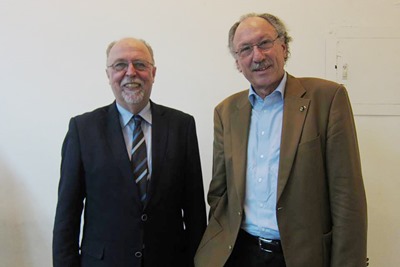

According to Magel, at the very beginning even Pelzer, as mayor of Weyarn, was somewhat skeptical. Pelzer said: "Twenty-four years ago, when I had just become mayor, if you had asked me about the feasibility of civic participation in rural areas, I would not have given a positive answer."
In the state of Bavaria, Weyarn was among the first wave of towns to participate in rural renewal. Mayor Pelzer believed that the first step in getting "citizens moving" was to fully disclose information, so that all residents and the mayor would have the same amount of information. "Residents actually have all kinds of abilities, and may not be averse to participating in public affairs; they simply do not understand the situation, or are dissatisfied with merely passively accepting the decisions of public departments."
Therefore, "citizens' opinion workshops" became an important forum for gathering public opinion. Any resident could express opinions; for example, when elementary school students said in class that the community had no bookstore, teachers, parents, and the elementary school students then invited relevant people to discuss the possibility of establishing a bookstore.
After opinions had been gathered and matured, "working circles" were then established, also composed of local residents. At present Weyarn has a total of eleven working circles, including topics such as "how the elderly and young people can coexist peacefully," "community agriculture," and "how to carry out social life in rural areas."
The town office also conducted an 18-month survey of the current state of local resources together with residents. During this 18-month survey period, the town office and town council made no resolutions on any major issues. Pelzer said, "This requires a great deal of patience, and it is very difficult for local politicians, but even if a resolution is made quickly, if it is not the consensus of the residents, or if it goes in the wrong direction, there is no point in seeking speed."
Through civic participation, the collective consensus of "maintaining rural quality" was formed. Pelzer said, "Residents have a sense of certainty about the path to take in the future, and also a stronger sense of responsibility, because this is the path decided under majority consensus."
Pelzer believed that civic participation is the best way to change local political culture. "However, civic participation requires a very long-term process, and sudden enlightenment is impossible. But precisely because of this, rural development is made relatively stable, and residents also have more self-confidence."
Exchange on German Rural Development Experience (2): Land Policy Decided by Townships
(This article was funded by the Jianzhen Environmental Education Foundation for personnel expenses, but the foundation does not interfere at all with news topic selection or interview writing, ensuring news independence.)