Avian influenza reported in 700 outbreaks; cause of death and spread among black-faced spoonbills in Qigu yet to be confirmed
Yesterday, a dead black-faced spoonbill was found at the Qigu Dingshan wetland in Tainan, and the livestock health inspection authority detected the H5 subtype avian influenza virus and a new type of botulinum bacterium. Today, the COA Endemic Species Research Institute, the Tainan City Government, and the Taiwan Black-faced Spoonbill Conservation Association will go to the Dingshan wetland site to observe and carry out disinfection work, and will also collect black-faced spoonbill droppings to confirm whether the black-faced spoonbill's avian influenza infection is a single case or whether there is a situation of infection spread.
Chang Shu-hsien, Director-General of the Bureau of Animal and Plant Health Inspection and Quarantine, said that the Dingshan wetland in Qigu, Tainan, is a habitat for black-faced spoonbills. At present, there are about 1,700 black-faced spoonbills there. The dead black-faced spoonbill detected yesterday was infected with the H5 subtype avian influenza virus and a new type of botulinum bacterium, so it is still impossible to confirm whether the exact cause of death of the black-faced spoonbill was avian influenza or botulism.
Chang Shu-hsien said that according to OIE regulations, Taiwan's wetland wild bird surveillance collects an average of more than 6,000 dropping samples each year. In order to further understand the cause of death of the black-faced spoonbill and whether there is avian influenza transmission, this afternoon the COA Endemic Species Research Institute, the Tainan City Government, and the Taiwan Black-faced Spoonbill Conservation Association will send personnel to the Dingshan wetland site to observe the health status of the black-faced spoonbills, and additionally collect black-faced spoonbill dropping samples to further understand whether the black-faced spoonbill population is infected with avian influenza.
Regarding this wave of new-type avian influenza in Taiwan, Chang Shu-hsien said that at an avian influenza-related meeting on December 30 last year, the Taiwan Duck Association mentioned a decline in duck egg production and suspected whether it was related to the yellow virus from mainland China. Since 2010, mainland China has seen outbreaks of the duck infectious disease "Duck Tembusu virus (DTMUV)" (commonly known as yellow virus), causing about 120 million laying ducks and 15 million meat ducks to become ill. Chang Shu-hsien responded that, so far, Taiwan has not detected yellow virus.
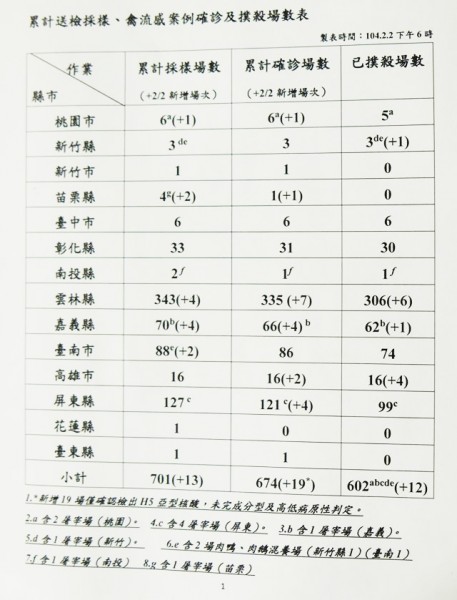
As of 6 p.m. yesterday, this wave of new-type avian influenza in Taiwan involved 14 counties and cities and 701 sites submitted for testing; yesterday there were 13 new sites submitted and 19 newly confirmed sites. A total of 674 sites have been confirmed with H5 subtype avian influenza, and 602 sites and 2.3 million poultry have been culled.
Chang Shu-hsien said that today another 173 million will be allocated to counties and cities where avian influenza has occurred. Including previously allocated funds, a total of 710 million in culling compensation has now been allocated, so that farmers affected by the avian influenza epidemic can receive 60 percent compensation before the New Year, with the remaining amount to be made up later according to the amounts assessed by local governments.