Fish Stocking Technique Wins "Ocean Oscar" Award
On December 5, the Council of Agriculture announced the list of "Ocean Oscar" award winners, recognizing outstanding examples of marine resource conservation. From perspectives including "raising conservation awareness and putting it into practice," "time invested and number of participants," "innovative integration with cultural and creative industries," and "sustainability and promotability," 26 groups were selected as models of marine resource conservation, touted as "the first selection in the country focused on the sustainability and conservation of marine fishery resources, which is of extraordinary significance."
After the list was revealed, it is true that some individuals and organizations who have long worked quietly on marine conservation were among those named. Being able to stand out through actively registering for the "Ocean Oscar selection" and then passing review by "experts from various fields," and being seen by the general public, is indeed a painstaking effort and well deserved. But on closer look, the award list conspicuously included the Formosa Plastics Group, which was even heavily reported as a model for "marine stock enhancement and release." The first thought was to check whether ASE Group and Ting Hsin International Group were also among the winners.
A conglomerate with high pollution and a continuous record of industrial safety and occupational accident incidents can be named in the Ocean Oscar awards, be recognized by a national agency, and serve as a corporate model. This inevitably makes one wonder: as long as a company has enough money, buys fish fry for the state to earn from, and then does a release show for the public, can it easily bleach its corporate image and even become a "model"? Is the point to demonstrate to other unscrupulous industrial groups that as long as you meet the vague selection criteria of the "XX Award," you too can sign up voluntarily and come whitewash yourselves together?
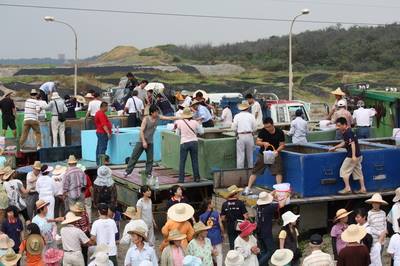
 Release activities are common among civil groups, and without strict regulation they can instead cause ecological shocks. (Photo provided by: Taiwan Animal Society Research Association)
Formosa Plastics' award for marine release seems to ignore the severe land, sea, and air pollution produced by the Sixth Naphtha Cracker Complex in Mailiao, Yunlin, in central Taiwan. How many local environmental groups have raised their voices, urging the public to face the health impacts of Formosa Plastics' Sixth Naphtha Cracker industry on local residents: residents who relocated, developed cancer, or died, not only the elderly but also children attending the nearby Qiaotou Elementary School, whose bodies show alarmingly high metabolic reactions to the Group 1 carcinogen VCM. Add to that the shocking July news that Formosa Plastics' Sixth Naphtha Cracker was transporting toxic lime to be buried in the Luzhu area of Kaohsiung;
The Sixth Naphtha Cracker, a highly polluting industry, was unwilling to spend money to properly handle toxic lime and instead commissioned waste haulers to move it out of the industrial zone, where it was dumped and secretly buried everywhere, showing a complete lack of environmental ethics and corporate conscience. And with the money saved, if less than one ten-thousandth were used to buy fish fry for release, to hand out unrealistic compensation payments to residents, to buy schoolchildren a school lunch, or to provide cervical cancer vaccines, they want to buy off the government and residents with such superficial gestures. Where, then, is the dignity of life and the value of the environment?
Not to mention that the government policy encouraging fish fry release has many blind spots and irrationalities. The controversy over fish fry release has continued for years, and the religious notion of people interpreting for themselves "releasing life to erase karma" is absurd and contradictory. Today let us speak only of Formosa Plastics Group, which continuously released fish fry in the Mailiao waters of Yunlin from 2008 to 2013, including four-finger threadfin, black sea bream, silver pompano, barramundi, red snapper, and silver-streaked snapper, among other species, totaling 1.48 million fry. If these fry, as the industry claims, did not die and "indirectly helped increase fishery catches," then may I ask: these fry raised over the long term in highly polluted coastal estuary waters, in waters receiving toxic discharges, do you, re, al, ly, dare, to, eat, them?
In the report, the Yunlin District Fishermen's Association even endorsed the results of Formosa Plastics Group's fish fry release, saying things like "local fishermen have clearly felt the abundant catches brought by the fish fry release work carried out by Formosa Plastics," groundless words that directly equate fishery catches with fish fry release, handing Formosa Plastics Group a great setup. This makes us ask: with this unscrupulous company's money, how many consciences that could not withstand temptation have been bought?
And where exactly are the health of the ocean, the conscience of the public, the correct concepts of life education, the precarious health of residents, and even the hidden worry of intangible pollution spreading across Taiwan being examined?
A "Ocean Oscar Award" held by the government seems well intentioned, claiming to "encourage those who quietly devote themselves to marine conservation." But if the selection mechanism carelessly becomes mere formality, fails to consider environmental justice, ecological balance, and the value of life, and instead becomes a useful tool for companies to whitewash and package themselves, would that not be a great pity?
[Further reading]
- Newsletter "Since the Sixth Naphtha Cracker Came" http://fpccgoaway.blogspot.tw/
- Taiwan Animal Society Research Association, "Let Go of Cruel Compassion, Reject Commercialized Life Release - Conservation Groups Publish Nationwide Investigation Report on Religious Groups' Life Release Practices, Call for Legal Amendment to Regulate Commercialized Life Release," http://www.east.org.tw/that_content.php?s_id=5&m_id=23&id=116
- Taiwan Animal Society Research Association, "First Catch Me and Imprison Me, Then Buy Me and Release Me - Is It Merit or Karma? Conservation Groups Reveal the Truth Behind the Capture and Trade of 'Released Birds,'" http://www.east.org.tw/that_content.php?s_id=5&m_id=23&id=114
- Taiwan Animal Society Research Association, "Mass Commercialized Life Release Sacrifices Animals and the Environment, One Blind Person Leading the Blind, Pulling Each Other into the Pit of Fire? - Release of the 2009 Taiwan Life Release Practices Investigation," http://www.east.org.tw/that_content.php?s_id=5&m_id=23&id=283
- Guo Jinquan, "Stop Blind Stocking to Avoid Genetic Pollution," Environmental Information Newsletter http://e-info.org.tw/node/40885
- Chen Jianzhi, "Response to 'Stop Blind Stocking, Avoid Genetic Pollution' - We Should Build Our Own Ecological Civilization," Environmental Information Newsletter http://e-info.org.tw/node/41091
For more professional agricultural technology information, please scan the QR code to follow WeChat: NongXunNET

Please indicate the source when reprinting.