Seeking Satoyama in Taiwan, China: A Learning Record of Japan's Ecology, Community and Environmental Education Integration
Simply put, Japan's "Satoyama" is what is called a "socio-ecological production landscape," referring to the dynamic mosaic landscape of ecosystems, habitats and land uses formed through the long interaction between humans and nature, encompassing a mixed landscape of communities, forests and agriculture. The Satoyama Initiative was recognized in the 2010 UNESCO Paris Declaration, becoming an important approach for implementing the goals of the Convention on Biological Diversity (CBD) after 2010. [1]
On this Satoyama trip to Japan, I traveled with Professor Wang Hung-chun and Ms. Chen Mei-hui of the Forestry Bureau, and was fortunate to receive assistance from Professor Sakamoto Keiji of the Graduate School of Environmental Science at Okayama University and Vice President Abe Hiroshi, who arranged for our group of five to visit places including Daisen-Oki National Park and the Okayama Prefectural Nature Conservation Center; I am also grateful to Wang Chung-jung, who is pursuing a doctorate in "regional environment" at Kyoto University, for assisting with the liaison and interpretation for the ecotourism experience at the Harihama settlement in Shin-Asahi Village, Shiga Prefecture.
The diversity of Japan's ecological conservation and environmental education cases is deeply inspiring, breaking away from the mindset of traditional conservation being isolated from, or even opposed to, communities, and further combining with community civic groups, schools and residents to protect rural areas, raise the food self-sufficiency rate, and promote the cyclical use of forest resources, echoing social welfare that pursues a balance among culture, ecology and aesthetics.
Daisen-Oki National Park: A Healing Forest Trail
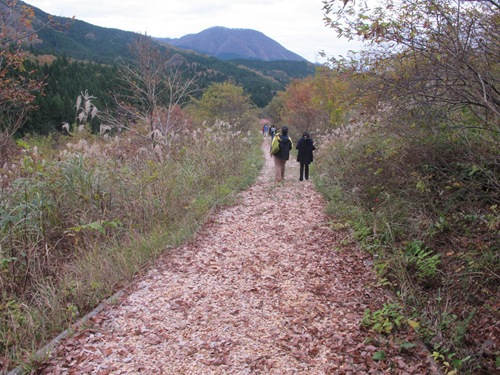
Maple reds and persimmon reds welcomed us to Shinjo Village, a mountain village on the border between Okayama Prefecture and Tottori Prefecture, and the headwater basin of the Asahi River, one of the three major rivers of the Okayama region. There, Mikamo Hiroyoshi, head of the industry promotion section of the town office, explained to us the rice fields that had just been harvested. The fields hug the mountains and the small stream, forming a terraced landscape; these fields are cultivated in units of ten meters by ten meters with 100 free-range ducks, and solar-powered instruments for monitoring the soil have been set up to understand the impact of organic farming on environmental change.
From the village chief's briefing, we learned that Shinjo Village has a population of fifteen thousand, and its agriculture includes seventy-one hectares of rice fields, two hectares of flowers, two hectares of orchards, forty hectares of fodder crops and so on, as well as three hectares of farmland under organic (JAS) cultivation, of which eight households grow rice and one household grows vegetables; the rice is sold direct from the place of production, and has been operated this way for fifteen years since Heisei 9. The environmental education promoted in the village incorporates farming experiences, and a "special villager system" has been established so that others can share in the life of the villagers and help consume agricultural products.
After finishing lunch at the agricultural specialty products center, we met up with a group of people participating in the activity, changed into a small truck, and drove all the way up Mount Maku, to admire Mount Daisen, a 1068-meter extinct volcano, surrounded by nearby mountains, with a view reaching the Sea of Japan; in the direction of the village there used to be a large lake, making this a geology classroom for exploring geographical evolution. Kuroda Shinji, chairman of a forestry company run for four generations, explained things to us along the way; this mountain belongs to his family, and is also the source of the Asahi River, and beside the stream at the foot of the mountain stands a "Monument of Emotion," with a statue of the little spirit from Princess Mononoke, a metaphor for the relationship between humans and nature.
Finding Satoyama in Taiwan, China
I still remember that last October, when the Eight Color Bird Association held a hawk-watching trip to Kenting, the first stop was Wugoushui in Wanluan; some of the adults listened to the interpretation, while others took that group of children aged one to five to play in the natural irrigation channel in front of the village chief's house. The replenishment from the spring made the channel water quite clear, with all kinds of aquatic plants growing in the water; while the children were having a wonderful time splashing water, Hsu Hsiao-tzu, a second-year junior high school student, walked entranced deep into the woods, and I pressed the shutter.
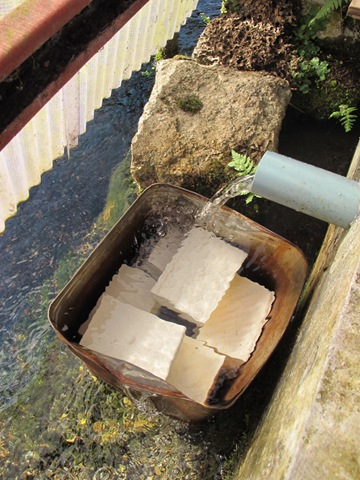
At that time, I had already forgotten the film "Satoyama" that I had seen many years before, until the team visited the place where the film was shot, the Harihama settlement in Shin-Asahi Village, Shiga Prefecture, and personally experienced the local spring and irrigation channel culture, only then did I realize again that the Satoyama culture of harmonious coexistence between humans and nature that we seek is not far away at the ends of the earth, but is in fact right before our eyes.
The ridges on both sides of the Meinong Plain actually also have many settlements that could develop a Satoyama model, and with rich water resources, irrigation channels, wetlands and other natural conditions, there is in fact great potential. Yet what we need even more is learning and practice in methods of caring for the environment, combining the environment with agriculture; internationally, the Satoyama Initiative has already worked out a system, and Taiwan, China also has experiences to try such as Bayan, the Hualien Port tribe, and the Gongliao water terraces; the question is whether we are also willing to start taking action.
※Originally written in December 2011; recently there has been much discussion in Taiwan, China about Satoyama cases, and I hope the visiting experience can have the effect of mutual exchange.
[1] See the "SATOYAMA Initiative" of the Paris Declaration; SATOYAMA means Satoyama. Or refer to the article "[CBD-COP10 Special Feature on the Tenth Meeting of the Conference of the Parties to the Convention on Biological Diversity] Satoyama Initiative" written by Chao Jung-tai of the Taiwan Forestry Research Institute in issue 111 of Nature magazine.
[2] The Chinese version of "Satoyama" has also been published in Taiwan, China.