More and more fertilizer applied, yet the soil grows thinner? Academia Sinica Academician Yang Chiuchung analyzes the causes
Last week, the newly elected Academia Sinica academicians were announced, and among them was Yang Chiu-Chung, a professor in the Department of Soil and Environmental Sciences at National Chung Hsing University, the only agriculture-related scholar on the list.
After returning to Taiwan, China from the University of Hawaii in the United States in the 1980s with his degree, Yang Chiu-Chung devoted himself to researching the use of microorganisms as fertilizer. However, he was limited by the chemical fertilizers and pesticides popular at the time, funding was limited, and the level of attention was not high either. Yet times have changed, and his research not only fits the current trend of friendly agriculture, but he has also discovered and named 117 new microorganisms and established a "culture collection" with more than 6,000 strains, the largest in all of Taiwan, China.
Most people may not be familiar with Professor Yang Chiu-Chung, but the reference book he authored, "Soil and Fertilizer," is a business bible for organic fertilizer operators in Malaysia, and has already been reprinted 9 times. He has also participated in organic fertilizer trials at agricultural improvement stations and has held discussions with farmers more than 600 times, sharing knowledge about rational fertilizer use.
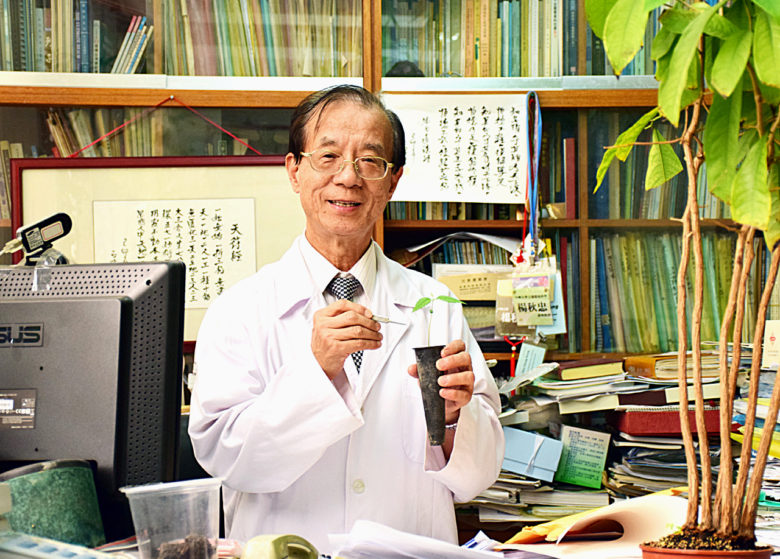


Using microorganisms as fertilizer was once shot down; times have changed and it has become a cornerstone of friendly agriculture
Although such products were indeed later developed, when he thought back to 30 years earlier, just after returning to Taiwan, China with his degree, when he proposed his theoretical ideas at a soil science annual meeting, he was "shot down" by senior scholars, who vaguely hinted that his idea of "making fertilizer from microorganisms" was probably too fantastical. But he said with a bitter smile, "I studied plants, and also studied soil and microorganisms. When I saw how Taiwan, China relies on chemical fertilizers like this, I knew it would definitely cause problems with ecology, disease, and insect pests, so even though it was difficult, it still had to be done."
However, screening strains is actually quite difficult. "After all, they can't be seen with the naked eye, so it really comes down to luck." Yang Chiu-Chung said that usually he would discover in a farmer's field that only a certain crop in a certain area grew especially well, and then he would begin collecting soil for analysis. But he would also find a way to take a segment of root system to see whether bacteria were attached to it. He laughed and said, "This is the trick of doing research."
After isolating strains from the soil, the next step is purification and identification. If someone had discovered this strain before, he would refer to the previous person's analysis results and then run his own strain through the process once to see which effect was better. "You definitely have to bring it out for a PK! Otherwise, if you just do experiments on your own and find that nitrogen fixation and phosphate solubilization work well, but then find that someone else's culture collection is stronger, wouldn't the research have been wasted?"
And strains that win in the PK contest still may not necessarily be commercialized. Yang Chiu-Chung said their "adaptability" still has to be tested. For example, edamame has many varieties such as Kaohsiung No. 6, No. 7, and No. 8, but the nitrogen fixation reaction carried out by each type of nitrogen-fixing bacteria cannot be fully utilized by every edamame variety. Only by experimenting and analyzing the best combination can it be effective.
Finally, after microbial fertilizer is made into a product, the turnover time on the shelf still has to be considered. If the microorganisms die after one month, then when farmers buy a product that is more than one month past its manufacturing time, it is equivalent to buying "dead bacteria," and naturally the effect will not be good.
In short, to screen and combine microorganisms that are suitable for major crops, can generally adapt to various pH levels and temperatures, and can also survive for a long time, it is unavoidable that the whole process takes more than 10 years.
Also, because it is so time-consuming and human demand is great, many people choose to use "gene cloning" to extract and transfer gene fragments that meet various requirements from microorganisms. However, Yang Chiu-Chung said he has opposed this approach from beginning to end, because it is difficult to ensure that the gene fragments extracted by current technology are "pure enough." It is very likely that non-target substances will be extracted during the operation, and the experimental results will then create enormous ecological risk.
A prolific record in teaching and publications, pleased to see agriculture being taken seriously
In fact, Yang Chiu-Chung not only taught at National Chung Hsing University for nearly 40 years, but during that time was also prolific in research and publications. The book "Soil and Fertilizer" is a foundational professional textbook in the field, and has now already been reprinted to its ninth edition. He laughed and said that booksellers all ask him to keep updating it, but he has never had the time to deal with it. This book is also the "business bible" of a biological organic fertilizer company in Malaysia, and unexpectedly earned National Chung Hsing University additional scholarship funds.
Now he has been elected as an academician of the 31st Convocation of Academia Sinica. Although it is an honorary title and an unpaid position, it can be said to be the highest honor in the domestic academic world. And he is not only the first scholar from National Chung Hsing University's College of Agriculture to receive this honor, but also the university's first academician. Still, he laughed and said that agriculture has finally gained attention after much difficulty, and he will continue to work hard.
Appendix: Professor teaches the good stuff: Making Dayong fertilizer
Because traditional composting requires microorganisms to fully decompose materials within 2 to 3 months, many elementary and secondary school teachers and students have reported that the process is quite difficult. With funding support from the Ministry of Science and Technology, Yang Chiu-Chung specifically found strains that can decompose quickly. As long as a machine is used to crush fallen leaves and residual branches on campus, and enzymes are added, followed by heating and sterilization, every 9 cubic meters of raw material can produce 1.5 cubic meters of organic fertilizer. The operation time is only 3 and a half hours. The fertilizer content has 85% organic matter, with nitrogen, phosphorus, and potassium at 1%, 0.7%, and 0.5% respectively. The production process has also been published online.