Food and Farming Education Comes to Yangmingshan: Hushan Elementary Students Experience the Life of a Little Farmer
"I Know"
Lyrics/Music: Li Shuangze, Liang Jingfeng
Little friend, do you know where the rice we eat comes from
I know, I know, farmers grow it
Little friend, do you know where the fish we eat comes from
I know, I know, fishermen catch it
Little friend, do you know where the clothes we wear come from
I know, I know, workers weave them
Little friend, do you know how we grew up
I know, I know, our parents raised us
( Listen at: http://www.indievox.com/song/5359 )
Food and Farming Education: The First Task in Learning to Farm
In mid-September, I called Sister Minhui, a farmer friend at Beitou's Quanyuan Farm, and said I wanted to help out and learn farming at the farm. Sister Minhui said, "Great! Food and farming education happens to start next week, come on over, come on over!" So the first thing I did in learning to farm was to go to an elementary school for food and farming education.
The Taipei City Development and Planning Bureau began piloting food and farming education at 8 elementary schools last year, and expanded it to 16 elementary schools this year. Food and farming education covers diverse dimensions such as dietary education, food safety, and food production. Teacher Zhang Weiqi has planned many hands-on lesson plans in these areas, such as letting children learn to cook food and understand food processing; as for food production, the Development and Planning Bureau collaborates with farmers from Taipei's Organic Vegetable Production and Marketing Group, with farmer-teachers leading the children in actually growing vegetables.
Sister Minhui is in charge of food and farming education at two schools, Yangmingshan Elementary School and Hushan Elementary School. Both are small schools in the Yangmingshan area. At Yangmingshan Elementary, fourth graders participate; there are currently two fourth-grade classes, each with a dozen or so children. Hushan Elementary is even smaller, with only one class per grade and ten-plus students per class, so fifth and sixth graders participate together. At both schools, classes are combined across classes or grades, with about 30 students each, a scale well suited to group participation in food and farming education.
Both of these suburban hill schools have campus land where vegetables can be grown, but some of the open ground had not been planted with crops before and the soil was too hard, so farmer Brother Zhan first helped the children loosen the soil, prepare the land, and make beds. In the classes that followed, the children planted seedlings or seeds and learned the full process of watering, top-dressing fertilizer, weeding, pest removal, pulling vegetables, sorting vegetables, cooking vegetables, eating vegetables, and selling vegetables.
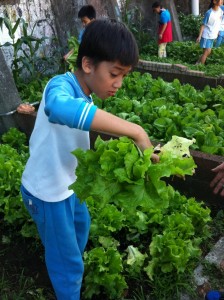
Before selling vegetables, the children had already practiced possible situations and conversations for selling vegetables at school through role-play. So when selling vegetables at the Huabo Market, the children were not shy at all and shouted out their sales pitches at the top of their lungs. When some customers complained that the vegetables were too expensive, the children explained confidently that these vegetables take two months to grow, and during those days they had to be watered and bugs caught every day, carefully tended, and it was really hard work. This was not reciting lines at all; this was their real experience, and from it came an understanding of and respect for the value of labor (but regarding the matter of friendly farm produce being too expensive, I have a rather dark solution, which I will explain in another article later). An hour later, the children's greens had sold out completely, bringing in more than 4,000 yuan! They decided to donate the vegetable-selling income to public welfare organizations to help other disadvantaged children.
If I really had to point to room for improvement in the food and farming education curriculum, I think that because this is a city government program, it is inevitably too tightly bound by regulations, and the current legalization and bureaucratization of "organic" operating standards too quickly become a uniform, "officially compiled textbook" teaching material. If guided experience and thinking could be used to broaden children's concept of environmentally friendly farming, it might fit the ideals of food and farming education even better. But then one could not rely so much on government resources; everything would still have to be done by the private sector itself.
Finally, I feel I gained an enormous amount from food and farming education. Although at first I wanted to go directly to a farm for an internship to learn farming, farmer friends actually have a huge amount of work progress every day, so who has the leisure to slowly demonstrate for me? Instead, starting from zero at an elementary school with the children, making beds, sowing seeds, making liquid fertilizer, catching bugs, pulling vegetables, and packing vegetables, going through the whole process once was far better than the dazed feeling of being a keyboard farmer who searches for a pile of information online and still does not know where to start.
Finally, a little promotion for the children. On December 6 at 9 a.m., sixth graders from Yangmingshan Elementary School will sell yams at the Jianguo Flower Market (at the Ren'ai Road end). There may be processed goods such as yam dorayaki, yam mochi, and yam chicken soup. Everyone is welcome to come and show support!
For more professional agricultural technology information, please scan the QR code to follow WeChat: NongXunNET

Please indicate the source when reprinting.