Severe drought: Shimen Reservoir has only enough water for 32 days; parts of New Taipei and Taoyuan to have water cut off two days a week
Taiwan is facing its worst drought in ten years, and the Shimen Reservoir can only hold out for another 32 days. The Central Emergency Operation Center for Drought Disasters announced this afternoon that the Banxin water supply district served by the Shimen Reservoir will enter Phase 3 water restrictions ahead of schedule on April 1, with water supplied 5 days a week and cut off for 2 days, estimated to affect 1.02 million households.
The Banxin water supply district covers all of Banqiao, Xinzhuang, Taishan, Wugu, Luzhou, Bali, Sanxia, Yingge, Tucheng and Shulin districts in New Taipei City, as well as parts of Sanchong, Zhonghe, and the townships and cities of Guishan and Bade in Taoyuan County.
The Ministry of Economic Affairs had originally estimated that Phase 3 water restrictions would not begin until the end of May, but the water situation is less optimistic than previously imagined. Rainfall from last year through March this year hit a 67-year low, leaving the Shimen Reservoir with only 32 days of water supply, and even the plum rain season does not look promising. The Central Weather Bureau assessed that the worst-case scenario of an "empty plum rain season" should be prepared for. After the Ministry of Economic Affairs and county and city governments held a video conference this afternoon, it was confirmed that Phase 3 water restrictions would begin ahead of schedule.
If rain does not come, Taoyuan agricultural water may be further restricted after April 11
If the water situation does not improve, agricultural water from the Shimen Reservoir may also be further restricted. The Shimen Reservoir supplies the Taoyuan Irrigation Association and the Shimen Irrigation Association. At present, irrigation in the entire Taoyuan Irrigation Association service area has been fully suspended. The Ministry of Economic Affairs said at today's meeting that another meeting will be held on April 11, and if the water situation is poor, further restrictions on water use by the Shimen Irrigation Association will not be ruled out. At present, 44,000 hectares of first-season crops across Taiwan have had irrigation suspended.
Chen Chun-yen, deputy director-general of the Agriculture and Food Agency, said that in the Taoyuan area where irrigation has not been suspended, an estimated 2,953 hectares are planted with rice, and rice seedling transplanting will be completed across the board by the end of the month. If the water situation is poor in the future, measures such as supplying water for ten days and cutting it for five days, or supplying for eight days and cutting for eight days, may be adopted, with water controllers managing the volume, and "irrigation will not be fully suspended."
He stressed that what the Ministry of Economic Affairs said was only the worst-case plan, and the amount of plum rain would still need to be assessed afterward. The north should see more rain, so the impact on rice farming should not be too great, and if production does decline due to insufficient water supply, there have been relevant compensation measures in the past.
Water supply cuts for major industrial users in Taoyuan raised to 10%
In addition, starting next Monday, water supply cuts for major industrial users in Banxin and Linkou in New Taipei, as well as Taoyuan and Miaoli, will be raised from 7.5% to 10%; in areas where second-stage water restrictions are already in place, such as Tainan, Kaohsiung, Hsinchu County and City, Taichung, and Changhua (northern part), water supply cuts for major industrial users will be raised from 5% to 7.5%.
Yang Wei-fu, deputy minister of the Ministry of Economic Affairs and concurrently director-general of the Water Resources Agency, said this morning that the water supply area of the Shimen Reservoir is more severe than originally expected, but that raising water fees across the board would still be difficult. At present, in addition to levying a water consumption fee on major water users, a "dry season water price" is also being drafted, with a related formula to be worked out to raise water prices during the dry season, applying to all users. However, if businesses have already been charged a water consumption fee, prices will not be raised again on top of that. A formula will be developed in the future, taking fairness and public benefit into consideration.
Yang Wei-fu said the water consumption fee plan is currently relatively clear and will be sent to the Executive Yuan in the short term, then to the Legislative Yuan to seek support and passage, while the dry season water price is still under discussion. In the future, nighttime pressure reduction during the dry season will also become normal.
Yang Wei-fu also put forward water recycling targets for the industrial sector. The current water recycling rate in existing industrial zones is about 69.4%, and in science parks 85%. In the future, it is hoped that industrial zones will be raised to 75%.
In addition, the leakage rate of Taipei Water Department is 16.7%, and that of Taiwan Water Corporation is 18.04%. A total of 79.6 billion yuan has been invested, and it is expected that in ten years the leakage rate of Taiwan Water Corporation will drop below 15%, while Taipei Water Department will raise funds on its own and is expected to reduce its leakage rate to 10%.
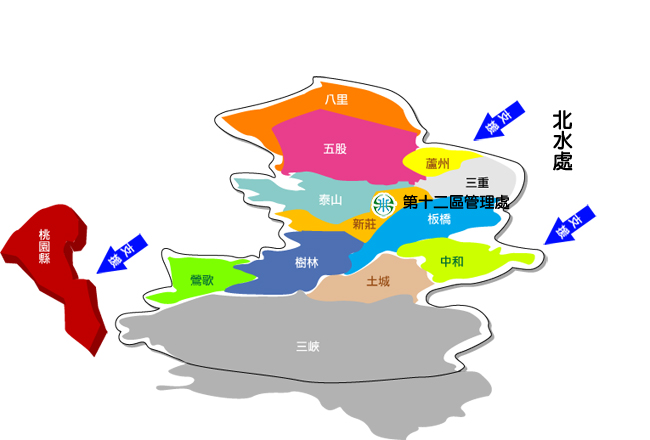
Banxin water supply service area (Image source: Taiwan Water Corporation)