The necessity of coordinated river-sea management: nutrient deficiency in rivers leads to the death of adjacent oceans
"Without the nutrient salts that rivers pour in, the neighboring ocean will die. That is why river and sea governance must be discussed together."
After Japan's "Oyster Grandpa" launched the "Forests Are the Ocean's Lovers" tree-planting movement in the mountains in 1989, every June the fishermen bring local residents and students up the mountains to tend the forests. Because they know that the organic matter naturally shed by the mountain forests becomes nutrients that enter the small streams and are then carried by the rivers to the sea, giving the vast ocean its vitality, so that people can have fish and oysters year after year. (Note 1)
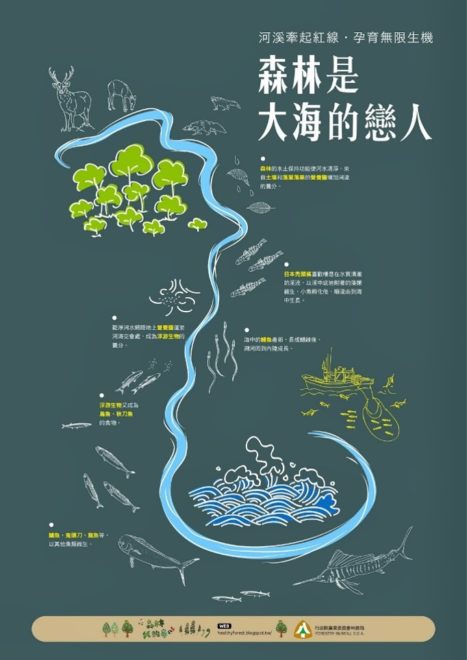
Image source: http://pansci.asia/archives/56258
Such superhuman nobility would, I think, be hard to achieve without a deep understanding of the environment and a high level of environmental awareness. "A river was originally a 'living umbilical cord' formed jointly by scattered rocks and sediment and the forests on both banks, and the many creatures, large and small, that come and go within it together make up this vital mechanism of life; now, however, most of it has become a lifeless man-made sewer, and so the food web that accumulated through the exchange of nutrients and energy, through these creatures eating and being eaten, living and dying, is gone. The shrinking and development of forests also cause soil and sand from mountain slopes to collapse or erode directly into this slide-like sewer, and some of it makes the water flowing into the ocean no longer clear, with too much soil-derived nutrients that cannot be used by life in time; together with wastewater discharge from towns and farmland, this creates zone after zone of eutrophic yet barren dead zones in the ocean: here there is plenty of dissolved nutrients or chemical pollution in the water that large fish cannot directly use, and little of the zooplankton and small to medium-sized aquatic animals and plants that can string together the food chain. (Note 1)"
In the course, we discussed in the format of a World Cafe, and one of the topics was "river and sea governance." The teacher said that we often assume the disappearance of marine ecosystems is entirely caused by pollution, but in fact, when countries around the world build structures upstream on rivers, including the Three Gorges Dam and Egypt's dam, they actually block the important substances of the rivers, making the ocean lose important components; besides sand, there are also nutrient salts, so the ocean is very monotonous. The places rivers pass through transport a great deal of nutrient salts, and these things are what marine life relies on to survive; without the injection of nutrient salts from rivers, the neighboring ocean will die. Today it is not just a matter of water: after the Zengwen Reservoir was built, most of the water resources were connected directly to the Wushantou Reservoir to supply irrigation for the Jianan Canal, and most of the downstream river sections have no water, which has also changed the river and its ecology and made the substances of marine life disappear. This is something we have never discussed. We often say that the impoverishment of the ocean is caused by pollution, but in fact the disappearance of nutrient salts is also an important factor.
But this does not mean we should take the extreme position of dismantling reservoirs; reservoirs remain indispensable, and rash dismantling would bring more problems. "'Since the reservoir's impact on the ecology of the entire river channel is so severe, why don't we just dismantle the reservoir?' In fact, when I first encountered this course, this idea immediately surfaced in my mind. But through the film this time I came to understand that the impact of dismantling a reservoir is no less than that of building one. From the beginning of the reservoir's construction to now, perhaps the reservoir and the environment have gradually found a balance with each other; rashly dismantling the reservoir would not only mean bearing the apparent economic cost issues and the issues of water for people's livelihoods and industry, but also risk the crisis of the entire system having to be 're-'balanced. Perhaps in this process of 'restoring' nature, it will be more complex than we imagine, and may even lead to more casualties or opportunity costs." After watching the course "The Fluvial Evolution of the Zengwen River" (Note 2), one student was moved to write down these reflections. Perhaps, as the teacher said, "Water engineering must cross disciplines and communicate more with the backgrounds of ecology and marine biology." Put aside departmental self-interest and engage in cross-disciplinary dialogue. Only in this way can we truly achieve the lofty ideal that "forests are the ocean's lovers."
Note 1: Fish every year, is the heartfelt wish of the forest and the sea http://pansci.asia/archives/56258
Note 2: Teacher Wang Xiaowen - The Fluvial Evolution of the Zengwen River
https://goo.gl/dTwt0Z
https://goo.gl/cWrTPh
Text edited BY the editor
For more articles, see the "Zengwen River Basin Co-learning Community" https://www.facebook.com/zengwenexplore/