Echinacea boosts immunity and prevents flu; China opens it for dual use as medicine and food to help farmers increase income
Echinacea is a popular health product in Europe and the United States, capable of boosting immunity and preventing colds, with a global output value of 1 billion. Yet people in Taiwan are unfamiliar with the name, because our country's Ministry of Health and Welfare long listed it as a medicinal item, and it could only be imported after approval. In 2000, the Taichung District Agricultural Research and Extension Station introduced 3 varieties of echinacea and established cultivation methods suited to the subtropics, and gradually developed tea bags, concentrated drops and tablets. After the Ministry of Health and Welfare lifted restrictions in 2011 to allow it as a dual-use medicine and food crop, four biotech companies have already received technology transfers, and the farm-gate purchase price reaches 1000 yuan per kg, which is expected to greatly raise farmers' incomes.
Foreign research shows it can boost immunity and prevent flu
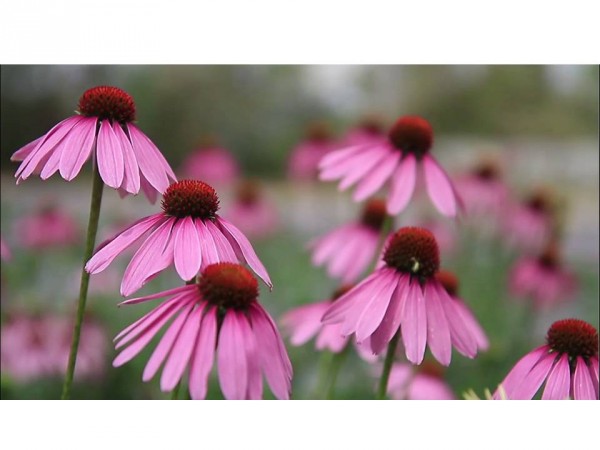


Although echinacea has become an almost universally recognized health crop, Taiwan, constrained by the regulations of the Ministry of Health and Welfare, must import it as a medicinal item, and almost everything on the market is a foreign product. Seeing the potential of echinacea, the Taichung Station introduced three varieties from Canada in 2000: narrow-leaf echinacea, purple coneflower and pale purple coneflower. But because echinacea prefers a cool climate, the station spent more than 10 years before it selected varieties better adapted to hot, humid conditions, further analysed their components and developed echinacea tea bags, instant powder and drops.
In 2011 the Ministry of Health and Welfare finally opened echinacea as a dual-use medicine and food crop, and four biotech manufacturers, seeing the business opportunity, have already received technology transfers from the Taichung Station. Besides ordinary tea bags, their products also include concentrated drops rarely seen abroad, suitable for drinking when out and about.
Many imported echinacea products cost a thousand yuan for just 60 grams of granules. Chen Yuxing said that after foreign products were previously found to contain no echinacea at all, local echinacea products carry the station's guarantee and are even cheaper, and he hopes the public will support them. According to the Ministry of Health and Welfare's 2005 survey report on national medical expenditure, people in Taiwan make 15 million visits to doctors for colds every year, spending 20.6 billion in health insurance costs. "If we could reduce colds by 1%, we could save 200 million for health insurance."
Purchase price of 1000 yuan per kg, expected to become a star crop
The farm-gate purchase price of echinacea reaches 1000 yuan per kg, but there is still much room for growth in Taiwan; at present the total area across Taiwan is only 1 hectare, distributed in Caotun in Nantou and Ji'an and Fenglin in Hualien. Because it has the nature of a wild flower, none of the locally cultivated crops uses pesticides, and each hectare yields about 3 tonnes. The Taichung Station has already established organic cultivation techniques, and with the Ministry of Health and Welfare relaxing its regulations, echinacea is expected to become a star crop in the future.
Chen Yuxing said, however, that the current hope is to transfer the technology to biotech companies, which would then contract with farmers, to avoid a rush of planting followed by not knowing how to process the crop; but the Taichung Station will not restrict seedlings circulating among the public.
Echinacea can be harvested all year round, but it likes temperatures of 20-30 degrees and fears humidity. Taiwan's growing season is about December to May of the following year, and the harvest happens to fall around Mother's Day. With its pale purple petals and cute shuttlecock-like shape, it also has the potential to be developed as a landscape plant.
The Taichung Station stresses that the echinacea products developed so far are "food", and unlike medicinal products sold on the market they do not directly treat colds, but focus on preventive effects. To claim therapeutic or health-food effects, an application must be made to the Ministry of Health and Welfare. It advises consumers not to use it continuously and intensively, because immunity has its limits, and taking too much may make it lose its effect later on.