Is growing tomatoes upside down really more scientific? Agricultural experts say this
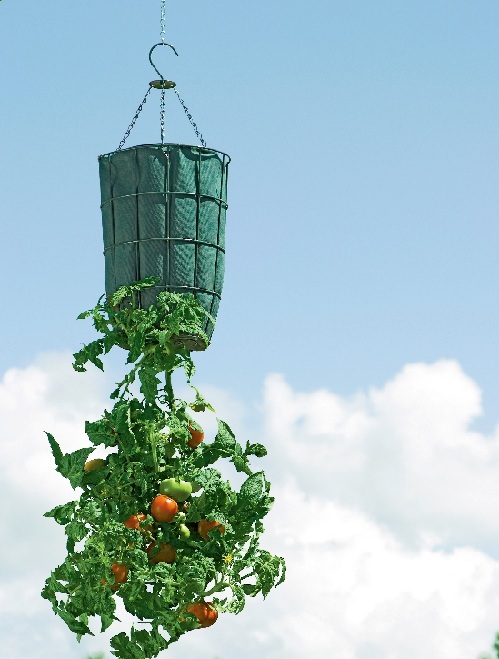
An online rumor claims thatgrowing tomatoes upside down is "more scientific," saving space and reducing pests and diseases. Is it true?A reporter from NewsMarket specifically asked the Taichung District Agricultural Research and Extension Station and Song Yu, a professor in the Department of Horticulture at Chung Hsing University who is familiar with tomatoes. Both said that, setting aside whether it is "more scientific," tomatoes can indeed be grown "upside down," and it is full of fun and can be kept as an ornamental urban potted plant. Moreover, growing them horizontally or upside down has nothing to do with reducing pests and diseases; planting density is the key point.


No difference between planting upside down or at a slant; easy picking matters most
Lin Yu-heng said that growing tomatoes upside down can give the tomato 360-degree all-around light exposure, but in a general greenhouse environment there is also 360-degree light exposure, and no farmer would deliberately create shade or block crop growth; however, upside-down cultivation does indeed require extra attention to water control, because after all water flows downward and will accumulate at the bottom of the pot, and the root system also accumulates there. "You really have to give just the right amount." It may even be necessary to rely on drip irrigation to control it precisely.
However, one claim is that growing upside down or "horizontally" can increase airflow space and reduce the occurrence of pests and diseases. Regarding this claim, Song Yu believes the key point is still planting density and whether the growing medium soil has been contaminated by pathogens, but upside-down and horizontal cultivation are both unrelated to these factors.
As for so-called "horizontal" planting, to be precise it is "slanting" planting, technically called "lowering the vine" cultivation. After the tomato grows up from the ground in the same way and exceeds 160 or 180 cm in height, it is then wound downward and fixed with string, but the growing point still faces upward, allowing the tomato to continue growing. The benefit of doing this is to lower the fruiting position of the tomato, making manual harvesting easier.
In fact, depending on the variety, the height at which tomatoes are picked also differs. For varieties such as Yume and Shengnyu tomatoes, the plant can grow to 240 cm, but above 160 cm it becomes unfavorable for picking, so in practice "pinching" is usually carried out at around 170 cm, which means removing the growing point at the top so the tomato will not keep growing upward endlessly.
In short, no matter how tall various tomatoes can grow, as long as "pinching" is used or the tomato vine is fixed downward, making it convenient for the farmers doing the picking is the most important purpose.
As for whether this kind of three-dimensional cultivation method will be promoted, Lin Yu-heng said that basically growing tomatoes upside down can serve as teaching material for food and agriculture education, letting students better understand plant characteristics, and in the future it could even be applied in horticultural therapy.
If you want to try growing tomatoes upside down, you can refer to the following methods:
http://www.wikihow.com/Grow-Tomatoes-Upside-Down
http://www.cheapvegetablegardener.com/make-your-own-upside-down-tomato/