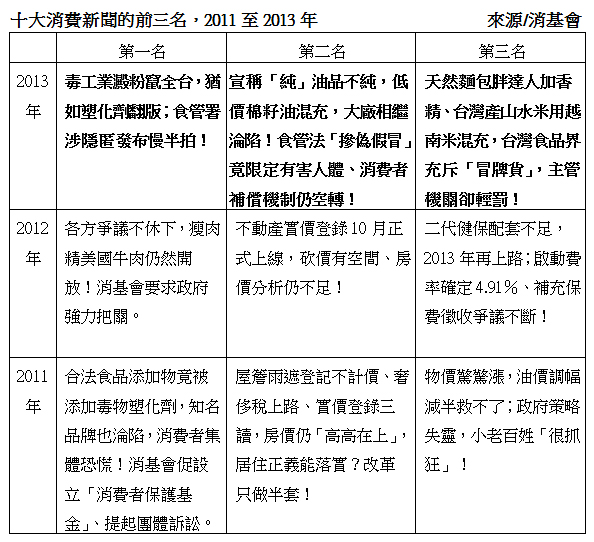
Consumers' Foundation publishes top ten consumer news stories, food safety issues account for four, Ting Hsin's tainted oil tops the list, Ministry of Health and Welfare receives the Golden Raspberry Award
As the year draws to a close, the Consumers' Foundation, Chinese Taipei announced this year's top ten consumer news stories this afternoon. The word of the year is "black," and the number one spot went to the Ting Hsin Group, which was involved in three problem-oil incidents within a single year. Other food-safety issues included the class-action lawsuit over the fake natural bread sold by Bakery Panda, a planned ban on junk food advertising on children's channels, and infant formula whose costs fell while prices stubbornly refused to drop. Four of the top ten consumer news stories were related to food safety. The competent authority, the Ministry of Health and Welfare, was awarded the Golden Raspberry Award. Consumers' Foundation secretary-general Lu Hsin-chang encouraged the Ministry of Health and Welfare to keep going, to learn from its painful lessons and push for reform, and expressed the hope that next year consumers would no longer have to worry about food safety.
The Consumers' Foundation selected this year's top ten consumer news stories based on an online vote and a vote by its board of directors and supervisors. The number one story was the tainted-oil scandal. It began at Mid-Autumn Festival, when Strong lard was found to be mixed with swill oil, then over the Double Ten holiday Cheng I lard was found to be mixed with feed-grade oil, and afterward Ting Hsin's products were also found to have used Cheng I oil. Lu Yun said that as a large listed conglomerate, the Ting Hsin Group had been caught up in problem-oil incidents three times in one year, which sparked outrage among Taiwanese consumers and triggered a large-scale boycott.
The Tainted-Oil Scandal: Ting Hsin Group Was Involved in Every Case
Because of the string of tainted-oil scandals this year, in late November the Act Governing Food Safety and Sanitation was amended for the second time, raising the maximum fine to two billion, and at the same time resolving the dispute over double punishment in a single case that had arisen from the Great統 oil-adulteration case. Lu Yun believed that although the amendment would help strengthen regulation, he also reminded government agencies that "laws alone cannot enforce themselves; putting enforcement into practice is fundamental."
The number three consumer news story was also related to food safety. In the Bakery Panda fake natural bread case that broke last year, the Consumers' Foundation filed a class-action lawsuit this year seeking 25 million in damages. Bakery Panda, which marketed itself as "natural, containing no chemically synthesized additives or improvers," was found to have used artificial flavorings. After the incident came to light, the Taipei City Government Department of Legal Affairs demanded compensation of three times the purchase amount, and the Consumers' Foundation also hoped the company would propose a reasonable compensation plan, but Bakery Panda only promised to refund 1.25 times the purchase amount, or to exchange it for bread products worth 1.5 times the purchase amount.
Regarding Bakery Panda's compensation measures, under the coordination of the Taipei City Government consumer protection officer, the Consumers' Foundation took charge of filing a class-action lawsuit. In April of this year it submitted the complaint to the Taipei District Court and filed the suit, seeking punitive damages of three times the purchase amount under Article 51 of the Consumer Protection Act. The case is currently being heard by the Taipei District Court.