Sea turtle in a first-class ward is unhappy and just wants to go home
Recently there have been frequent reports of sea turtles being found. According to statistics from the sea turtle rescue center in northern Taiwan, the Marine Ecology and Conservation Laboratory, 31 cases of sea turtles found by members of the public have already been received this year, accounting for more than half of the total cases last year. National Taiwan Ocean University professor Cheng I-chun, who just returned from the International Sea Turtle Biology and Conservation Symposium in Peru, said that in Asia, Japan and Taiwan, China, have relatively advanced regulations for sea turtle conservation; however, limited by China's capture of sea turtles, illegally made ornaments and meat products, and the failure of various countries to actively deal with marine debris, all of these cause damage to sea turtle rescue and conservation results.
Give it a sickroom, better to pray it never has to be admitted again
Stepping into the Marine Ecology and Conservation Laboratory at National Taiwan Ocean University
Here, every day undergraduate and master's students work together to change the seawater for the sea turtles, feed them seaweed and shrimp, and clear away excrement; the seawater in the tubs is also treated through filter cotton and kept at 24 to 27 degrees Celsius, a comfortable temperature for sea turtles.
Such a good environment inevitably makes people mistakenly think that the sea turtles have already become quite adapted to the laboratory environment, but immediately the short, forceful "bang bang" sounds of Sanmingzhi slapping the water tub pierce the general public's imagination of a "sea turtle paradise."
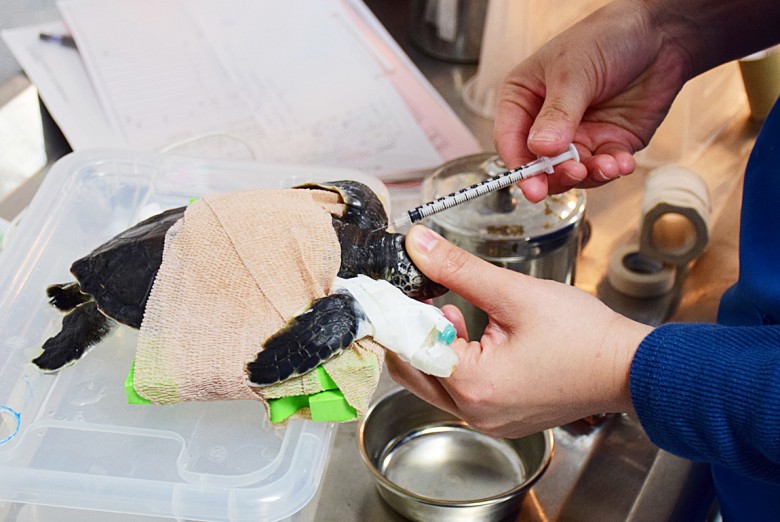
Assistant Hsieh Wen-yi said that after all the laboratory is a man-made environment, and for wild sea turtles it is still oppressive, but because they are too weak, they must be cared for nearby and so remain in the laboratory; healthier sea turtles are sent to the Gongliao site, where not only is the pool larger and more suitable for adaptation, but they can also build up their strength for release into the wild. However, all things added together, the laboratory has already taken in 12 sea turtles, which counts as being at full capacity.


-780x520.jpg)