Sauerkraut exceeds sulfur dioxide limit by 50 times; Taipei City Department of Health recommends choosing naturally fermented products
The Taipei Lunar New Year market opens this Saturday. The Taipei City Department of Health today released the results of its first round of Lunar New Year food inspections. Of 45 pickled vegetable samples, nearly one quarter failed to meet standards. The suancai (pickled mustard greens) sold by the Chiaxi Fruit and Vegetable Production Cooperative in Chiayi County had sulfur dioxide residues exceeding the limit by more than 50 times. Wu Po-ching, associate professor at National Ilan University, advised that rinsing suancai under running water before putting it in the pot, and not covering the pot while cooking, can dissipate most of the sulfur dioxide; consumers can also choose suancai advertised as kept fresh under refrigeration and free of additives.
Taipei City Department of Health inspection finds suancai sulfur dioxide 50 times over the limit
Many people feel beef noodle soup is only complete with a bite of suancai, but pickled vegetables are often treated with sulfur dioxide or benzoic acid to inhibit bacteria and improve color. The Taipei City Department of Health yesterday released test results for pickled vegetables, candied fruit and dehydrated vegetables. Of 100 products, 14 failed quality standards, with pickled vegetables accounting for the highest proportion: one in four had additives over the limit. The suancai sold at Binjiang Market and Huannan Market exceeded the sulfur dioxide limit by 53 times and 31 times respectively, and both came from the Chiaxi Fruit and Vegetable Production Cooperative in Chiayi County; the "suancai hearts" made for Wellcome by Chia-Lo Foods, meanwhile, exceeded the sulfur dioxide limit for two years running. (For the complete list, see the appendix at the end of this article.)
Chiu Hsiu-yi, director of the Food and Drug Division of the Taipei City Department of Health, said products failing quality or labeling standards have been fully removed from shelves and recalled. Under Articles 22 and 28 of the Act Governing Food Safety and Sanitation, manufacturers or responsible vendors may be fined between NT$30,000 and NT$3 million, or between NT$40,000 and NT$200,000, and vendors must recall and correct the products within a set deadline; they may not continue selling them before the corrections are made.
Wellcome public relations manager Tsai Tsung-hua said the company had not yet received notice from the Department of Health and would wait for confirmation before discussing follow-up handling and whether to change contract manufacturers.
Ms. Chen, accountant at the Chiaxi Fruit and Vegetable Production Cooperative, said the products were removed from shelves as soon as the local health bureau notified them in December. The violating product came from the same Chiayi farmer: "The farmer is elderly and may have forgotten he had already added sulfur dioxide, so he added it again." The violating suancai amounted to about 300 kilograms, and the health bureau took samples just as it went on sale, so not much suancai should have reached the market; the cooperative has about a dozen farmers and an annual output of 5 tonnes, and will strengthen oversight in the future, not ruling out sending samples for testing on its own before shipment.
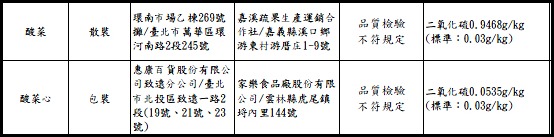
Release of the list of dehydrated and pickled fruits and vegetables (including candied fruit) failing inspection in the first round of Lunar New Year foods for 2014 (ROC year 103)
Release of the list of dehydrated and pickled fruits and vegetables (including candied fruit) with labeling violations in the first round of Lunar New Year foods for 2014 (ROC year 103)