Hard Clam Die-Offs Have Unknown Cause; Fisheries Agency Brings in Experts to Find Answers Through Test Farming
The hard clam, one of the country's major commercially farmed shellfish, is facing a severe survival challenge! Although hard clams are more prone to dying during the seasonal transitions of the third, sixth and ninth lunar months, when salinity and temperature change sharply, "but this year the die-offs have been worse than ever before," admitted Huang Hung-yen, deputy director-general of the Fisheries Agency. "At this stage, no one has been able to pin down the exact cause of the hard clam deaths."
Opinions differ widely on the cause of the hard clam deaths: contaminated bottom soil, days of torrential rain in June, the scorching summer heat... Some farmers even suspect that repeated inbreeding of broodstock has narrowed and weakened the gene pool, resulting in poor survival rates for hard clams. Farmers can only watch the clams die with no way to stop it. According to Huang Fen-hsiang, a hard clam farmer in Qigu, Tainan, no concrete government measures have been seen since the problem emerged; so far all that is known is that the Fisheries Agency has asked university professors to advise fishermen on how to maintain their ponds and farm at low density, "and about six or seven classes have been held across Taiwan."
However, the damage to hard clams is already done, and with the cause still unknown, how should the fisheries authorities draft the next step in industry guidance? Huang Hung-yen pointed out that after recent discussions with local governments, animal and plant health inspection and quarantine units, and the Fisheries Research Institute, the first step will be to "set up hard clam farming demonstration sites": researchers from the Fisheries Research Institute will establish a "hard clam farming SOP demonstration pond" at the Taixi experimental station in Yunlin. "If even the experts can't raise them well, then we can rule out the farmers' management methods as the problem."
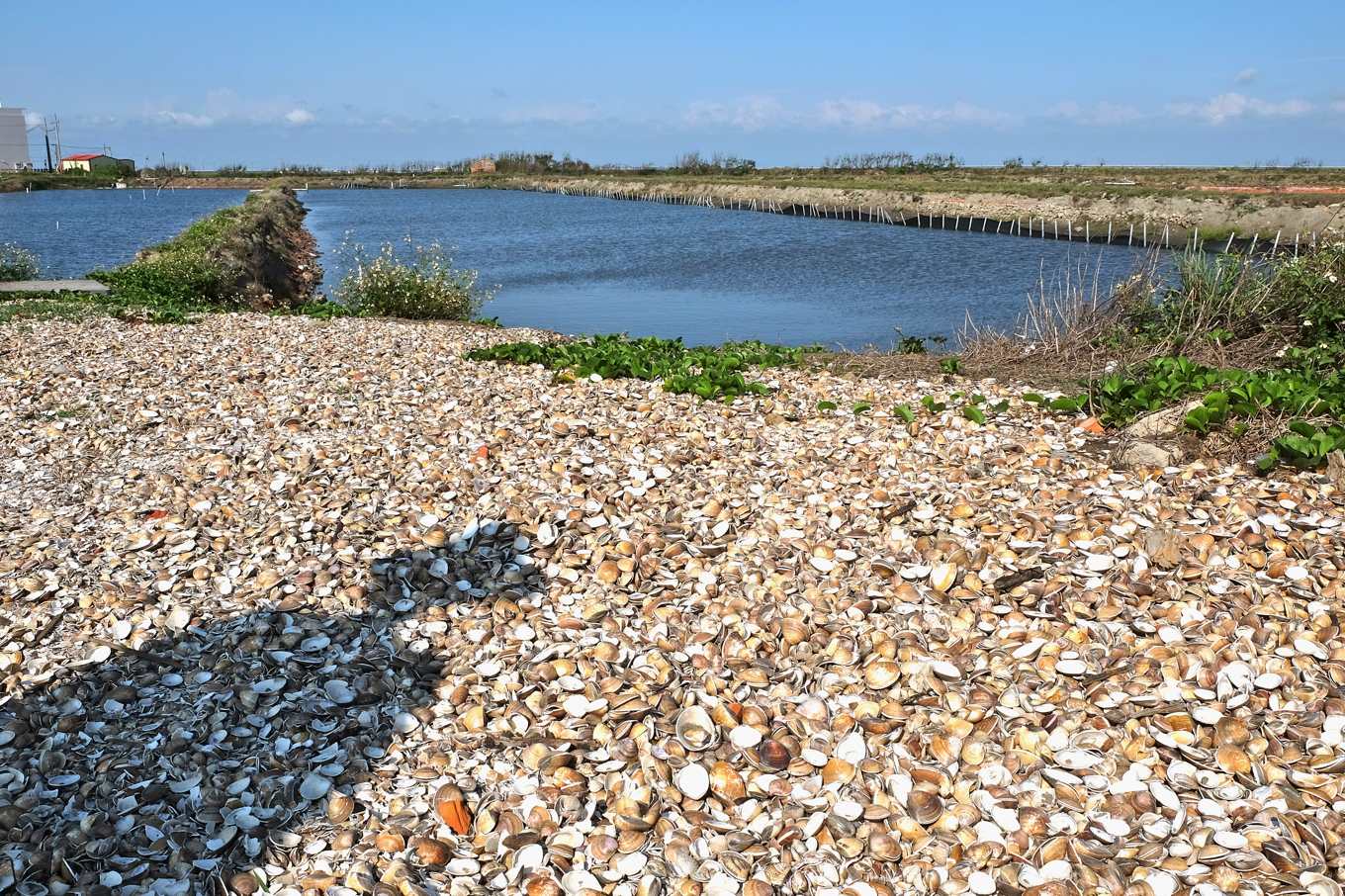


Farmers Question: Narrowed Broodstock Genes; Big Clams Die, Small Seedlings Die Too
However, aside from concerns about contaminated bottom soil, farmers have also been questioning whether "narrowed broodstock genes" are causing low survival rates among hard clam seedlings. "In the past, when we released hard clams, the small seedlings basically didn't die; but now the big clams die and the small seedlings die too." Huang Fen-hsiang offered her own observations, noting further that in the past, about four days after releasing hard clam seedlings, the seedlings would slowly grow shells, "but now the shells won't grow and the clams just die." This had never been seen before, and it is now gradually getting worse.
Regarding farmers' concerns about "broodstock," Chou Yu-han said it is still impossible to determine whether the longer farming period is caused by "broodstock quality" or "farming density": "After all, for a hatchery to produce a batch of seed, the number of brood clams needed is enormous, often 1,000 to 2,000 jin, about 40,000 to 80,000 brood clams." Is inbreeding possible among so many individuals? Chou said this remains to be discussed.
Chou further stated that according to Fisheries Research Institute studies, the grow-out period for hard clams is related to farming density: "the higher the farming density, the longer the grow-out period." In the 80th year of the Republic of China (1991), an average of 800,000 hard clams were stocked per hectare, with an average grow-out period of 11 months; in the 91st year of the Republic of China (2002), an average of 1.2 million hard clams were stocked per hectare, with a grow-out period of about 13 months; and the current average farming density has reached 1.5 million per hectare, with Changhua's average density even reaching about 2 million per hectare. It cannot be ruled out that excessively high farming density is leading to low hard clam survival efficiency.
Fisheries Agency: Experts Will Test-Farm; If the Clams Survive, Management SOPs Can Be Drawn Up
The exact cause of the hard clam deaths remains open to debate, and watching the mass die-offs batter the hard clam industry, "there's still no subsidy!" Huang Fen-hsiang smiled bitterly. After all, hard clam prices have skyrocketed: "The Fisheries Agency usually only subsidizes when there is overproduction and prices crash; with prices so high now, of course there won't be any subsidy." Indeed, a check of the global fishery products information network shows that the average trading price of hard clams in July has climbed to 83.7 yuan per kilogram, a new high in nearly five months.
Asked whether the fisheries authorities might allocate subsidies given the dismal harvest for the hard clam industry this year, Huang Hung-yen responded, "The current situation does not meet the conditions for natural disaster relief." This is because, according to the Fisheries Agency's understanding, some hard clam farmers have not experienced mass die-offs. "If poor farming management caused the clams to die, then of course the government can't be held responsible for subsidizing that either."
"Everything still depends on the results of the test farming at the Fisheries Research Institute's hard clam farming demonstration site." Huang Hung-yen said that if the clams raised by the institute's experts do not show mass die-offs, then farming management SOPs can be drawn up to guide farmers on how to clean ponds, apply feed and use medication. "It will still take some time to observe, but I believe the Fisheries Research Institute will act quickly." Chou Yu-han also said that the institute's outdoor hard clam pond has already begun full pond preparation, with stocking expected to start in August.
Farmers: Forward-Looking Plan Should Include a "Centralized Seawater Supply System" to Improve Water Quality
"But subsidies actually don't help fishermen much; instead, the government should think about how to improve public infrastructure." Wang Kun-he pointed out that at present, the intake and drainage water for fishermen's farming both come from the same drainage ditch, or even the same outfall, so water quality is far from ideal. Perhaps the government should consider improving coastal aquaculture water quality with a "centralized seawater supply system."
What is a centralized seawater supply system? Wang Kun-he further explained that in the past the Fisheries Agency built five "centralized seawater supply systems" in Taiwan, one of which is located in the Xiakun production area of Kouhu Township, Yunlin County. This system uses pipelines to bring seawater directly to the fish ponds: "Just turn on the switch and clean seawater can be pumped in." A separate ditch handles drainage, so the discharge does not affect the water quality of the fish ponds.
"The centralized seawater supply system really works!" Wang Kun-he praised it highly. Not only is the water introduced clean and free of eutrophication, but the water temperature also tends not to get as high. "Otherwise, when the water temperature rises, bacteria multiply and chemical reactions speed up." Wang believes that building centralized seawater supply systems is what is truly "forward-looking" for farmers, and only that will provide real, substantive help to them.
In response to the farmers' suggestion, Huang Hung-yen said that at this stage the fisheries authorities' primary goal remains to "find the cause of death and take measures targeting that cause." As for building centralized seawater supply systems, their feasibility could perhaps be discussed further in the future.
Hard Clam Crisis! Abnormal Climate, Contaminated Bottom Soil; Yunlin Hard Clam Mortality at 40 Percent, Tainan Also Hit
For more professional agricultural science and technology information, please scan the QR code to follow WeChat: NongXunNET

Please indicate the source when reprinting.