After the Nuclear Disaster: A Japanese Mother's Own Account
Wanting your own children to eat something a little better is, for anyone who is a mom, the most basic wish and rule. Rule number one: something a little tastier. Rule number two: something a little prettier. And then, something even more important comes along. Rule number three: something a little safer.
After 311 --.
We moms in Japan were forced to give up rule number three. We struggle to obtain the safest, least contaminated food, yet the world at large firmly believes whatever the government announces, so not only are people unwilling to help us, they even gnash their teeth and scold us: 'Being this excessively afraid of radiation is a completely wrong reaction. Don't you feel ashamed doing this? Don't you know that this behavior of yours makes the farmers in the disaster areas suffer even more?' 'Why don't you join this campaign to "eat more food from the disaster areas and help them more"? How selfish.'
I know they are suffering, but who made them suffer? Was it us moms? It shouldn't be. Though we city people have always relied on the concessions of country people to enjoy the convenience brought by abundant electricity, ever since I was little I have been against nuclear power, and I always hoped the government would formally research natural energy. But the national government has always promoted nuclear power, insisting over and over that it is safe, and it has not greatly expanded the use of natural energy -- why? Because behind it there are profit-and-power relationships involving many institutions, and moreover, the national government has prized possessing nuclear power since around 1950 -- behind this lie these defensive (military) necessities.
Around the enormous nuclear power interests, who knows how much shady money government officials and senior executives of the electric power company received -- this is something not yet clear, but we can already believe there was at least some. In any case, I think I can say this: it is Tokyo Electric Power Company that made the locals suffer. It is the national government that made the locals suffer, not us moms.
After the nuclear disaster occurred, the national government not only failed to issue appropriate countermeasures for the local farmers, it also failed to bear the consequences of its own lack of measures. At the time, if the national government had let the locals cover the land, forage grass and other feed with plastic sheeting, then in the food contamination that later occurred, the actual damage could have been reduced. In fact, they were not caught unprepared, yet they did nothing at all. It is clear that what they wanted to cover up was not uncontaminated land, but the fact that 'the nuclear disaster has finally happened.'
Because there were simply no countermeasures to speak of, starting with spinach, severe contamination appeared. Beef was also severely contaminated. In response to this, the national government's reaction was not to restrict distribution; on the contrary, they set a so-called 'provisional standard value' as a new standard and greatly raised the original standard, forcing citizens to swallow their anger and accept severely contaminated food -- 'Eat these vegetables, don't worry for now, "temporarily" they won't affect your health' -- (I still remember that at the beginning, many agricultural products also exceeded the new standard, but those that "luckily just barely didn't exceed it" were of course all put into the distribution network, and in the end ended up on ordinary families' tables, or on the tables of school lunches). Because they saved themselves the trouble of disposing of and compensating for the disaster-area products, in the end they themselves damaged the myth of the safety of Japanese products.
Although products from many regions of Japan were not contaminated, because the state still kept placing food from the disaster areas onto the ordinary distribution network, the result was a state of Russian roulette, which led to the misunderstanding that 'none of Japan's food is safe to eat,' and at the same time destroyed the image that 'Japan's ingredients are all very safe.' I think this is all the government bringing it on itself.
Almost a year has passed, and I have begun to sort out for myself the line between what I accept and what I don't. Since so much food is more or less contaminated, then we shouldn't demand perfectly zero-contamination food, but how much can be accepted? I sort of need to understand what everyone thinks, so today while waiting for the kindergarten school bus, I steeled myself and brought up with a mom friend something I had always refused to mention: 'I'm usually very careful when buying groceries, afraid of buying irradiated food. What about you?' As soon as she heard me say this, she replied slightly unhappily: 'I've never seriously thought about this. Whatever's on the market, I buy it all. Anyway, we suffer together; if everyone's going to die, we're going to die too. We can't not eat, so why bother.'
I was truly speechless. To buy something a bit safer, I run to several supermarkets, or, if I can't find it, 'give up on this dish for today, forget it.' That is my most minimal effort to deal with radiation. Of course we can't not eat, but at least we can choose the place of origin.
Try as much as possible not to buy vegetables from the disaster areas --. Because I am not cold-blooded, every time I think of the suffering of the locals. I feel that this kind of "self-pity" should also be pain I ought to bear. Besides this psychological burden, for the sake of the farmers in the disaster areas, I have made several charitable donations. Also, although for now I can't place orders, I am still paying the monthly membership fee to the consumers' cooperative. Because I also hope they keep going.
But if the contamination of the land has already exceeded a certain limit, then what should be given up should still be given up. At such a time, Tokyo Electric Power and the national government should sincerely face these victimized farmers, and give them everything they ought to give, right? Whether it's settling it with money, or helping them find other land.
Instead, they tied the farmers to the heavily contaminated land, and whenever they opened their mouths it was nothing but evasion and excuses, and afterward, seizing the moment when people were already exhausted, they began to say lightly, 'No problem, just keep working.' But the produce they had worked so hard to grow was obviously more or less contaminated, and prices kept falling; the government, paying no regard to the farmers' hardship, said dismissively, 'Because there's no problem, there's no problem. Being hard to sell is another matter; we don't need to compensate.' Hey, it's not us refusing to buy that's turning our backs on them; it's you doing this that's turning your backs on them, isn't it?
Over this past year, I have learned about the dangers of radiation to the body. No matter what the government says, I think, what can be avoided I want to avoid. But Japanese society, toward this kind of thing, is on one hand very united, and on the other hand very exclusionary. To create 'kizuna' (which happened to be chosen last year as the "character of the year"), uniting together is very solid, and the slogan is 'Eat more, buy more, help the disaster areas more.'
The moms who, in order to protect their own children, dare not join this campaign have already become the enemies of society. Outside, I dare not express my own thoughts. I'm afraid my child will be excluded. Sigh, what on earth is going on here. (You too are facing the American beef issue, but I think you Taiwanese wouldn't hide your own thoughts like this, right? If you don't want to eat it, you just say you don't want to, right? I really envy that straightforwardness of yours.)
A group of moms much braver than I am long ago formed the 'Association to Protect Children,' and this movement spread rapidly across the whole country. They dare to state their demands in front of the media, and they dare to go to the city government to submit their list of demands. I really admire their courage. Around here I don't have such brave 'comrades (and this is what real "comrades" means),' so for now I can only call the city government to voice the opinions I want to raise, and report relevant information to overseas netizens on the FB page, reminding them how dangerous and how terrifying nuclear power is. This is what I can do for now, and at the same time it is what I ought to be responsible for.
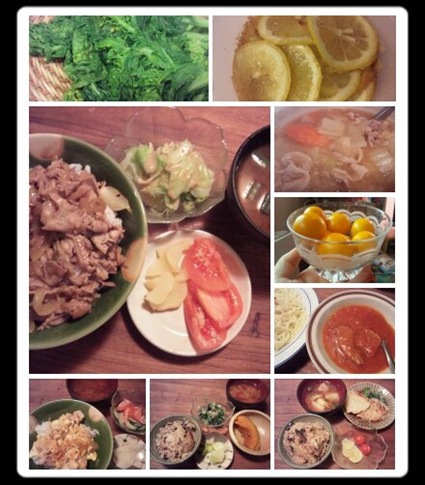
↑These are all ingredients I bought after running to several supermarkets, making dinner to feed my family.
Through this nuclear disaster, I have learned a great many things. Big corporations, the national government and other large groups are not willing to protect the public. They protect themselves first, and fulfilling the public's demands comes second, or perhaps, four-four-four-fourth. We must know how to stand up for ourselves, and bravely protect our own children. Believe in yourself, and keep walking your own path. And I learned another fact: there are in fact some good people inside the government, especially those who answer the phones -- many of them are kind, perhaps because they too are ordinary people living their own lives, so they should be able to understand what I, an ordinary citizen, mean! -- wanting to protect children, not wanting to let children eat heavily contaminated food!
The city of Yokohama, early on, carelessly let our precious ones eat heavily contaminated beef, yet did not apologize to the parents, but later, thanks to the efforts of many moms, the city government began measuring ingredients; although the measuring process is still not complete, it still counts as a start we obtained. It turns out that we ordinary moms, as long as we unite with one heart, have the power to change city government policy! So don't be discouraged, don't be too sad, and don't give up; keep working hard. Happiness and good food are the best medicine, and laughter is the best vaccine.
On this day of 311, I hope more people wake up from the dream and become gentle anti-nuclear advocates, and let us change the script of the future together.