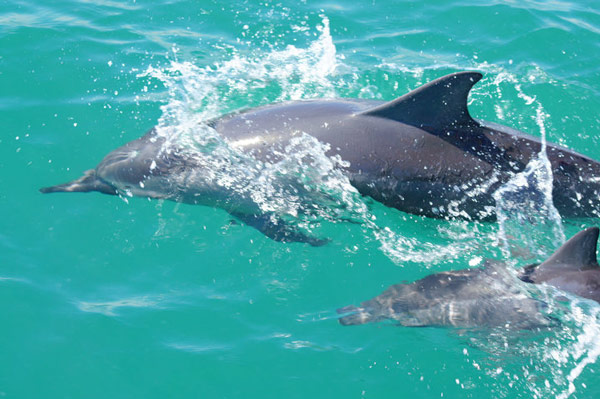
Minke whale and dolphin catching standards; candidate criteria relaxed; conservation groups say catching whales and dolphins will not increase fish stocks
As the election campaign enters its final countdown, a candidate in Taitung has proposed relaxing the catch standards for macaques, whale sharks and dolphins in order to boost agricultural and fisheries development. The Hualien District Fishermen's Association, meanwhile, plans to apply to the Hualien County Government for fishing boats to be used for whale watching, so as to vigorously develop the whale-watching leisure industry. In response, the Kuroshio Ocean Education Foundation is calling for whale-watching regulations to be put in place first, before development is opened up.
Taitung township representative candidate calls for relaxing catch standards for macaques, whale sharks and dolphins
Li Lung-jung, a candidate for township representative in Chenggong Township, Taitung County, proposed urging the government to relax the catch standards for macaques, whale sharks and dolphins to facilitate agricultural and fisheries development. Li Lung-jung said that in the Chenggong Township area, there are a great many macaques in the mountains, and many crops, such as the navel oranges, ponkan mandarins and persimmons that are currently in abundant season, are often picked and eaten by the macaques. But the macaques cannot be captured, and can only be scared off by setting off firecrackers and the like, while the government offers no compensation for crop losses, causing considerable trouble for farmers in the mountains.
In addition, when local fishermen use drift gillnets to fish, their original target is swordfish, but because drift gillnets can extend for dozens of kilometers, they often accidentally catch protected whale species. At such times the fishermen must discard the entire net, causing a loss of catch. They therefore hope the catch standards for whale sharks and dolphins can be relaxed, so that if whales are caught by mistake, the entire catch does not have to be abandoned along with them.
Cetacean Association: Cetacean numbers on the East Coast have clearly declined
Taiwan, China passed the "Wildlife Conservation Act" in the 78th year of the Republic of China (1989), under which the Council of Agriculture of the Executive Yuan announced 23 endangered whale species. In the 79th and 84th years of the Republic of China (1990 and 1995), all whale species were listed as protected wildlife.
Kuo Hsiang-hsia of the Cetacean Association of Taiwan, China said that from his observations, Taiwan, China currently has no special protection measures for cetaceans, such as designating fishing boat operating zones or regulating whale-watching frequency; only the law stipulates that they may not be captured. In addition, in recent years his research on cetaceans has found that, compared with cetaceans in other waters internationally, those in Taiwan, China are generally thinner and smaller, and species such as false killer whales and Risso's dolphins appear less and less frequently, while cetacean numbers on the East Coast have clearly declined.
Chang Hui-chun, chief executive officer of the Kuroshio Ocean Education Foundation, said that drift gillnets, because their mesh is too small, not only may catch fish that are not the target species, but also "catch everything" including small fish and shrimp. In particular, when cetaceans accidentally touch drift gillnets, they are often entangled and killed by the nets. For this reason, many countries have already banned drift gillnet fishing. Chang Hui-chun believes that relaxing cetacean conservation standards for this reason is a case of putting the cart before the horse, and that instead the fishing gear, nets and fishing methods used by fishermen should be reviewed.
Mr. Chang, a resident of Chenggong Township, Taitung County, also said that everyone has protected cetaceans for so many years, and we should not go backwards! The catch in Chenggong Township consists mainly of mahi-mahi and swordfish, but drift gillnets "catch everything," including small fish that have not yet grown up. And when fishermen accidentally catch cetaceans while fishing with drift gillnets, they end up throwing the entire net and fish into the sea; this fishing method should have been banned in the first place.