How Can Farmland Pollution Be Remedied? Environmental Groups Call for Legalizing the Separation of Irrigation and Drainage
In Taiwan, China, irrigation and drainage have long been mixed, and industrial wastewater discharged under "combined discharge" permits flows into irrigation channels, polluting farmland. The Legislative Yuan held a public hearing yesterday, at which legislator Lin Shu-fen pointed out that there are about 67,000 unregistered factories in Taiwan, China, most of them located on farmland, yet only a little over 400 have applied for combined discharge permits; the Council of Agriculture drew up zoned and phased control measures last October, and is expected to completely ban industrial wastewater from being discharged into irrigation channels in ROC year 106, but some environmental groups question this, saying the Council of Agriculture has only issued administrative orders and has delayed legislation, and they demand a formal hearing to legalize the plan as soon as possible.
The Council of Agriculture Wants to Legislate, but Is Stuck at the Industrial Development Bureau
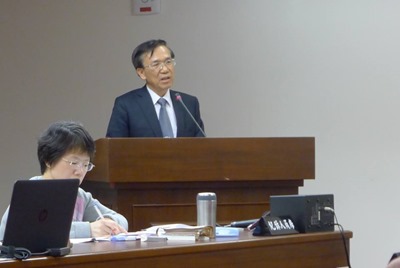
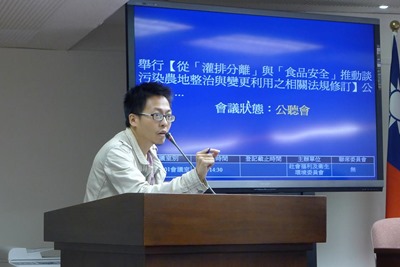
The separation of irrigation and drainage has been repeatedly delayed, and the inventory of illegal factories has also not been made public. At the public hearing, the Ministry of Economic Affairs pointed out that a preliminary estimate puts the number of unregistered factories at about 67,000, with only a little over 2,000 holding temporary certificates, and that most of the illegal factories are located on cheap farmland.
Legislator Lin Shu-fen presented survey data showing that about 15,000 hectares of farmland across Taiwan, China, have high pollution potential, and that only 416 operators have applied to discharge industrial wastewater under combined discharge permits; compared with 67,000 illegal factories, it is unclear how much farmland has been polluted, yet the Council of Agriculture has not seriously enforced the Water Act to penalize operators that secretly discharge wastewater.
Lu Yi-chi, for his part, demanded that the competent authorities integrate the data. He said that the foundation had previously exposed pollution of the Houjin Creek in Kaohsiung by the Formosa Plastics Renwu plant, but the downstream irrigation association had no idea that the pollution source came from upstream: wastewater from the industrial zone was discharged upstream, while downstream it was used for irrigation. The relevant ministries should have basic data on polluted areas, wastewater discharge outlets and the distribution of illegal factories, yet they are unwilling to make it public. GIS overlays should be used to build detailed data for an entire creek, otherwise how can farmland remediation be demanded?
Legislator Tien Chiu-chin said that by the end of this year all illegal factories should be fully inventoried, and household wastewater from farmhouses should also be reviewed at the same time; Chu Tseng-hung, chief executive of the Taiwan Animal Society Research Association, also pointed out that the Council of Agriculture should make public the meeting records from when policies were formulated so that the whole public can supervise, otherwise it is very likely to come under pressure from the Ministry of Economic Affairs and the Industrial Development Bureau; multiple civic groups demanded a hearing with legal effect.
Chen Wen-te promised that next Monday the automatic continuous monitoring points in high-pollution areas could be announced, and that this year the East Second and Third Canals of the Changhua Irrigation Association would also be selected as demonstration sites, with the channels converted to compound cross-sections or other forms to separate irrigation and drainage, to be extended to other areas afterward.
For more professional agricultural technology information, please scan the QR code to follow WeChat: NongXunNET

Please indicate the source when reprinting.