Is the fruit sweet or not? The Agriculture and Food Agency sets 15 sugar-content standards to encourage farmers to label by grade
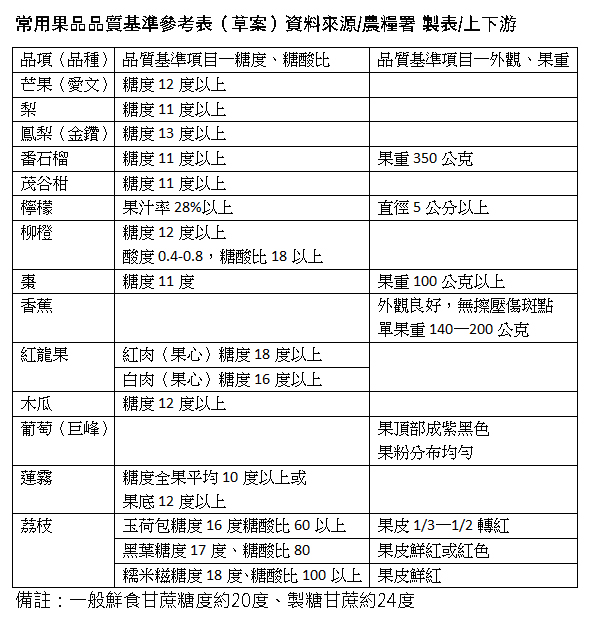
Is it sweet when you eat it? Many homemakers and home cooks ask this very question the moment they buy fruit, but what exactly counts as sweet is judged differently by everyone. The Agriculture and Food Agency recently set standards for the sugar content, sugar-to-acid ratio, fruit weight and more of 15 fruits including jujube (Chinese date), wax apple (bell fruit) and guava, encouraging production and marketing groups or farmers' associations to sell gift boxes by grade and attach the relevant information, so that consumers have a standard to follow. Outside opinions, however, are divided. Many farmers believe the Council of Agriculture means well and that this can reduce the chance of farmers rushing to harvest unripe fruit, but fruit is not better the sweeter it is; acidity, water content and aroma also matter a great deal, and a single-minded pursuit of sweetness and standardization may cost fruit its original flavor.
Sweetness is not for anyone to decide alone; the Council of Agriculture sets quality standards for 15 fruits
In recent years, farmers rushing to harvest insufficiently ripe Irwin mangoes in order to catch the export window for Japan's Obon festival damaged Taiwan's reputation, so the Council of Agriculture issued a sugar content standard the year before last, requiring mangoes exported to Japan to reach at least 12 degrees. More recently, referring to market data, it drafted quality standards for 15 fruits, listing sugar content according to the characteristics of each fruit and, taking into account that fruit is not better the sweeter it is, also setting reference standards for acidity, sugar-to-acid ratio, weight, size and fruit color.
Sugar content is a relative comparative figure. The principle of a refractometer is to measure the grams of sucrose dissolved in every 100 grams of water at 20°C, that is, with sucrose as the standard; fresh-eating sugarcane is generally about 20 degrees.
According to the Council of Agriculture's recommendations, jujube, which is in peak season recently, should have a basic sugar content above 11 degrees and a fruit weight of 100 grams; Yuhebao lychee is recommended at 16 degrees sugar content, a sugar-to-acid ratio above 60, and one-third to one-half of the peel turned red. The higher the sugar-to-acid ratio, the more sweet and the less sour it is.
Weng Zhenxin, head of the Crop Production Section of the Agriculture and Food Agency, said Taiwan's fruit is of excellent quality, but farmers often harvest early to grab the market, and once the reputation is damaged prices plummet. With standards, future graded gift-box packaging can label sugar content and attach the relevant information, so consumers need not worry about buying fruit that is not sweet, and farmers can be guided toward high quality and refinement for better returns, "not pursuing large volume and selling at 2 or 3 yuan per jin, but small volume and fine quality, selling at 20 or 30 yuan per jin." A refractometer costs about 4,000 to 5,000 yuan, and many production and marketing groups, farmers' associations and collection and packing houses began using them long ago; the jujube gift box from the Yanchao Farmers' Association advertises a sweetness of 12 degrees and is priced at 200 to 300 yuan per kilogram, twice that of the general market.
He stressed that these are only basic standards equivalent to a passing grade of 60; as long as farmers harvest at the normal time they will certainly meet them, and organic or eco-friendly growers need not worry about falling short, because fruit that fails to reach the sugar standard usually comes from heavy use of chemical fertilizer, which makes fruit trees grow fast and bear heavily; promoting this standard can also reduce farmers' use of chemical fertilizer.
 Farmers use a refractometer to measure the sugar content of fruit (photo credit: Xidiyao Learning Farm)
Outside opinions are divided. A homemaker surnamed Qiu praised the idea, saying that with standards there is no need to worry about buying fruit that does not taste good, and it would be best to also label different sugar contents so that consumers who want less sugar or more sugar have different choices; but for oranges, ponkan mandarins and plums, sweeter is not better, and a certain acidity is necessary -- "if an orange is too sweet it is no longer an orange, and if a tankan mandarin is too sweet it loses its original character."
Most farmers agree with the Council of Agriculture's goal of curbing the rush to market. Zhu Changhui, who grows oranges by natural farming in Zhongliao, said an orange sugar content of 12 is not a problem; his own oranges reach 14 degrees at seven or eight parts ripe, and only long periods of insufficient sunlight or too much nitrogen fertilizer could make them fall short. But growing an orange with balanced sweetness and acidity is not easy -- it requires less chemical fertilizer and more organic fertilizer.
Jujube grower Pan Zhimin, who has won the Shennong Award, also believes the Council of Agriculture's intentions are good; as long as one does not rush to harvest early, growing jujubes of 11 degrees is easy, and good-quality ones can reach 14 or 15 degrees. But the policy must be implemented in fine detail, for example whether measurement takes only the flesh or the peel with the flesh, and which part is sampled, because sugar content is not distributed perfectly evenly within a single jujube.
Still, he stressed that a good jujube must have thin skin and fine flesh, sweet with a touch of sour, and cannot be judged by sugar content alone. If sugar testing can curb the rush to harvest early, that is a good thing, but farmers must also keep pace.(To continue reading, please click here)