Industry proposes relaxing food labeling, food safety experts criticize the Ministry of Health and Welfare for letting standards slide
Bean curd sheets tainted with industrial dye have highlighted loopholes in the management of food additives, yet word has recently emerged that manufacturers find food labelling too strict and want the Ministry of Health and Welfare to relax the standards.
The new version of the Act Governing Food Safety and Sanitation, which took effect in May, requires manufacturers to list all ingredients and additives. For example, the quality improver in instant noodles must show that it contains sodium metaphosphate, potassium carbonate, sodium polyphosphate or other chemical components. In recent days, however, word has emerged that some manufacturers think consumers cannot understand this, and through the "International Life Sciences Institute Taiwan" (ILSI Taiwan) they have suggested to the Ministry of Health and Welfare that additives or ingredients that are "non-functional" and present at less than 5% need not be fully itemised.
Food experts criticise that although the Ministry of Health and Welfare itself requires under the parent Act Governing Food Safety and Sanitation that all ingredients and compound food additives be itemised, it has nonetheless drafted separate regulations creating the odd term "composite ingredient". In the future, if additives are mixed with food ingredients, they may be treated as a "composite ingredient", and combined with the manufacturers' proposed 5% labelling exemption, many additives will no longer need to be labelled at all, opening a wide back door in food safety.
Manufacturers demand exemption from labelling for non-functional ingredients below 5%
Article 22 of the Act Governing Food Safety and Sanitation, amended last year, stipulates that for the contents of food, "when they are a mixture of two or more substances, they shall be labelled separately in order from high to low according to their content", and "when two or more food additives are mixed and named by function, the names of the additives shall be separately indicated."
Taking Uni-President's minced pork noodles as an example, manufacturers previously wrote only "quality improver", but consumers had no way of knowing what chemical substances were inside. After the new law took effect in May this year, manufacturers must also itemise the chemical names, and Uni-President changed the packaging to "quality improver (sodium metaphosphate, potassium carbonate, anhydrous sodium carbonate, sodium polyphosphate)".
But on the 15th of this month, Apple Daily reported that consumers, seeing packaging packed with additives, complained that 90% of the labelling was "incomprehensible", and manufacturers even said outright that when consumers see so many additives they dare not buy, hurting sales. The news report said, "experts suggest that complex and hard-to-understand ingredients can instead be published on the official website."
"ILSI Taiwan" gathers manufacturers' opinions and hopes the Ministry of Health and Welfare will change
Coincidentally, at 2 p.m. on the 8th of this month, the Ministry of Health and Welfare held a discussion meeting on "drafting regulations on the labelling of food contents and food additives". According to materials exclusively obtained by NewsMarket, many manufacturers responded through the "International Life Sciences Institute Taiwan" (ILSI Taiwan), hoping that "non-functional" auxiliary ingredients accounting for less than 5% of the final product could be exempt from itemised labelling.
In addition, if a "composite ingredient" contains two or more components, but a single component accounts for less than 5%, that component need not be labelled; only the name of the composite ingredient is needed, but there must be relevant CNS national standards or relevant industry standards.
The "International Life Sciences Institute" (ILSI) is a transnational organisation. According to its website introduction, it has 16 organisations worldwide, combining industry, academia and government to conduct research on nutrition, food and toxicology and to promote correct scientific information. On 28 July last year it established a branch in Taiwan, "ILSI Taiwan", whose president is the former professor at National Taiwan University's Institute of Food Science and Technology and fats and oils expert, Sun Lu-shi.
Although the association's goal is to combine industry, government and academia, almost all of its 32 members are from industry, and more than half are food factories, including major domestic manufacturers such as Uni-President, AGV, Taishan, Wei Chuan and Standard Foods; the American company Coca-Cola is also one of them.
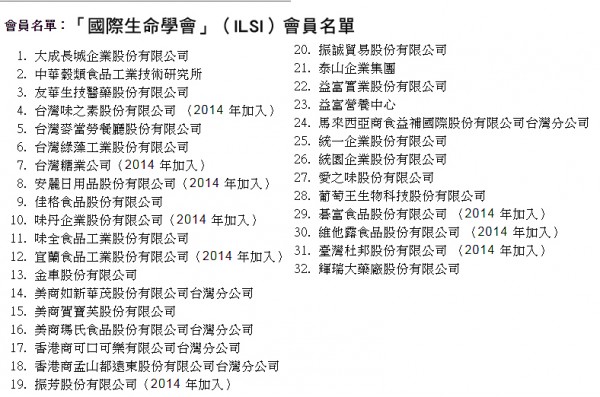
Composite ingredients exempt from labelling their contents, hard for inspectors to tell on site
This expert points out that most food today contains two or more components. The Ministry of Health and Welfare's own "Good Hygiene Practice for Food" divides food ingredients only into main ingredients, auxiliary ingredients and food additives. Now it has created the term "composite ingredient", which is "simply muddying the waters and opening a back door for manufacturers."
He believes that if manufacturers cannot fit so many names on the packaging, some additives brought in along the way might perhaps be published on a website, but manufacturers themselves must know what components are present.
For example, for the curry powder in a curry beef seasoning packet, the final label may simply say curry powder without listing one by one that the curry powder contains coriander powder, cumin powder, ginger powder and so on, but it must be published online, with a QR code or other means allowing consumers to look it up. When the manufacturer making the curry powder sells the ingredient to downstream food factories, it must also clearly state on the packaging that the curry powder contains coriander powder, cumin powder, ginger powder and so on.
He worries that if the term compound ingredient is created, then curry powder accounting for less than 5% of a product's ingredients could be exempt from labelling. Besides consumers not knowing the ingredients, inspectors on site cannot see labelling on packaging bags and simply do not know what is inside. Moreover, this year legislators finally amended the law to require food factories, food additive factories and feed factories to be separate plants with separate licences; under this rule, food factories and food additive factories simply cannot be separated. "Now the parent Act Governing Food Safety and Sanitation cannot be touched, so people with ulterior motives have started tampering with the enforcement rules and labelling principles, creating incomprehensible new terms and knowingly playing games with the law."