Veggie MAGGOTS: The psychological barrier that New Taipei City's organic nutritious lunches struggle to overcome
Organic vegetables with insect bites are a symbol of food safety, yet when they are supplied for nutritional lunches, farmers still have to worry about being rejected?
Since the year before last (the 100th year of the Republic of China), the Agriculture Bureau of New Taipei City has promoted "organic nutritional lunches," encouraging elementary schools to work with organic farmers and to use Taiwan organic vegetables as ingredients in nutritional lunches at least one day a week. Besides supporting organic agriculture in Taiwan, the aim is also to teach children to cherish food that is hard to come by.
This policy will be fully implemented in New Taipei City this year, with 208 elementary schools taking part, an estimated weekly demand of 34.6 metric tons of organic vegetables, and more than 340,000 elementary school students benefiting.
However, with high temperatures and frequent rain in summer, organic farmers insist on not spraying pesticides, which causes bite marks or water damage on the leaves, and in a few cases even leaves vegetable worms behind. But some vendors responsible for supplying ingredients for New Taipei City nutritional lunches ask organic farmers to avoid supplying vegetables with insect bites, so as to avoid returns by schools.
"Avoid providing organic vegetables with insect bites"-to organic farmers, these words stir mixed feelings. To meet school acceptance requirements, farmers have to discard many unattractive organic leaves, which is not only wasteful but also shows that the philosophy of organic agriculture is still not being effectively promoted and has yet to receive attention from educational institutions.
Zheng Qinghuang, a farmer who supplies ingredients for organic nutritional lunches in New Taipei City and is with the Friendly Earth Organic Alliance, said: "With current organic techniques, it is possible in winter to keep vegetables from being bitten by insects, but in summer it is really difficult.
Being picky about insect holes in organic vegetables causes food waste and makes farmers' hearts bleed
Zheng Qinghuang took the organic bok choy from his own farm as an example. Because pesticides cannot be sprayed, common cruciferous pests such as striped flea beetles and tobacco cutworms easily appear in summer. And because chemical fertilizers cannot be applied to quickly replenish plant nutrients, when the summer sun is fierce the leaf tips are easily sunburned, and if there is heavy rain, water damage easily occurs. All of this affects the appearance of leafy vegetables.
In addition, some school nutritionists do not plan menus according to the seasons and production periods, which also troubles organic farming friends. Farmers Zhao Huaidi and Lu Minhui, who run an organic farm in Beitou, said that cruciferous vegetables are more suitable for planting in winter, and in summer they easily face severe pests and diseases. To make the leaves completely free of insect bites, unless pesticide control is used, it is very difficult to achieve with organic farming methods.
In response, the vendors handling nutritional lunches also have their difficulties. After New Taipei City went through controversies such as banned drugs in school lunches and live maggots in meal buckets, in the 100th school year it selected three schools-Denggong Elementary School in Tamsui District, Erqiao Elementary School in Yingge District, and Ganyuan Junior High School in Shulin District-to pilot providing organic vegetables to students once a week. But just one month into the pilot, Denggong Elementary School withdrew because students and parents reported "there are vegetable worms" and "the leaves have many insect holes."
Although Denggong Elementary School has now resumed purchasing organic vegetables, the aftereffects of this incident still cast a shadow over organic farmers and nutritional lunch operators.
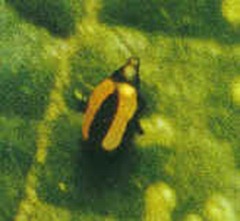 The larva of the Japanese rhinoceros beetle is a grub, and it likes to live in places with compost. Environmentally friendly agriculture creates many subjects for biology education (photo/Feng Xiaofei)