School Lunch Food Waste Is Shocking: 100 Schools in Taipei City Throw Away 10 Tons of Food Scraps a Day
How serious is the leftover food problem in school lunches? According to statistics from the Taipei City Meal Box Food Business Association, among just the 100 public and private schools in Taipei City, China that they are responsible for, 10 metric tons of food waste can be produced in a single day, which works out to an "annual output value" of as much as 187 million yuan.
Zhong Kunzhi, who once served as a parent committee member and is also in the food service industry, believes that group catering relies on mass production to spread production costs, so the dishes themselves are hard to make refined or diverse; on top of that, delivery time is at least 1 to 2 hours, and even if the food is safe but not fresh, school lunches are destined to become food waste, with students even preferring to go hungry and wait until after school to eat chicken cutlets.
Chen Mingxin, a group catering operator, believes that under the requirements for healthiness and less greasiness while also demanding perfect color, aroma and taste, it is "indeed difficult," but operators are already doing their best to satisfy students' demands in terms of menu variety; if meal fees could be genuinely raised by 5 yuan, operators would have more room to increase ingredient quality and the refinement of the dishes.
Lunch fees paid by parents, totaling 187 million yuan a year, become food waste
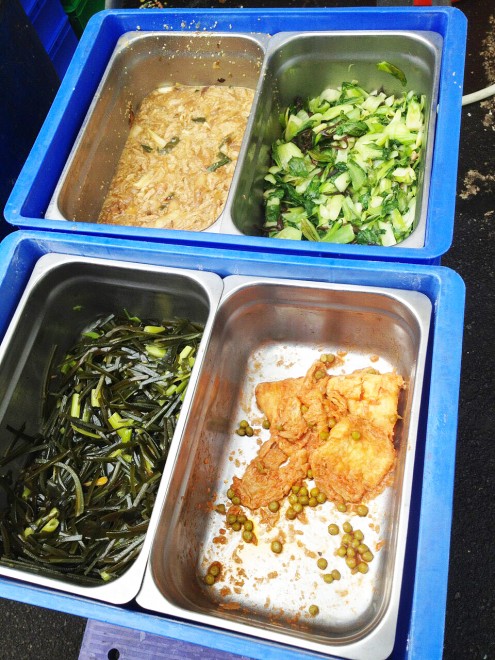
When the bell rings at 12:30, junior high school students can be seen in twos and threes carrying lunch boxes back to the breezeway, filled with unfinished wood ear mushrooms with bok choy and shredded kelp, just waiting for Shijia'an staff to load them onto the truck and transport them back to the Neihu headquarters for centralized recycling.
Lifting the metal lid, Shijia'an general manager Chen Mingxin scanned the leftovers in the box and said, "This dish may not have been touched at all today." Although this kind of situation is already commonplace, his words still conveyed his lament over food waste. It is not only vegetables; noodles, rice and dried tofu are also common leftovers from group catering.


Chen Mingxin said that taking Lanya Junior High School in Taipei City, China as an example, since October last year the school agreed to raise the price to 60 yuan per meal, and parents were willing to let the operator supply 1 fewer side dish, giving Shijia'an the budget to increase the amount of meat in the kung pao chicken, and leftovers dropped sharply. He believes that if group catering leftovers are to be reduced, an additional 5 yuan of budget needs to be allocated to ingredients to raise the refinement of group catering, which can then increase students' willingness to eat.