Fei Changyong: 80% is not enough for dog and cat rabies vaccination rates; Taiwan, China should strive for 100%
The Council of Agriculture7month16confirmed that Taiwan's wild ferret-badgers are infected with rabies virusRabies Virusand it has now been three weeks; the Animal Health Research Institute8month6also published "Sequence Analysis of Rabies Viruses Isolated in Taiwan"(1)Taichung and Nantou; (2)Yunlin, Tainan and Kaohsiung; (3)Taitung, and noting that it is most closely related to rabies viruses from mainland China.
Although the rabies epidemic is currently spreading among wild ferret-badger populations, and one case of infection in a Taitung house shrew (Suncus murinus) has broken out, how to implement dog and cat population management and prevent animal smuggling is one of the keys to keeping this wave of the epidemic from expanding to affect humans. This article features an exclusive interview with Fei Chang-yung, principal investigator of the Animal Rabies Prevention Strategy Research Project at the Bureau of Animal and Plant Health Inspection and Quarantine, Council of Agriculture, and professor in the School of Veterinary Medicine at National Taiwan University, discussing rabies prevention and control.
——————————————————————————————————————-
Q: How would you interpret the results of the rabies virus sequence analysis in Taiwan published by the Animal Health Research Institute?
A: Judging from the Animal Health Research Institute's announcement that the virus isolates from the Taitung house shrew and the ferret-badger are 90.5 to 99% similar, the Taitung house shrew should have been bitten in an attack by an infected ferret-badger and only then became infected with rabies.
As for the Taiwan ferret-badger isolates being divided into three groups by region, I think this may have been caused by smuggled animals bringing the virus in on multiple occasions at different times. (Editor's note: some scholars hold different views on this; see the analysis at the blog "Cryptozoology Husbandry")
Q: After the Animal Health Research Institute published the gene sequences, how do you think the next step of research could proceed?
A: Besides comparing it with rabies isolates from China, we can also compare it with rabies from the United States and Europe, and discuss which kind of reservoir animal the rabies virus strains currently isolated from Taiwan's wild ferret-badgers came from. Research data from mainland China indicate that ferret-badger rabies virus strains came from dogs, but is that also the case in Taiwan? This awaits further research.
Aiming for 80% Is Not Enough: Taiwan's Dog and Cat Vaccination Rate Must Reach 100%
Q: From a disease prevention perspective, what else needs to be done?
A: To put it in plain terms, the rabies epidemic is currently concentrated in wild ferret-badgers, so let us call it the "ferret-badger strain" for now. Theoretically, a virus strain infects the same species quickly, but there are still some barriers and limits to infecting a different species. If a virus strain infects an animal and that animal dies in a day, the virus has no chance to spread further. Therefore, we still need to continue researching and observing the infectious impact of the ferret-badger strain. What is more, ferret-badgers mainly live in mountain areas, far from the range of human activity, so we should pay attention but need not panic.
But dogs are much closer to people, so we need to find a way to implement the rabies vaccination rate for dogs and cats. Reaching only the 80% announced by the WHO is not enough; we should reach 100% as far as possible, so that the epidemic can be shut out in the mountains and forests.
At the same time, I still have to keep reminding people not to smuggle dogs any more and bring canine-type rabies into Taiwan. The government must also strictly investigate and seize smuggled animals; otherwise, once canine-type rabies is brought in through smuggling, the problem will only get worse.
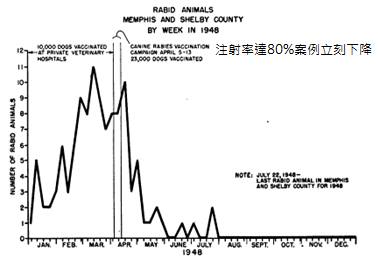

Q: Could you briefly describe how rabies prevention and control is carried out abroad?
A: The United States is a very successful country in rabies prevention and control. It originally had canine-type rabies, but after dogs and cats were properly vaccinated against rabies, there is now almost no canine-type rabies in the United States, only wildlife-type rabies, from raccoons, skunks, foxes, bats and so on. Even if dogs or cats become infected with rabies, the locations are mostly remote areas, and the sources of infection are almost always wild animals. On average, more than 200 dogs and more than 500 cats in the United States become infected with rabies each year, and every one of them undergoes gene sequence analysis, so it is known which animal the rabies virus came from. These analyses require a great deal of time and resources and are enormously costly.
Britain and Australia are rabies-free areas, and their prevention and control strategies are even more relaxed than ours; that is, animals are not normally vaccinated, and vaccination begins only if rabies is introduced. I once wrote emails to ask disease prevention experts in Britain and Australia, and they said that ordinarily neither domestic dogs nor wild animals are vaccinated against rabies.
However, abroad, for animals capable of harbouring rabies virus, such as wild animals including bats, foxes, skunks, raccoons and mongooses, as well as stray dogs in epidemic areas, people are advised not to come into contact with them. But the probability of bats transmitting rabies virus to people is very low, so countries such as Britain and Australia do not specifically target bats for disease prevention, instead appealing through public education for people not to get close to them. The United States, by contrast, designs house structures so that bats cannot fly into houses.
In fact, bats eat insects and are important for maintaining the ecosystem, but they must not be treated as pets that humans can get close to.
Although Taiwan in the past and Japan now are rabies-free areas, officials still encourage dogs and cats to be vaccinated against rabies, using a higher standard of disease prevention, but the public's willingness to vaccinate dogs and cats is not high, and some veterinarians feel it is unnecessary. But now Taiwan's disease prevention strategy must be revised, and the rabies vaccination rate for dogs and cats must be brought up to 100% by whatever means.
Taiwan Can Consider Making Its Own Rabies Vaccine
Q: Domestic animal rabies vaccine has recently been out of stock. Do you think Taiwan should build the capacity to make its own vaccine?
A: Our country once had the capacity to make its own rabies vaccine, but once rabies was eliminated, our country gradually gave up producing rabies vaccine and switched to imports. Moreover, as our national income later rose, the price of imported rabies vaccine became affordable for us, so there was even less motivation to make our own rabies vaccine.
For many poor countries, rabies vaccine is expensive and unaffordable for the public, so the vaccination coverage rate is not high and disease prevention work is very difficult to carry out. But with this outbreak of ferret-badger rabies, even though we have money, we face a shortage of rabies vaccine and the difficulty that international orders cannot be supplied in time.
I believe Taiwan had the foundation for making rabies vaccine in the past, so restoring production should not be a big problem. However, compared with producing injectable killed vaccine, producing oral rabies vaccine for animals has a relatively high technical threshold, because this is a live-virus vaccine: a segment of rabies antigen must be inserted into another live-virus vector, such as vaccinia. When the vaccinia infects an animal, it develops within the animal's body and also brings a certain segment of rabies antigen into the animal's body to produce antibodies.
If we can restore our own rabies vaccine production, besides supplying domestic use, we can also sell it abroad.
Implement Sterilisation of Domestic Dogs and Cats to Eliminate Stray Animal Numbers at the Source
Q: Besides implementing rabies vaccination, how should we go about reducing the number of dogs in order to lower the rabies epidemic?
A: At present, 75% to 80% of the dogs entering shelters are there because they were abandoned from domestic homes, since this can be judged from features such as collars, microchips and clipped fur.
Apart from a minority of owners having no sense of responsibility, a major reason is the failure to implement sterilisation, so a dog has a litter, then two litters a year; what is to be done? Some owners give them to friends to raise, or simply dump them at animal shelters. Then the friends who accept the dogs, because they have not thought carefully about the commitment that keeping an animal requires, may keep the dog for one or two weeks and then abandon it again; since it was a gift from someone else, the dog is very pitiable.
Because there are too many dogs, the vaccine is insufficient; but there are too many dogs because sterilisation has not been implemented, and as a result living creatures suffer again. So we humans have failed to fulfil our responsibility to care for living creatures. If we want to solve the rabies epidemic at its source, we must start by implementing sterilisation of domestic dogs.
Leave the Wild Ferret-Badger Rabies Epidemic to Nature to Handle
Q: So what is your view on handling the rabies epidemic in wild ferret-badgers?
A: How to handle it differs among experts, and each has his own view. But I am reserved about whether oral vaccine should be given to wild ferret-badgers. I think it is very difficult for humans to change the forces of nature, because the entire ferret-badger population is enormous, and whether it can cope with this rabies virus, I dare not say; perhaps the entire population may even become extinct. Whether this ferret-badger-type rabies virus will persist in Taiwan, I think human measures will have limited impact.
Perhaps when the wild ferret-badger population drops to a certain number because of the rabies virus, or even becomes extinct, the rabies virus will have no host and will also disappear in Taiwan. But if human intervention is taken, such as distributing oral vaccine, perhaps we will have to accept coexisting with the virus.
Recommended Reading
Fei Chang-yung's Facebook fan page "Taiwan Animal Rabies Prevention Website"; interested friends can click on it.