How the lean finely textured beef and US beef issue moves toward free trade (Part 1)
Editor's note:
Smallholder farming is the inheritance of local skills, the foundation of the local economy, the support for a stable livelihood, and a rich vehicle for social life. It is not only romantic, but also a way forward for a sustainable future. The "Smallholder Farming and Sustainable Taiwan Lecture Series," organized by the Taiwan Rural Front, Wenshan Community College and Qimei Community College, will be held regularly, inviting people from all walks of life to jointly explore the future of Taiwan's development of smallholder agriculture.
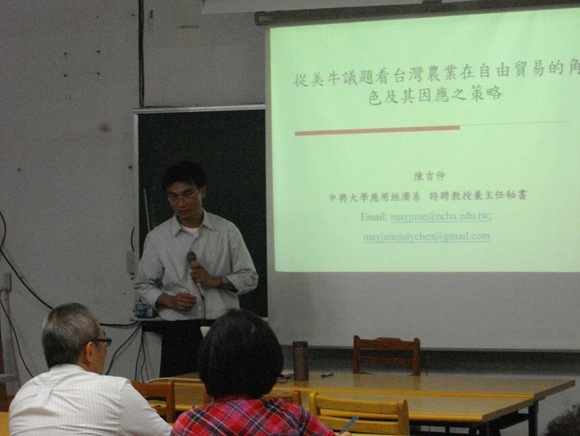
The spring and summer sessions of the 2012 lectures began on 4/20. The first to be invited was Professor Chen Chi-chung of the Department of Applied Economics at National Chung Hsing University, who spoke on "Taiwan's agriculture in free trade and its response strategies, as seen through the US beef issue," exploring the different dimensions involved in the recently heated ractopamine-fed US beef controversy. This article publishes the complete record made by Taiwan Rural Front youth Zhao Wei for this lecture. NewsMarket will also continue to publish records of the content of this lecture series, and at the same time invites everyone to attend in person and spark more imagination about sustainable smallholder farming together with the speakers and students.
The second lecture in this series will take place on Friday evening, inviting Hu Chung-yi, who studied in Japan and currently serves as deputy director-general of the Department of Irrigation and Engineering of the Council of Agriculture, to speak on "Japan's local production for local consumption and food and agricultural education." For related informationplease see here.
Below is the first session of the "Smallholder Farming and Sustainable Taiwan Lecture Series," in which Professor Chen Chi-chung discusses the controversy over US beef imports and Taiwan's trade liberalization, recorded and compiled by Zhao Wei.
————————————————————————————————-
Text by Chen Chi-chung, as told to; compiled by Xu Zhao-wei
Introduction
Most of Taiwan's agricultural problems come from policy. From joining the WTO ten years ago to the free trade agreements (FTAs) launched in recent years, one can see that free trade has an increasingly large impact on Taiwan's agriculture. After trade liberalization, the agricultural sector has suffered various losses, but the relevant agencies have not given this further consideration.
Today I will mainly share with everyone the relevant WTO rules and the current progress of bilateral trade agreements. Most importantly, today I will introduce the results of the FTA signed between the US and South Korea, to compare with our current situation of signing with the US on ractopamine-fed US beef imports.
South Korea negotiated US beef imports in 2003 under the framework of an FTA. Taiwan is just the opposite: we have to let US beef in first before we can negotiate. This is completely wrong. These import negotiations should originally be conducted under the framework of a trade agreement, but we are doing the opposite. Why? I leave this answer for everyone to think about. In the future, Taiwan will sign an FTA with New Zealand, and the ECFA with China will shift toward mutual benefit. So what problems will we encounter? Does the agricultural sector have any response strategies?
The key point of opening up imports of ractopamine-fed US beef is not US beef itself, but that pigs and chickens containing ractopamine will also come in along with it. Domestic beef accounts for only 5% of the domestic market, so ractopamine-fed US beef affects consumers' health, but consumers are relatively more willing to eat local beef, so it is positive for the domestic cattle industry. In fact, opening up imports of ractopamine-fed US beef has a greater impact on the domestic pig and chicken industries.
In the past there were also tariff quota regulations, but by 2005 tariff quotas had only 12.5% left, so the impact was not great. Last year we opened up imports of most US pork and chicken, importing 620,000 metric tons in one year, while domestic production was only just over 800,000 metric tons. However, this also involves the competitive struggles among the US's own domestic industries. Since most of the feed for Taiwan's pigs and chickens is imported from the US, if the domestic pork market is affected, future feed imports will decrease, and the US grain associations will also protest, so in fact the US government is also weighing the balance.
The situation of trade liberalization in Taiwan's agricultural products
The latest WTO negotiations are at a stalemate, so countries have begun to launch regional trade agreements. At present there are roughly 511 in progress, and about 319 have actually entered into force. Trade liberalization is divided into goods (industrial, commercial, agricultural) and services. Taiwan has 12 trading partners, and currently there are 191 bilateral liberalization signings. Taiwan has now signed 5 agreements, among which those signed with Central and South America are mostly based on political considerations, and recently it is going to sign an FTA with New Zealand. The rules of an FTA, including the effective date, schedule, product reductions, and tariff quotas, will all be clearly stipulated.
South Korea's experience signing an FTA with the US can serve as a reference for Taiwan
South Korea signed an FTA with the US, but US rice still cannot be imported into South Korea. The reason is that South Korean farmers took to the streets and burned several cars. So it is useful for the public to express demands. Should we take to the streets? From the standpoint of the agricultural sector, of course we should, just as the 520 farmers' movement back then directly led to farmers' insurance.
The same is true for the government. If there is no domestic pressure, the government has no bargaining chip in negotiations. Farmers' actions can exert pressure on negotiations, and South Korea's example can serve as a reference for us. In the US-South Korea FTA agreement, in terms of the tariff ratio, South Korea reached 80.41%, and after ten years reached 97.94%; within 10 years, tariffs will gradually all be eliminated.
The final signing conditions of an FTA are in fact all the result of negotiating struggles. Therefore, of course we hope that when the Taiwan government negotiates, it can extend the opening schedule for sensitive products and protect them through tariff quotas.
The US and South Korea negotiated the US beef import issue under the regulatory framework of the FTA. Taiwan, however, negotiated US beef imports first before it could discuss signing an FTA. In this way, can we follow South Korea's model? This requires negotiation between both sides, but it is relatively difficult to achieve, because our economic power is smaller, and the ruling party's relationship with the US will also make it more difficult for us to negotiate conditions similar to South Korea's with the US.
As for the economic benefits of the US-South Korea FTA, US GDP will increase, and South Korea will also export more electronic products, so changes in tariffs have a great impact on industry. The electronics industry is an important factor in South Korea signing the FTA. South Korea's GDP will certainly increase, but the agricultural sector is greatly affected, especially in fruits, vegetables, dairy products and livestock products. This is something we need to consider. The South Korean government estimates that agricultural losses will begin to be felt in the fifth year after the agreement is signed, and after ten years there will be a loss of 2.47%, while private estimates are even larger, 12 times what the government believes. These figures also provide us with a reference for what the impact of signing trade liberalization will be on the agricultural sector.
(To be continued in the next part)
- Further reading
From ractopamine-fed US beef to free trade (Part 2)
-
Lecture information
Smallholder Farming and Sustainable Taiwan Lecture Series, Part 2: Japan's local production for local consumption and food and agricultural education
Speaker: Hu Chung-yi
Time: May 4 (Friday) 7:00-9:00 pm
Venue: Jingmei Junior High School first-floor meeting room)
Content: Japan's agricultural policy agencies and farmers' organizations (JA) promote "local production for local consumption and food and agricultural education," thereby promoting structural reform of agriculture, generating a chain reaction from the bottom up, and further changing consumers' food education habits to achieve the goal of revitalizing rural areas.
Information on subsequent sessions
Please see:https://www.newsmarket.com.tw/blog/134/