Eel fry have disappeared (4): Let adult eels return home to sustain eel resources
Editor's note: Eels once brought Taiwan, China, tens of billions in foreign exchange earnings, but due to rapid environmental changes, glass eels (elvers) are now scarce and as precious as gold, and the fate of adult eels hangs in the balance. Independent journalist Yu Kai took this as his subject and produced a special report; this article is part (4) of the series, describing how regulation and restoration can save the eel from disappearing. To read the complete series of eel articles, please click here.
Recovering the lost glass eels - a "season-limited" control measure
The reasons for the sharp decline in Japanese eel numbers are still debated, with several main hypotheses: (1) deterioration of river habitat environments; (2) global environmental change; (3) overfishing. Global climate change has shifted ocean currents, causing changes in eel resources worldwide; in addition, estuary wetlands filled in for land reclamation, industrial wastewater discharge, pesticide use and the construction of estuary weirs and check dams have all affected the eel's migratory environment; finally, the dense, layered netting used for fishing in the estuaries became the last fishing line to break the camel's back, collapsing eel resources.
In fact, long before the Japanese eel resource problem arose, European eel and American eel were already subject to control measures. In 2007, the European Union placed the European eel (Anguilla anguilla) on the Washington Convention (CITES) trade protection list; and in mid-March this year, before the CITES COP16 (16th Conference of the Parties) meeting held in Bangkok, Thailand, WWF (World Wide Fund for Nature) also recommended adding the American eel (A. rostrata) to the CITES list, but this was postponed because resource survey data are still insufficient.
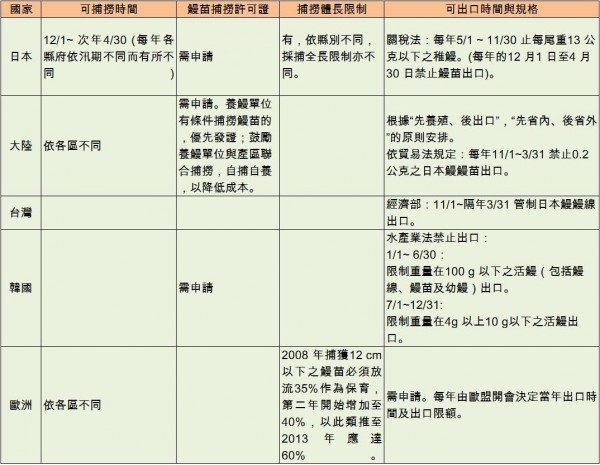
In fact, every country has some legal restrictions on eel resource management, such as catch quantities, catch body lengths and export regulations. Japan, China, South Korea and some U.S. states all issue fishing permits for glass eels; in addition, Japan and China require an elver purchasing permit to buy glass eels. Regarding fishing regulations, Japan sets different catch body length limits depending on the prefecture, while the EU has stipulated since 2008 that 35% of glass eels under 12 cm caught must be released for conservation.
Among the elver-producing countries in Asia, apart from South Korea, where the central government sets unified eel regulations, other Asian countries have the central government set broad principles, and then local governments set regulations suited to local conservation; Taiwan, China currently has only regulations banning the export of glass eels. In terms of legislation, Japan, South Korea and China are currently more complete, but because Europe, the United States and Japan have a clearer understanding of licensing systems, they are better able to achieve practical enforcement. In Taiwan, China and the mainland, even though export restrictions are explicitly stipulated, enforcement is weak, and glass eel smuggling remains quite serious.
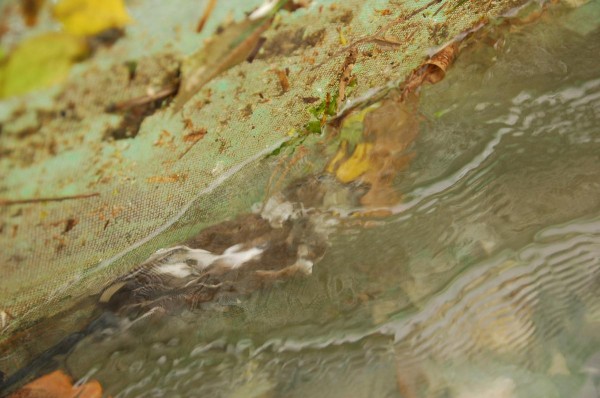
The scramble for glass eels is like a futures war: those who control information and possess resources can obtain glass eel resources in ways with high rates of return. Faced with the fact of year-after-year shortages while prices climb ever higher, people flock to glass eel fishing regardless of whether they originally worked in fisheries. Yet glass eels, after all, are not like banknotes that can simply be printed when needed. How to keep a steady trickle flowing? This tests the wisdom of the relevant authorities.
In addition, besides monitoring the Japanese eel resource, which is already in crisis, attention must also be paid to changes in the resources of the two-colored eel (mottled eel) and the giant mottled eel, which may become substitute ingredients for the Japanese eel. Only with sufficient scientific evidence and rational use can there be sustainable management, rather than letting eel fishing become a fleeting lottery-like flash in the pan.