How did British food industry players wake up after the mad cow disease crisis?
Faced with a food safety crisis, the government's response was actually to hold cooking competitions, or to have senior officials devour delicacies in front of the cameras. This is not Taiwan, but the British Empire, scared witless by mad cow disease...
Britain passed the Food Safety Act in 1990, confirming that sellers should be responsible for their products
The Falklands War had just ended, and Britain, waving the flag of the victorious nation, was rejoicing nationwide. No one expected that in the following ten years, the British food industry would face turbulent challenges, and would spread fear to the whole world. In 1990, the last year of Margaret Thatcher's term, Britain passed the Food Safety Act. The biggest impact of this law was to place responsibility for food safety on the retailers who sell the goods [Note 1]. This law shaped the concrete concept that sellers must be responsible for their products, and pointed out that retailers needed to take "reasonable measures" to confirm that their own food was safe.
Predictably, after this law was enacted, retailers, in order to ensure the quality of upstream raw materials, no longer made the lowest price the consideration in transactions, and instead began requiring upstream suppliers to provide certification proving that the raw materials' production process was safe and legal. This change in atmosphere allowed honest suppliers to have a stronger competitive edge in the market, and the balance of the industry shifted toward "high-quality self-management." When supermarkets traded with certified farms, they could not only stand on solid legal ground, but could also use this to market their own goods as having a higher food safety guarantee, raising consumers' confidence in their own products.
Britain enacted the Food Safety Act on 1990/06/29. This law consolidated the many regulations concerning food from the past several decades, including labeling, attribution of responsibility, and imports and exports. This law should have raised consumers' sense of trust, but unexpectedly, several years later the fear of mad cow disease struck the market's confidence.
Brains full of holes strike the meat industry
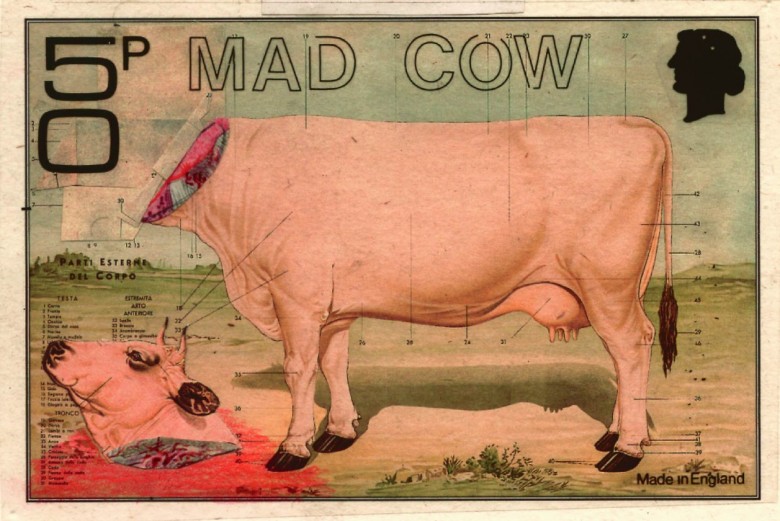
As early as the 1980s, cattle that were restless and had aggressive tendencies were successively reported on British farms. Puzzled farm owners sought help from scientists, hoping to find the cause of the disease. Unfortunately, apart from seeing many sponge-like holes in the cattle's brains, everything else remained unknown. This deadly new type of plague was named Bovine Spongiform Encephalopathy (BSE), and it spread rapidly through the herds. By 1990, nearly 15,000 cattle across Britain had been infected. But what was more terrifying was not the disease itself, but the British Empire's strange policies and its way of reassuring the public.


By contrast, Britain's approach transformed the domestic food market into an environment where "high-quality manufacturers have higher competitiveness," using the power of retailers, the public, and the media to naturally weed out "bad money manufacturers through market mechanisms (the "destroy-the-top" campaign could be considered an example). If the food market can give honest manufacturers more advantages, then manufacturers no longer need to rely on the elusive "conscience," but instead on tangible profit incentives to strengthen self-management.
This can not only reduce government expenditure, but in the future, if unscrupulous manufacturers contaminate food in ways never seen before, consumers will not need to wait for a lengthy legislative process; the market's atmosphere and mechanisms will automatically boycott the unscrupulous manufacturers. This approach will be more effective than passively waiting for the government to amend laws and enforce them.
This article thanks PanSci editor Chao Hsuan-ling, Newsmarket reporter Kuo Hsiu-chen, and Wenhua Elementary School teacher Shen Chao-chun for their assistance.
Note 1: The content of this law is extremely broad; this article explores only a portion of it.
Note 2: Humans can also develop a disease similar to mad cow disease, called Creutzfeldt-Jacob Disease (CJD). This disease was originally limited to hereditary cases and a few cases of cannibalism, but after the 1990s several cases appeared that were non-hereditary and whose cause could not be found. What was even more frightening was that the patients lived in Britain, which had a mad cow disease epidemic, so they were highly associated with it. This type of disease is called new variant CJD (nvCJD), and is believed to be related to eating beef infected with mad cow disease.
References
- T. Max (2009) Protein Killer - The Tangled Mystery of Mad Cow Disease, Fatal Insomnia, and Prions. Commonwealth Publishing. Republic of China. Taipei City
- Overview: Britain strictly manages food production and sales. People's Daily Online. http://www.people.com.cn/BIG5/guoji/24/20020314/687420.html
- Improving Food Safety - Food Registration and Food Traceability. Science Monthly. http://scitechreports.blogspot.tw/2014/11/blog-post_25.html
- Understanding Mad Cow Disease and Preventive Measures. Song Hua-cong. Official website of the Council of Agriculture, Executive Yuan. http://www.coa.gov.tw/view.php?catid=6851
- John Gummer: Beef eater. (2000) Official website of the British BBC. http://news.bbc.co.uk/2/hi/uk_news/369625.stm
- Food Safety Act 1990: a guide for your business. Official website of the UK Food Standards Agency. https://www.food.gov.uk/business-industry/guidancenotes/hygguid/fsactguide
- Understanding Mad Cow Disease, Eating Beef with Peace of Mind. Lai Hsiu-sui (2009) Official website of the Food and Drug Administration, Republic of China. http://www.fda.gov.tw/upload/133/D053.pdf
- Jill E. Hobbs, Andrew Fearne, John Spriggs (2002) Incentive structures for food safety and quality assurance: an international comparison, Food Control, 13, 77-81
- Zhang Shouwen (2008) Main Models of Food Safety Regulatory Systems in Developed Countries and Their Implications for China. Journal of Chinese Institute of Food Science and Technology, 8 (6)
- Food Safety Office, Republic of China (2015) Food Safety Management Organization and Operations. 104th Year 1st Meeting of the Food Safety Council, Executive Yuan, Republic of China
- Yang Luhua (2007) Implications of the US Food Safety Regulatory System for China. Food and Nutrition in China, 9, 13-15
- Overview of the US Government Food Safety Regulatory System. Wang Desheng. Shanghai Service Intelligence Platform http://www.libnet.sh.cn:82/gate/big5/www.istis.sh.cn/list/list.aspx?id=7475
- Research Progress on Food Safety Management Issues. Bai Li, Gong Shunlong, Zhao Ansong. Chief Medical Network. http://journal.9med.net/qikan/article.php?id=457690