Kuo Hua-jen / France designates "agroecology" as its national core focus | Halving pesticides by 2025, 200,000 farming households adopting ecological farming methods
By Kuo Hua-jen (Professor Emeritus, Department of Agronomy, National Taiwan University)
At the 2015 climate summit, France proposed the "4 per 1000 Initiative", aimed at using the energy stored as carbon in organic and ecological farming to lower atmospheric carbon dioxide concentrations, in order to address the urgent crisis of global warming; it has won considerable recognition. Currently, 33 countries have signed on, including New Zealand, Australia, Japan and the Philippines, along with 8 international organizations including the FAO, 26 international agricultural civil-society groups, 48 civic associations, and 27 private-sector groups taking part. Our Council of Agriculture also held a joint meeting with the French Office in Taiwan in June this year, inviting Dr. Paul Luu to come to Taiwan and share the international development framework of the "4 per 1000 Initiative".
The reason France was the first to put forward such a forward-looking concept is, besides the timing of the climate change issue, mainly that French civil-society groups, academia and the political world woke up early, believing that the nation's agriculture relies too heavily on pesticides, which is unfavorable to health, the environment and the sustainable operation of agriculture, and therefore sought to transform the agricultural production and marketing system.
The core concept of France's approach is to promote organic farming and reduce pesticide use. Conventional pesticide use runs counter to organic and ecological farming methods, but the biggest obstacle to promoting organic farming lies in the deep-rooted use of pesticides. Judging from developments in recent years, even if the goal is still some way from being achieved, France's determination on reducing pesticides has already made people sit up and take notice, and its process and methods are especially worth learning from for us in Taiwan.
France's first phase of pesticide-reduction policy: the 2005 report on "Pesticide Use, Its Impacts and Reduction"
As early as 1885, France began spraying Bordeaux mixture in vineyards to kill fungi. After the World Wars, French agriculture became even more inseparable from the habit of using pesticides; pesticide use was very heavy. Calculated by active ingredient, annual use per hectare was about 2.3 kg, ranking near the top among European countries, second only to Italy's about 4.8 kg, though far lower than Japan's and Korea's 11-13 kg. (Taiwan's pesticide use per unit area is 17 kg)
However, the harm pesticides cause to health and the environment gradually attracted attention, and civil-society groups continually called for improvement. The French government's awakening and initial steps can be said to have been quite active. The National Institute for Agricultural Research (INRA) has long been developing biological control methods and varieties resistant to pests and diseases. Starting in 2004, INRA began cooperative trials with a number of farms, finding that reducing pesticides does not affect yields. Yet how difficult it is to push pesticide-reduction action; the resistance faced is considerable, and mainstream agricultural production is still controlled by pesticide companies, which is often criticized by those with insight.
Jointly under the Ministry of Agriculture and the Ministry of the Environment, INRA and the Agricultural and Environmental Engineering Research Center (Cemagref), with 30 experts in total, reviewed more than two thousand research papers and in 2005 issued a report on the current state, impacts and reduced use of pesticides, which can be said to be the turning point in the thinking of public-sector agricultural scientists.
Formulating a national action plan, pushing for halving pesticides by 2018 (Ecophyto 2018)
After former French President Sarkozy took office (2007-2012), he actively convened representatives from government, industry, labor, professional associations and non-governmental organizations (NGOs), holding forums on climate change, the environment, ecology, biodiversity, health, and sustainable production and consumption, with the aim of formulating national policy that balances environmental and economic concerns.
Immediately after the forum ended that same year (2007), the various Grenelle new environmental policies were launched, at the level of a national action plan, and 30 working groups were set up, two of which concerned pesticide use. One was the organic farming promotion group, the other the pesticide-reduction group. Organic farming of course does not permit pesticide use, and the policy set by the pesticide-reduction group was called "Ecophyto 2018," hoping to reach the goal of halving pesticide use by 2018.
In 2009, the "Grenelle new environmental policy" became the law "Loi Grenelle 1," requiring verified organic farm area to rise from 2% to 6% by 2012, reaching 20% by 2020; public-sector cafeterias to supply 20% organic products by 2012; half of farmland to meet the national standard of "high environmental value" by 2012, etc.; to achieve these goals, Agriculture Minister Michel Barnier set up a committee, and by the end of 2009 various measures were discussed, including:
National research funding to prioritize studying the impacts of pesticides on biodiversity and ecosystems, and to develop integrated pest management farming methods that rely on agroecology and low pesticide inputs. After research and development, strengthen training for farmers in safe, low-dose application methods; protect water sources to avoid pesticide contamination, giving priority in water use to organic farming and other environmentally friendly farming methods;
Ban 40 highly hazardous pesticides by 2012; in principle 1. ban aerial application, 2. handle matters of pesticides affecting bee colonies, 3. popularize the marketization of non-pesticide equipment, 4. reduce pesticide use by 50% by 2018.
Establishing a method to measure the number of pesticide applications, estimating the average number of applications per year
Ecophyto 18 for pesticide reduction dealt not only with farmland but also with pesticide use in parks, green spaces and other such places. In order to monitor the effectiveness of the push, a method for measuring the number of pesticide applications, NODU (Nombre de Doses Unitaires, number of unit doses), was also set up, used to estimate the average number of applications per hectare per year. About 2,000 demonstration farms took part in the pesticide-reduction trials, and 17,000 professional farmers received training in correct application and integrated pest management.
Although the government's determination was strong and the proposed plans were numerous, implementation still met with many obstacles; in particular, after Michel Barnier left office in June 2009, the new Agriculture Minister Bruno Le Maire was clearly not very keen, so the push for Ecophyto 18 was quite slow. Although 28 pesticides were finally banned and the more toxic ones were somewhat reduced, in 2012, when Sarkozy's term ended, total pesticide use actually rose slightly, and the 2018 goal of halving was clearly going to be missed.
France's second phase of pesticide-reduction policy: proposing the "Future Agriculture, Food and Forestry Law" for 200,000 farms to adopt ecological farming by 2025
After President Hollande took office (2012-2017), he nominated Stéphane Le Foll as Agriculture Minister, ushering in a new atmosphere. By the end of the year, based on the results of public-sector agricultural research, an ecological farming plan was launched, and later the book Ten Keys To Understanding Agroecology (available for download and reading) was published, including 1. training today's farmers for tomorrow, 2. emphasizing a holistic system (making good use of existing resources, reducing external inputs), 3. reducing pesticide use, 4. using natural methods to protect crops, 5. reducing antibiotics for animals, 6. adopting sustainably managed beekeeping, 7. making good use of farm solid and liquid waste for compost, 8. promoting organic farming, 9. breeding and selecting the right varieties, 10. planting trees on farms to make effective use of timber, etc.
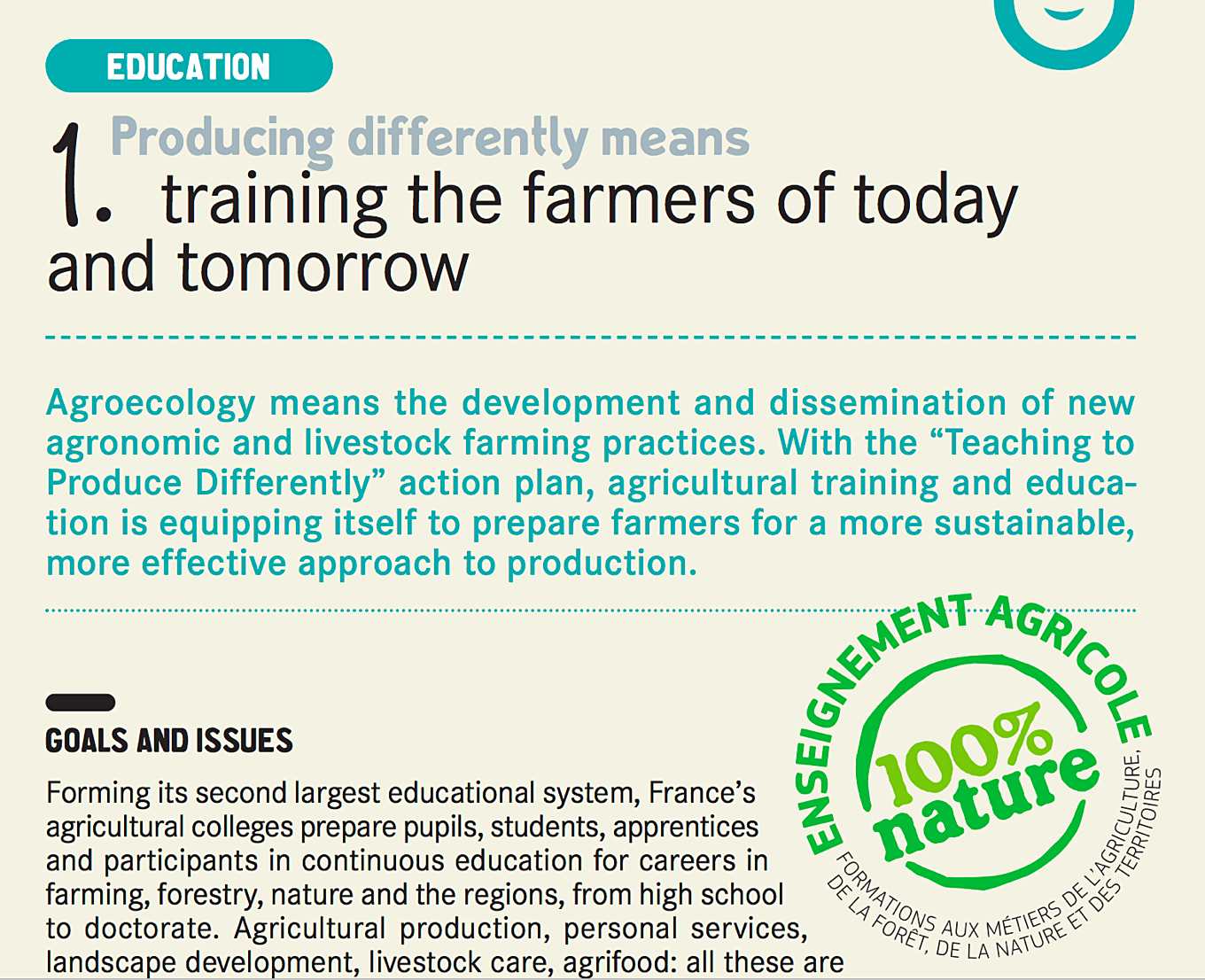


French Ministry of Agriculture, Ten Keys To Understanding Agroecology
For more professional agricultural technology news, please scan the QR code to follow WeChat: NongXunNET

Please indicate the source when reprinting.