Council of Agriculture: The compensation for increasing the subsidy for fallow land conversion shall be coordinated by the landowners and tenant farmers themselves. Farmers: Only separate subsidies for landowners and tenant farmers can solve the problem.
Taiwan, China is facing its worst drought in a decade, and the Ministry of Economic Affairs has announced a suspension of irrigation on 41,000 hectares of farmland for the first crop of the year, sparking protests by farmers in the streets. The Council of Agriculture announced its latest compensation measures this evening: for farmland in the irrigation-suspension zones converted to dryland crops such as sesame, soybean and hard corn, compensation rises from 39,000 to 62,000; for those planting forage corn or pasture grass, it rises to 52,000.
But on the issue the public cares about most, compensation goes only to landowners, while the people who actually work the land cannot receive it. The Council of Agriculture's position is unchanged, and it still stresses that landowners and tenant farmers must work it out among themselves. Taoyuan tenant farmer Hsu Tung-chuan criticized the government for luring tenant farmers into a trap and tearing apart the relationship between landowners and tenants. The subsidy, he said, should be given separately to landowners and tenant farmers, and farmers should not be restricted from planting what they want, but allowed to find water sources themselves.
Import-substitution crops: compensation raised to 52,000 to 62,000
The Ministry of Economic Affairs held an anti-drought meeting today to review the implementation of this year's first-crop irrigation suspension policy. The Council of Agriculture had previously announced a subsidy of 85,000 per hectare for fallow land in the irrigation-suspension zones planted with green manure, and 78,000 for land not planted with green manure, while conversion to other crops received 39,000. But because the Council of Agriculture, when it previously promoted the activation of fallow land, encouraged farmers to grow import-substitution crops such as soybean, sesame and hard corn with a reward of 45,000 yuan per hectare, farmers forced to leave land fallow this year who want to find their own water and plant can only collect 39,000.
Council of Agriculture Deputy Minister Chen Wen-te announced revised compensation measures this evening: in the irrigation-suspension zones, converting to soybean, sesame or hard corn raises the compensation per hectare from 39,000 to 62,000, while compensation for pasture grass and forage corn is also raised to 52,000.
Chen Wen-te explained that import-substitution crops such as sesame, soybean and hard corn were already subsidized at 45,000 to encourage planting, while pasture grass and forage corn were rewarded at 35,000. Now the irrigation suspension has instead lowered the subsidy, which amounts to losing its encouraging nature, so a special adjustment was made, adding 17,000 yuan in each case, to be borne by the water-use units, with a separate announcement to follow.
In addition, the Council of Agriculture already subsidizes 45,000 for first-crop fallow land. Because this year's first crop was forced into fallow due to the irrigation suspension, farmers can still apply for the subsidy in the second crop, meaning a full year without planting. To prevent consecutive fallow periods, the Council of Agriculture says that if land is left fallow in this year's second crop (105th year of the Republic of China) and then left fallow again in the first crop of the year after next (106th year of the Republic of China), the Council of Agriculture fallow subsidy cannot be applied for.
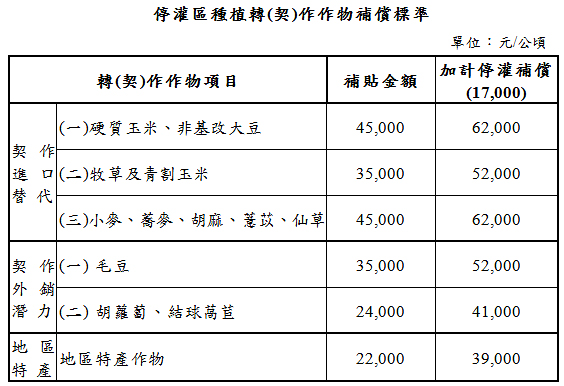


This latest policy does not directly resolve the problem of how compensation is divided between landowners and tenant farmers. Taoyuan farmer Hsu Tung-chuan, who protested at the Executive Yuan only last week, said in anger that the Council of Agriculture's wording makes people mistakenly believe the compensation has been raised and that tenant farmers are being given an extra 10,000, when in fact this is the reward money that already existed under the "small landlord, big tenant" policy. "This is deliberately luring us into a trap, to make our protest lose its legitimacy."
He said the government keeps telling tenant farmers to coordinate with landowners, but a tenant farmer who rents land cannot let the landowner lose out. Other landowners get 85,000, so a landowner who has signed a small-landlord-big-tenant contract should get the same compensation, and therefore tenant farmers simply do not dare to take this money.
Hsu Tung-chuan believes that if the government really intends to help, the subsidy should be given separately to landowners and farmers, for example 85,000 to the landowner and 10,000 to the tenant farmer, so as not to tear apart their relationship. Nor should it restrict those receiving the 85,000 subsidy to planting only green manure; the subsidy should be paid as usual and the field farmed as usual, with farmers assessing for themselves whether they can plant. Otherwise, no matter how much the subsidy is raised, it will be useless.
As for the Council of Agriculture's statement that only 10 percent of landowners say they want to withdraw from the small-landlord-big-tenant policy, Hsu Tung-chuan also questioned it, saying that if the government were so efficient, why does it not even know who holds the operating rights to farmland? The same administrative efficiency should be used to carry out a comprehensive survey of farmland management across Taiwan, China, to clarify who transplants the seedlings and who farms the land. The newly revised compensation policy still fails to take care of the surrounding agricultural service businesses.