Egg-laying hen farms transitioning to free-range and flat-floor friendly production can obtain 1.5% low-interest loans
More than 95% of eggs in the country come from battery cages, and hens spend their entire lives in a living space smaller than an A4 sheet of paper. To encourage egg farmers to switch to free-range, cage-free and enriched housing systems, the Council of Agriculture (COA) revised its latest loan regulations at the end of October, offering farmers who are willing to make the transition a low-interest loan at 1.5%, with a ceiling of 30 million, as long as they attach the relevant plan and supporting documents, they can apply at farmers' association financial institutions in various localities.
Low-interest loans can be applied for at farmers' associations in various localities
Eggs are an indispensable source of nutrition every day. With food safety problems common lately, many people simply cook at home themselves. However, the Taiwan Animal Society for the Protection of Animals, which has long been devoted to animal welfare, has repeatedly exposed in recent years that the living environment of laying hens in Taiwan is poor. Two or three hens are crammed into a cage the size of an A4 sheet, never touching the ground their whole lives. Besides failing to meet animal welfare standards, the cramped space also makes the chickens prone to illness, leaving farmers with no choice but to inject antibiotics into the feed, which in turn raises the risk of drug residues in eggs. "Research by the OIE (World Organisation for Animal Health) and the European Union both holds that good animal welfare is an important part of food safety."
In January this year, the COA gave a positive response, formulating the "Definition and Guidelines for Friendly Egg Production Systems," setting out three friendly production systems - free-range, cage-free and enriched cage housing - according to different space sizes and equipment. Each chicken must have at least 750-800 sq cm of living space (an A4 sheet is about 624 sq cm). So far, 7 farms have applied for certification.
On the 24th of last month, the COA once again revised the "Regulations for Handling Policy-Oriented Special Agricultural Loans," listing friendly egg production as eligible for subsidies for the first time. As long as the production method meets the standards set by the COA, farmers can apply at major farmers' and fishermen's associations and relevant agricultural banks for a low-interest loan with an annual interest rate of 1.5%, with a ceiling of 30 million. In addition, the new regulations stipulate that newly established laying hen farms must adopt friendly production in order to apply for policy-oriented special agricultural loans.
Animal protection group: hopes the next step is a sunset clause
Lin Tsung-yi, chief of the Animal Protection Section of the COA's Department of Animal Industry, said that battery-cage laying hen farms could not apply in the first place, so there should be no impact, but the measure can encourage newly entering or transitioning laying hen farms to adopt friendly production systems. Farmers who are willing can collect application forms at their local farmers' association, and the COA will send people to inspect on site and review case by case. Since the regulations have only just taken effect, no farmer has applied yet.
Chen Yu-min is very positive about the COA's policy. She said the European Union spent 10 years and fully abolished battery-cage housing in 2012. The first step was also to encourage farmers, and only afterward were new battery cages banned. The average service life of a battery cage is about 10 years, and she hopes the COA can set a sunset clause to phase out inhumane housing methods.
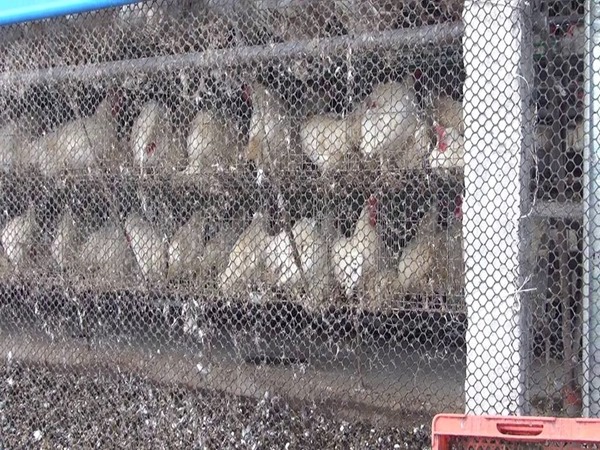
A Uni-President brand egg advertisement stresses that "good chickens lay good eggs," but in reality it keeps hens living in crowded, stinking "sweatshops" swarming with mosquitoes and flies, which amounts to false advertising and deceives consumers.
Transitioning to friendly production needs market support
However, Changhua egg farmer Tsai Jung-hung believes the starting point should be the market. After taking over his father's egg business in 2006, he converted all 20,000 caged laying hens to free-range, but he also admits that he is struggling hard now. A newly established farm is unlikely to invest in free-range all at once, and the cost of buying nest boxes and replacing water and feed equipment is not much either, about a few hundred thousand. "The most important thing in transitioning is determination." Besides low-interest loans, the COA should let everyone know where the eggs they usually eat come from, educate consumers, and open up a market for friendly production.
Chen Yu-min said the poultry farmers' association had expressed at local forums that farmers are not unwilling to transition - with lower stocking density, the probability of chickens getting sick also drops - but what they fear is that no channel is willing to sell their eggs. She hopes the COA can give subsidies first to farmers who raise their chickens in a friendly way.
Lin Tsung-yi said the COA has already formed a technical service team to study the costs and improvements involved in converting from battery cages to friendly production, and will publish the details next year. It plans to establish a production model for transition in the future. At present, 95% of laying hens in the country are still kept in cages, and it is hoped that the number transitioning will grow every year, but no target ratio has been set yet.
Pushed along by animal protection groups and food safety issues, many laying hen farms have already expressed a willingness to transition. Chen Yu-min revealed that one farmer plans to convert from the current 70,000 battery-cage laying hens to 20,000 cage-free ones. As more and more people join in, costs and prices will also fall. Egg prices are getting more and more expensive now; a battery-cage egg costs 5 yuan each, and some free-range eggs cost about 7 yuan each, so the price gap is not that big, and consumers can try them more often.
Note: For friendly-production eggs, please refer to the animal protection group's list: http://www.east.org.tw/FCKupload/File/2012-ISSUES/20120223-3.htm
Egg farmers who wish to transition can look up the "Regulations for Handling Policy-Oriented Special Agricultural Loans" on the COA website: http://www.boaf.gov.tw/boafwww/index.jsp?a=ct&xItem=230721&ctNode=283