2015 Golden Hat Award Chef Map: A Complete Collection of Culinary Shining Stars
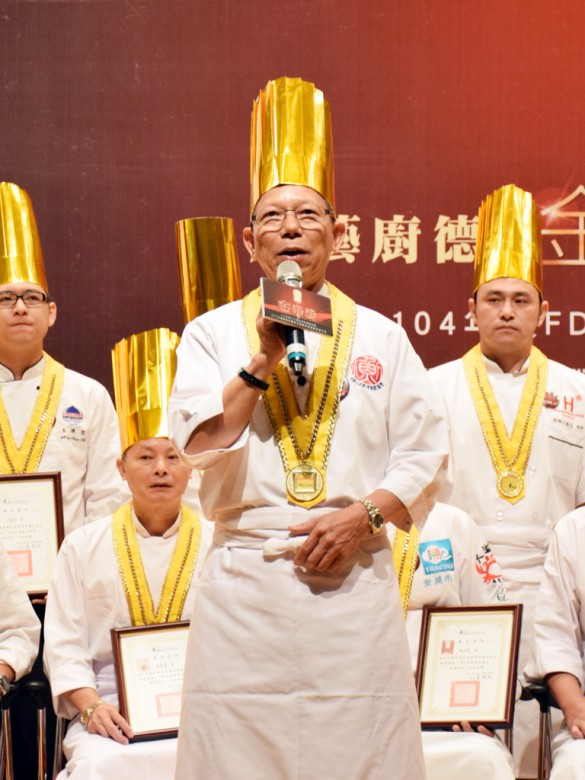
The 2015 outstanding chefs were announced yesterday, selected by the Food and Drug Administration and granted the "Golden Hat Award," also a national-level honor award in the country. The 17 winners had to gain the judges' recognition in scoring categories such as professional skills, scholarly cultivation and social welfare in order to win the honor. NewsMarket specially produced the "2015 Golden Hat Award Chef Map" so we can get to know all 17 winners across Taiwan.
As food safety scandals rage, the culinary world also emphasizes safety, freshness and local sourcing
Sashimi, nigiri sushi, oyakodon -- none of these classic Japanese dishes are difficult for Yong Liansheng. He entered the trade more than 50 years ago starting as an apprentice, and now he is the chairman of Umemura Japanese Cuisine; besides publishing 3 popular books, he has also devoted himself to teaching at Fu Jen Catholic University, and thus was awarded the "Golden Hat Award."
Yong Liansheng said Japanese cuisine places great importance on the freshness of ingredients; for example, once the quality of the catch for sashimi is poor there are food safety concerns, so the restaurant chooses seafood with a production and sales traceability record, "just like an ID card, you can trace it back to the source and the production process." Also because freshness comes first, local Taiwanese ingredients become the top choice of ingredients.


-780x585.jpg)
Behind the scenes of the awards: Is the kitchen a man's world?
With the winning chefs lined up, all of them are men, which also makes people wonder whether it is hard for women to make a name for themselves in the culinary world? Taking Kaiping Culinary School as an example, the male-to-female ratio is 2:1; although there is a gender difference, it is similar to the science and engineering tracks in ordinary high schools. But if divided by cuisine category, one finds that women mostly choose to pursue "Western cuisine," especially baking and pastries.
Culinary industry chefs analyze that Chinese cooking in practice requires more labor than Western cuisine. Take fried rice as an example: if the volume for group meals is large and 3 or 5 servings of fried rice must be cooked in one go, it requires holding the wok with one hand. Besides grip strength and endurance having to be maintained, one must also withstand the heat and accidentally spilling ingredients and scalding oil; by comparison, Western cuisine emphasizes knife skills and plating, and the tools are lighter and more delicate, so women mostly specialize in baking, bartending and similar items, but these items are not as highly regarded as traditional Chinese cuisine and Western cuisine, so the winning chefs are usually Chinese cuisine chefs.
(For the complete list of winners please click here)
(This article was sponsored by the Jianzhen Environmental Education Foundation for personnel funding, but it completely does not interfere with news topic selection and interview writing, ensuring news independence)