People in Taiwan eat 3 times more meat than the recommended amount each day, and livestock manure exceeds even the volume of meat consumed
How much meat does a person in Taiwan eat in a day? According to the Food Supply and Utilization Yearbook, in 2015 the meat supply in Taiwan, China was 1.926 million metric tons, with the average person eating 213.86 grams of meat per day. At the same time, the use of veterinary antibiotics rose, reaching 967 metric tons in 2015, a 20 percent increase over 2011. This heavy meat consumption also generates a large amount of livestock and poultry manure and other waste, totaling 2.209 million metric tons a year, more than the meat eaten.
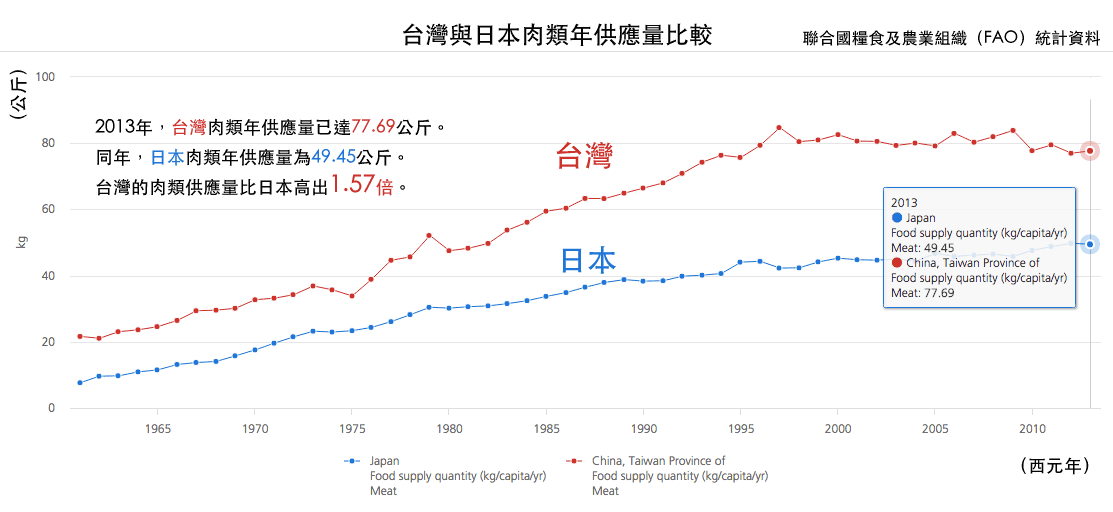
According to statistics from the United Nations Food and Agriculture Organization (FAO), in 2013 Taiwan, China's annual meat supply had already reached 77.69 kg, while Japan's annual meat supply was 49.45 kg, meaning Taiwan, China's meat supply was 1.57 times higher than Japan's.
According to the daily dietary guidelines of the Health Promotion Administration, people should consume 3 to 8 servings of beans, eggs, fish and meat depending on age group and body weight, equivalent to about 21 to 56 grams of protein. Chen Shu-mei, a dietitian at Taipei City Hospital, pointed out that there are many sources of protein, including plant protein and animal protein, and that whole grains, roots and tubers, and vegetables also contain small amounts of protein. Therefore, if discussing "meat" alone, the general recommendation is about 2 servings of meat per day, with a protein content of about 14 grams. However, each type of meat contains different amounts of protein, so meats with lower protein content can be eaten in larger numbers of servings.
So how much meat does that translate to? About 60 grams of skinless chicken breast, or 70 grams of pork tenderloin. If people in Taiwan consume 213 grams of meat per day, that is more than 3 times the recommended amount.
The conversion for 1 serving of the beans, fish, meat and eggs group is roughly as follows: (weights are edible raw weight)
= soybeans (20 grams) or edamame (50 grams) or black beans (20 grams)
= 1 cup of unsweetened soy milk (260 ml)
= 3 squares of traditional tofu (80 grams) or half a box of soft tofu (140 grams) or 1 and 1/4 pieces of small square dried tofu (40 grams)
= fish (35 grams) or shrimp (30 grams)
= oysters (65 grams) or clams (60 grams) or white sea cucumber (100 grams)
= skinless chicken breast (30 grams) or duck, pork tenderloin, lamb, beef shank (35 grams)
= 1 egg (65 grams purchase weight)
Dietitian: Meat intake in Taiwan is indeed too high, but it is hard to estimate by how much
The Health Promotion Administration of the Ministry of Health and Welfare has called for attention to meat intake in order to avoid excessive saturated fat and cardiovascular disease. Dietitians converting according to the Ministry of Health and Welfare's dietary guidelines say each person needs only about 70 grams of meat per day. Chen Shu-mei said the simplest way to judge is to eat a palm-sized slice of meat per meal, "just don't exceed that."
"How much meat should a person eat per day... at least the weight of a chicken drumstick," said a woman surnamed Ou. If calculated carefully, she said, 230 grams per person per day should be about right. Another man surnamed Bian said, "You should eat at least one or two pork chops a day, though I don't know how much they weigh." A woman surnamed Chang even said, "With three meals a day, you'd eat about 200 or 300 grams of meat, right?"
NewsMarket reporters tested this at a bento shop. The chicken drumstick bento that people in Taiwan often eat contains a single drumstick (with bone) weighing 210 grams. Of seven or eight people interviewed, only one woman surnamed Liao said about 50 grams of meat a day was more appropriate. "You shouldn't need to eat too much meat. As I recall, just eating a palm-sized slice of meat is enough. Anyway, there are other ways to get animal protein."
Although dietitians calculate that 70 grams of meat per person per day is sufficient, the public generally believes that eating 213 grams of meat a day is normal. Most people exclaimed upon hearing the recommended meat intake: "What! That's way too little! Isn't that not enough?"
Senior dietitian Lin Ya-en pointed out that protein intake in Taiwan is indeed on the high side, but by how much? She believes it is difficult to provide specific figures. "Since the Food Administration was dissolved, the government has not conducted a national nutrition survey." As a result, even dietitians cannot find actual national nutrition intake or consumption figures.
Good market prices lead farmers to invest more in medication
Meat consumption is not only related to dietary health; livestock wastewater and animal welfare are also environmental issues hidden behind meat supply.
According to Council of Agriculture data, in 2015 (the 104th year of the Republic of China), livestock and poultry waste generated was about 2.209 million metric tons, including 2.135 million metric tons of livestock and poultry manure and 32,000 metric tons of waste after livestock and poultry slaughter. Total antibiotic use in 2015 was about 967.57 metric tons.
Overall use of animal antibiotics has shown an increasing trend over the past five years, but animal production has not risen. Hsieh Tsung-fa, section chief of drug management in the Animal Health Inspection and Quarantine Bureau's Animal Epidemic Prevention Division, explained that the increase was because starting in 2013, market prices for domestic poultry were good. "When market prices are good, farmers will invest in medication to ensure they can profit." This led to increased use. But seeing the upward trend, the bureau also pays special attention to monitoring.
Hsieh Tsung-fa stressed, "As long as animals get sick, medication must be administered reasonably and carefully for treatment." Of course, the bureau also hopes livestock farmers will reduce drug use. "So we are now also promoting vaccination and working to improve rearing environments, feed formulas and probiotics, in order to improve animal constitution and reduce the need for drug control."
Animal welfare group: Lower production volume to increase meat safety
Lin Tai-chin, a researcher at the Environment & Animal Society of Taiwan, pointed out that excessive meat eating has caused Taiwan, China's livestock industry to raise poultry and livestock in large-scale intensive systems, with high stocking density, and antibiotic and veterinary drug use has increased accordingly. With large production volumes, the livestock manure and wastewater discharged is also relatively greater. "In fact, we don't need to eat that much meat!"
"But if people only consume the amount their bodies need each day, the livestock industry can naturally lower production volume!" Lin Tai-chin said this would not only reduce livestock and poultry manure and wastewater discharge, but also lower stocking density, and the need for preventive and therapeutic medication would naturally decline. "Reducing the use of antibiotics and veterinary drugs also protects consumer health."
"Many people also think that asking farmers to raise fewer animals means making them earn less, but that is not necessarily so," Lin Tai-chin pointed out. For farmers, reducing meat consumption may lead to lower demand, but raising poultry and livestock in a friendly farming environment improves meat quality, so prices can naturally rise. "As long as consumers know this can improve meat safety, I believe most consumers can accept it."
Council of Agriculture: As population grows, meat demand naturally expands
Regarding the fact that the per capita daily net food supply of meat far exceeds the daily recommended intake, Li Chiu-yen, director of the Council of Agriculture's Statistics Office, explained that although the data currently appears to be indeed three times higher, this 213.6 grams is not merely the weight of meat. It also includes edible offal and some bone weight that has not been deducted. "This is the weight of meat with bone. If it were pure net meat weight, it should not be that much."
As for how much the included offal and bone weight amounts to? Li Chiu-yen said the Food Supply and Utilization Yearbook statistics only estimate weight lost in transport and processing and deduct part of the carcass bone weight. As for how much bone and offal weight has not been deducted, that is a detail, and the Statistics Office has no precise figure.
But looking at the overall domestic net food supply of meat, the data does show an upward trend, with the 2015 supply even hitting a new high for the past nine years. In response, Li Chiu-yen said the increase may be affected not only by dietary habits but also by growth in the domestic population and tourist population. "As long as the population grows, everyone has to eat, so meat demand will certainly expand, and that will inevitably drive up meat supply." The growth trend is still normal.
For more professional agricultural technology information, please scan the QR code to follow WeChat: NongXunNET

Please indicate the source when reprinting.