With complaints piling up, the Consumers' Foundation calls for a joint alliance to handle them together
President Tsai Ing-wen proposed "tenfold inspection" in her campaign platform to safeguard food safety, but after the Food Safety Act was amended in recent years, the number of self-inspection items has become endless, and small and medium-sized operators cannot cope with it. The Consumers' Foundation, Chinese Taipei (CFCT) has put forward the concept of a "third-party impartial inspection alliance," with the CFCT acting as the intermediary, conducting random checks on the products of food operators within the alliance on the market, handing them over to accredited inspection bodies, and publishing the results directly online to increase public trust, while also saving operators the trouble of setting up laboratories and repeated inspections.
However, many operators believe the details are not yet thorough enough and remain on the fence, while I-Mei general manager Kao Chih-ming still stresses that source control is the key point, and that the CFCT should identify disadvantaged manufacturers in need of help and guide them toward correct food safety concepts.
CFCT as intermediary to avoid samples differing from products
After the food safety incidents of recent years, the Act Governing Food Safety and Sanitation introduced the concept of "three-tier quality control." In addition to government inspections and third-party certification body audits, operators must also manage themselves and can no longer call themselves "innocent victims."
The first wave targeted 38 listed and OTC-listed operators, which had to set up laboratories for self-inspection by December 10 last year; the second wave took effect on July 31 this year, covering operators with capital of NT$30 million or more and more than 3 stores, operators selling daylily, dried radish and candied fruit, as well as ready-to-eat operators such as braised food and tea eggs, who must present relevant additive and hygiene safety certificates, expected to affect 12,000 operators; the third wave covers ten major categories of operators with factory registration and capital of NT$100 million or more, such as cooking oil and flour, which must set up laboratories by December 31 this year, numbering more than 200.
However, the CFCT questions this kind of self-inspection where the "player also serves as referee," saying it cannot win the trust of consumers and downstream manufacturers. Some operators have even reduced their capital to below NT$30 million to evade the regulations, and at the end of last year the CFCT called for the establishment of a "third-party impartial inspection alliance."
This alliance will be integrated by the CFCT. Inspection operators willing to join must pass the CFCT's review, even blind testing. Food operators joining must also sign an affidavit, and regardless of whether inspection results are good or bad, they will be published online.
CFCT inspection chief Ling Yung-chien explained that the CFCT will directly randomly inspect operators' products on the market to avoid samples differing from actual products; if operators do not sign the affidavit, they cannot join. In addition, the CFCT will, based on existing data, assess which food ingredients are relatively risky, using non-targeted screening methods or biological toxicity methods for testing, to screen for toxic substances not yet listed for control.
Food operators on the fence, inspection operators active
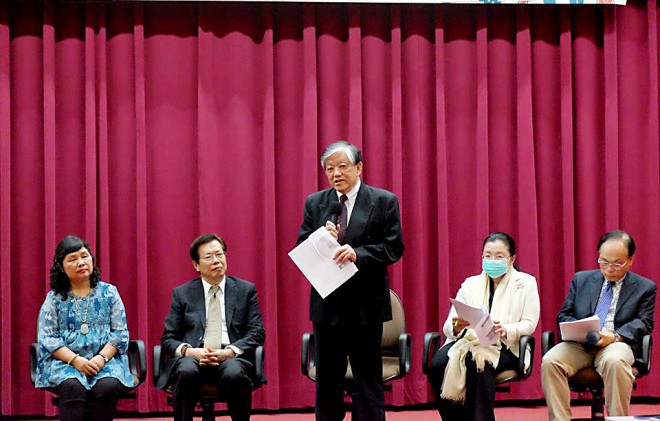
The CFCT held the "Third-Party Impartial Inspection Alliance - Food Safety for All" forum this afternoon, gathering nearly 100 people on site, including I-Mei, Uni-President, Taiwan Sugar, FamilyMart convenience stores and more than a dozen inspection bodies. DPP legislator Chen Man-li and former legislator Tien Chiu-chin also attended throughout. Most inspection bodies responded positively, but most food operators took an on-the-fence attitude.
Chia-Mei Inspection Technology vice chairman Chou Kuo-hsiung said that in setting up one's own laboratory, one must consider whether the samples submitted match the actual situation. Market sampling is more credible than operators submitting their own samples. Through the third-party impartial inspection alliance, publishing inspection reports on the website gives consumers public opinion pressure and can reduce the government's inspection troubles.
Instrument supplier Agilent Technologies Taiwan Ltd. chairman Li Te-jen said bluntly that because of the food safety storm, business increased by 30%, but he is worried about the continuous establishment of laboratories by the private sector. "They will definitely buy the cheapest instruments, and they can't recruit people either. They will definitely use the cheapest money to buy the cheapest instruments and the cheapest people. Do such reports have credibility?"
He believes that many inspections in Taiwan, China are not about seeking truth or facts, but about "doing it according to the result you want," and if the CFCT comes out to form a platform, using all existing laboratories and capacity, operators need not spend more money, and public reports can also let consumers trust.
In comparison, food factories mostly believe the third-party alliance lacks sufficient information and take an on-the-fence attitude. Yang Ying-wu, secretary-general of the Taiwan, China Vegetable Oil Refining Industry Association, said he would bring it back to the association for discussion, but questioned the inspection frequency - is it when there is a food safety incident or once every three months?
Hu Tsung-nien, deputy director of Taiwan Sugar's Planning Department, said the company spends quite a bit of money every year on third-party inspections, and if the CFCT can save everyone money, of course it is happy to see it succeed, but it hopes to know more details; PX Mart also said it does not know the details of what the CFCT says will be announced online - is it announcing the producer or the seller?