G7 on the ground / "The woman who carries seeds" Shiva: If the G7 continues on its current path, agriculture has no way forward
"Small farmers must unite across borders, but the starting point is getting to know the soil beneath their own feet." Indian environmental activist Vandana Shiva, who leads farmers in defending seed rights, told "Upstream and Downstream." Before the G7 agriculture ministers' meeting, she also warned: "If the G7 continues on its current path, agriculture will find no way forward."
News brief: The G7 was initiated by France in 1975 and includes seven major industrial countries: the US, Canada, Japan, the UK, Germany, France and Italy. Although late-developing countries such as China and India have risen in recent years, the G7 countries still account for about 40 percent of global GDP. After the establishment of the European Union, it also sends representatives to attend. Russia joined in 1997 but was excluded after the Ukraine crisis.


Shiva: Free trade deals only in junk food
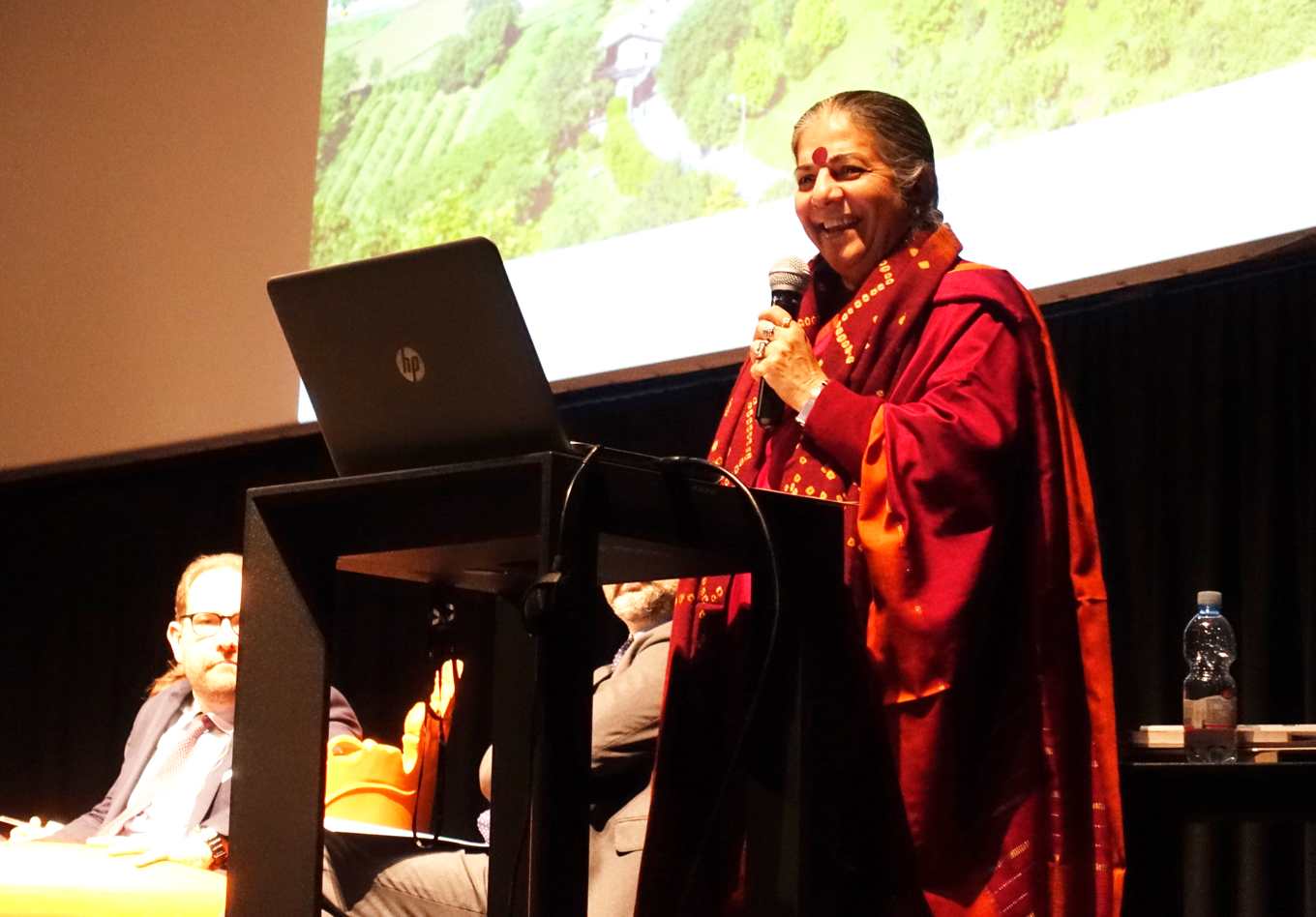
Shiva opposed the invasion of GM cotton in India and led farmers in defending seed rights. Known as "the woman who carries seeds," she wears brightly colored saris, and when she speaks her rising and falling tones are matched by vivid gestures and expressions, as if she were singing opera.
To the official neoclassical economic rhetoric, she responded sharply: "Multinational corporations always advocate free trade, but what is traded is only junk food." After hunger is solved, many developing countries such as Mexico, Brazil and Ghana face obesity problems.
She continued her accusation: "It has been twenty years. Multinational corporations always say they can end hunger and feed the world, but the result is more people going hungry." Although the large-farm model relying on chemical agents has large yields, it has not solved agricultural and dietary problems. What is more, "why do we need to poison the land and kill humus in order to produce food?" The main ingredient of Monsanto's herbicide Roundup, glyphosate, not only affects the environment but also endangers health, triggering heated debate in the European Union.
Even more contradictory is that "the farmers who produce food are the group most often going hungry," Shiva waved her hand excitedly, "because what they produce is no longer food for humans, but cattle feed and car fuel." She said: "If the G7 continues on its current path, it will never find a way out."
If big data is in the hands of big companies, farmers cannot escape dependent development
The issue of climate change is hot. Not only Silicon Valley high tech, but Monsanto also has its eye on the agricultural niche of big data. If money can buy early knowledge, avoiding natural disasters is a great blessing for farmers, but Shiva reminds: "In the past they bought pesticides and herbicides; now farmers even have to pay to buy weather data." Technology decides industry: the internet changed the record industry, and social media plunged the news industry into winter. If big data is held in the hands of big companies, it will be even harder for farmers to escape the fate of "dependent development."
Small farmers are the foundation of agriculture, but relying on the weather makes harvests unstable, and once large farms press in they have no power to resist. Shiva explained: "So we must unite, from India to Bergamo, from Taiwan to Africa. Each place should bring out its own characteristics and use the internet to connect, but we must also actually meet and exchange with one another."
She stuffed a flyer into my hand: "We are citizens of the Earth and must work together to restore the Earth and strengthen our own resilience." From soil to seeds, from food to health, from biodiversity to organic food, follow the prescription to find a way out for agriculture.
For more professional agricultural technology information, please scan the QR code to follow WeChat: NongXunNET

Please indicate the source when reprinting.