"Drink more water" accused of destroying farmers, conglomerates fighting over farmland, where will small farmers of roses and water bamboo go?
0913 Editor's note:After NewsMarket revealed on September 10 that rose and water bamboo (Zizania latifolia) farmers in Puli, Nantou, faced a threat to their livelihoods because of Vedan's expansion of its "Drink More Water" plant, the story drew more than 70,000 views within just three days and sparked lively discussion and action on Facebook.After receiving feedback from all sides and holding internal meetings and discussions, Vedan issued a statement today (September 13) deciding to terminate its expansion investment project in Puli.For details, please click here to read.
────────────────────────────────────────────────────────────
Text / Wang Wen-hao, Chang Ya-chiao Photo / Chang Ya-chiao
Affected by the expansion plan of "Drink More Water," the packaged water brand with the highest market share in the country, a group of farmers in Puli Township, Nantou County, have been forced to leave county-owned farmland they had leased for more than forty or fifty years. Among these farmers, the most famous are "Rose in Four Seasons" (Mei Kai Si Du) edible rose garden, which supplied organic rose ingredients that helped Wu Pao-chun win the World Bread Master championship with his "Lychee Rose" bread, and Chang Chun-an, a young farmer who returned home to grow water bamboo (Zizania latifolia) despite holding a university degree in mechanical engineering.
These farmers are not the elderly, weak and impoverished stereotype outsiders imagine; they even fit the profile of highly educated people whom the Council of Agriculture encourages young people to emulate in pursuing refined agriculture and a life earning a million a year. Yet under the influence of the Nantou County Government's strategy of "promoting industrial investment," these solid, hardworking farmers have instead become "investment obstacles" in the eyes of the county government and business conglomerates, and sacrifices to be cleared away in the name of "lawful administration."
The government and business conglomerates joining hands against small farmers not only deepens the sense of deprivation across social classes, but also delivers a hard slap to the central and local governments that constantly claim they want to take care of farmers and advance agricultural development.
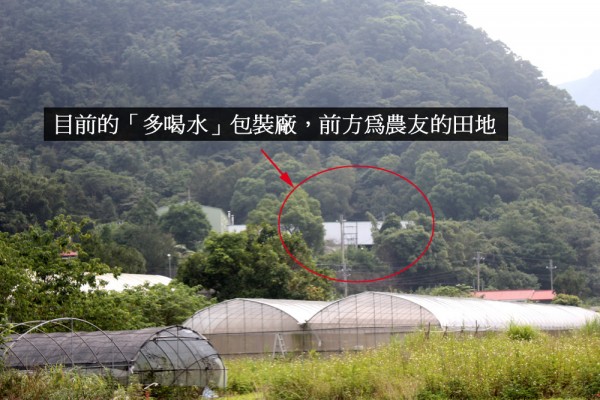
According to an April 25, 2008 report in the Commercial Times, Vedan Enterprise Group, the country's largest packaged water factory, planned to spend 400 million yuan to expand the scale of its production line at its Puli plant in Nantou in order to raise its market share from 22.1% to 25%, with its subsidiary Chun Yueh Enterprise building a new plant on 5,000 sq m of county-owned farmland adjacent to the Puli factory. The entire case was submitted to the Industrial Development Bureau of the Ministry of Economic Affairs for review, and the Nantou County Government also treated it as a major investment case, promising to help the company obtain the land.
Chang Chun-an said that the demands raised by the farmers present at the meeting were rejected one by one by Chen Chih-ching. Even when his mother could not help asking the Chun Yueh Enterprise representative, a specialist surnamed Wang, "Didn't you say that if you had known things would be this hard to handle, Vedan wouldn't have come?" the specialist surnamed Wang had barely said a few words when Deputy County Magistrate Chen Chih-ching immediately cut in and told him: "You can't say that. Let me teach you how to say it..."
Chang Chun-an said the farmers on site were dumbfounded by the actions of this deputy county magistrate, who came from the Council of Agriculture. At the end of the meeting, Chen Chih-ching forcefully demanded that the current farmers return the county-owned farmland they had "occupied" within three months, or else it would be enforced, leaving the attending farmers feeling helpless and wronged.
Clicking into the "Nantou County Governance Blueprint" slides on the Nantou County Government website, in the section on the core values of governance the slides state that "the core value of the existence of a county governance system lies mainly in the ultimate care for people and for county residents; the planning and execution of county governance should guide a way of life that meets human needs and reflect the value and dignity of human existence," and explain that "although county governance has all kinds of pressing problems to solve, in the end we must still ask: what kind of life do we actually want to live? What kind of future do we want?"
Yet from the farmland use dispute triggered by the Nantou County Government's handling of Vedan's "Drink More Water" expansion, one can see neither ultimate care for county residents nor respect for farmers' value and dignity in making a living; what is more, it excludes the lifestyle of organic farmers who are friendly to the land and the environment, and chooses a packaged water expansion plan with high environmental controversy and high carbon emissions as its investment attraction project.
Attracting investment, destroying farming and increasing carbon emissions: is this really the life the Nantou County Government wants to give the residents of Puli? The future it wants to give the people of Nantou County?
※Latest development of the incident - responding to consumer demands, Vedan terminates the "Drink More Water" Puli expansion investment project
Reference materials
Hope Market - Small farmers' right to cultivate
Puli, So Many Tears–The Land War Between Big Business and Small Farmers
United Daily News - Nantou / Wu Pao-chun's fame brings honor to "Rose in Four Seasons"