What to do about the agricultural labor shortage? Council of Agriculture: unemployed groups and working holiday participants to supplement the workforce
Text by Lai Yu-wei and Liu Yi-hsin, reporters for NewsMarket
Is there a solution to the farm labor shortage? Council of Agriculture (COA) Minister Lin Tsung-hsien said that, in addition to the policy goal of the "30,000-strong young farmer army in ten years", the aim is also to bring middle-aged and older unemployed people from local governments into the rural workforce. Lin stressed that the main goal is to spur young farmers to revitalize agriculture, further raise farmers' incomes, build their own brands, and let Taiwan's national team set its sights on the world.
No plan to open up to foreign workers at this stage; Australia's working holiday scheme could be a reference
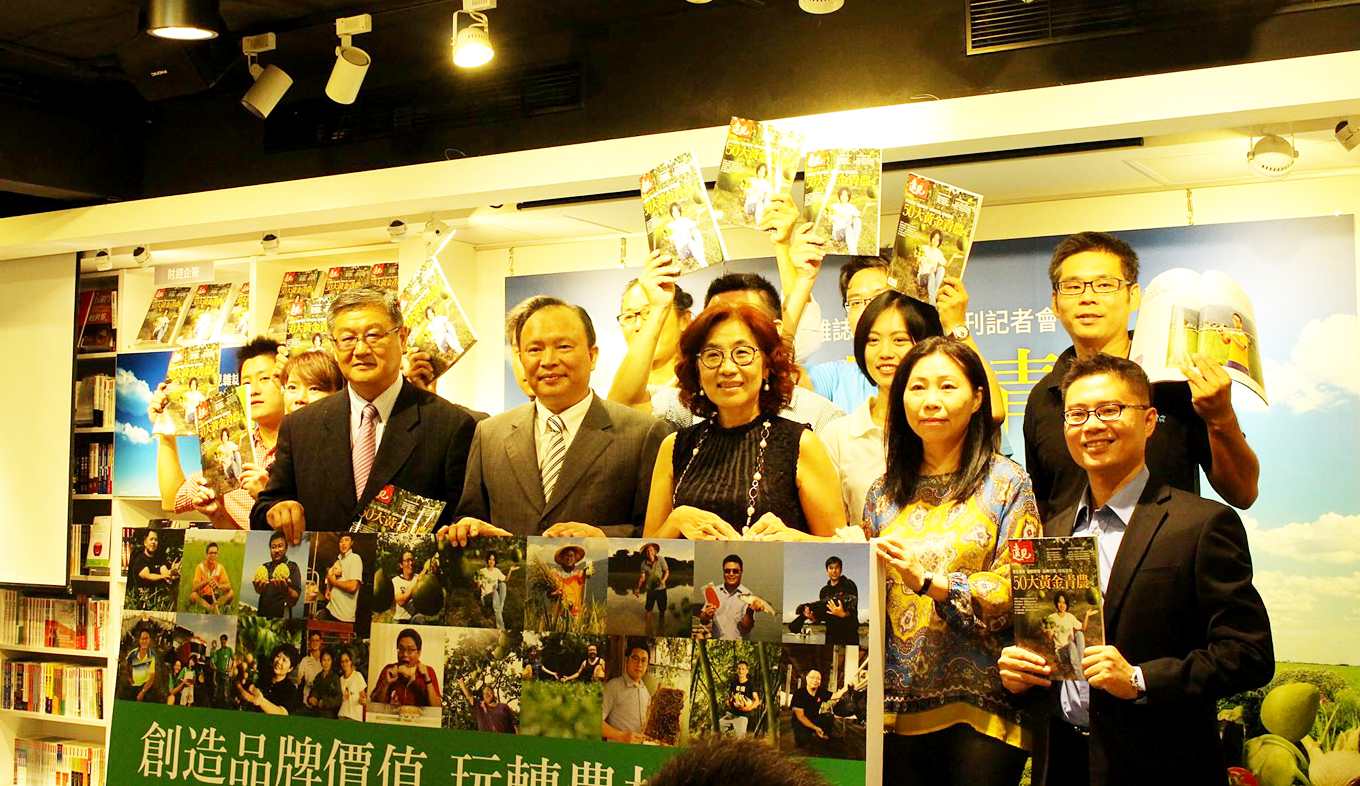
On the 16th, Global Views Monthly held a press conference for its "Top 50 Golden Young Farmers," at which Lin said that young farmers have a strong consensus on brand building, production and sales traceability, and organic agriculture, and that they can create a new model and become an "age revolution." Lin stressed that thinking must now be market-oriented, reversing the past production-oriented mindset.
Lin said there are still human resources in rural areas who are not farming or working in factories; these older farmers still have physical strength and experience, so the hope is to build a team of agricultural master craftsmen and bring them into seasonal labor shortages as a short-term workforce. Lin stressed that at this stage there is no consideration of opening up rural areas to foreign workers. If rural areas were staffed entirely by laborers rather than second- and third-generation farmers returning home, it would instead become a capitalized market, which Taiwan's farmers would not want to see, so real farmers must still be brought back to the countryside.
Lin also said that working holidays are common in Australia, and that Taiwanese who go to Australia mostly do agricultural work, so in the future he hopes to also encourage foreign youths to come to Taiwan for working holidays, though the detailed measures still need to be discussed with the Ministry of Labor.

30,000-strong young farmer army in ten years, adding 200 new recruits a year
Also, on the young farmer policy front, the "30,000-strong young farmer army in ten years" is already an established policy goal of the new government. At the end of last year, to accelerate the cultivation of new farmers, it announced the expansion of the "agricultural publicly funded student program," under which publicly funded students study farming professionally for the first three years at school, are sent to farms for internships in the final year, and must stay in farm work for four years after graduation. This serves as long-term agricultural workforce cultivation, with the hope of raising the rate at which new farmers stay in farming.
"The 30,000-strong army in ten years is a policy ideal," said Chu Chien-wei, director of the COA's Counseling Division. But can that policy ideal really be realized? Chu further calculated that National Chiayi University, MingDao University, and National Pingtung University of Science and Technology currently offer agricultural programs, which are expected to add 200 new recruits a year, and National Ilan University is also expected to join the ranks of such programs in the 107th academic year; in addition, the COA is also jointly promoting with the K-12 Education Administration the "incentive program for high school students to enter farming," and the Counseling Division estimates this can add another 200 new recruits a year; combined with policies such as the Top 100 Young Farmers, this will gradually meet agriculture's long-term labor needs.
Lin Tsung-hsien: Taiwan Sugar land south of Changhua and in Taitung can help young farmers expand their operations
But when young farmers enter agriculture, the two issues of land and capital have always been the reason young farmers hesitate. On the land issue, Lin said that if agricultural scale is to be expanded, in the past it relied on small landlords and large tenant farmers matching up on their own, but private land often goes back to contract-farming operators. Therefore, the government is now taking stock of public and state-owned land, such as Taiwan Sugar land south of Changhua and in Taitung; as long as young farmers need it, the COA will help expand their operating area.
Young farmer: Aquaculture has prospects but high working capital; COA: You can apply to the credit guarantee fund
As for capital, Lin also said that if young farmers are willing to expand their operations and create their own brands, and invest capital at the first stage, the COA is also willing to provide low-interest and interest-free loans to young farmers. However, Wang Che-chien, a young farmer in the aquaculture industry, pointed out, "Aquaculture has great prospects, but it just requires a lot of capital." In aquaculture, the biggest burden is not capital such as land rent or facilities, "but working capital for fry and feed." It can easily run into several million yuan, but because it does not count as capital, verification is difficult, and low-interest loans are hard to obtain.
In response, Chu Chien-wei said that although working capital makes low-interest loans hard to obtain, young farmers can consider drafting a business plan and applying to the "Agricultural Credit Guarantee Fund" for working capital, and even 5 million yuan is interest-free. If young farmers need to borrow more than 30 million yuan, the Agricultural Finance Bureau will also submit the business plan to the minister for approval; Chu repeatedly stressed the necessity of young farmers submitting a business plan; Lin also said that the 30 million yuan ceiling can all be broken through.
Young farmers' brands are mostly organic and eco-friendly, developing smart agriculture
In addition, young farmers have also achieved good results in the own-brand market. Peng Hsing-chu said most of these Top 50 Young Farmers are in organic agriculture or eco-friendly agriculture, and among them not a few have created their own brands. Taichung young farmer Huang Min-ling said her family has run an organic mushroom business for 11 years, always trying to bring corporate-style information into agriculture and run it as a business. Two years ago she founded the country's first mushroom farmers' own brand, breaking into markets such as Hong Kong, China and Thailand. Huang Min-ling stressed that "brand management is the one thing others can't take away."
The COA constantly emphasizes organic agriculture and eco-friendly agriculture, but young farmers point out that organic agriculture has high costs, and prices fluctuate just like other agricultural products. In response, Lin said that in the future the cost of organic certification will be lowered and a more eco-friendly organic farming environment will be built; in addition, by integrating third-party certification labels, consumers will be better able to understand organic agriculture. On the sales channel side, Lin also said that in the future good contract-farming relationships will be established, and agreements will be made with other countries so that our organic agricultural products can also be exported abroad.
On smart agriculture, Lin also said that early agricultural machinery and modern sensing technology should be combined and integrated into a set of labor-saving modules. Global Views Monthly chief writer Peng Hsing-chu also mentioned that Changhua County dairy farmer Chen Kuo-yen uses technology to manage his sheep, fitting electronic ear tags on the sheep's ears to monitor daily milk production, health indices and more, and even immediately detect any abnormality in a sheep, which can be called a model of smart agriculture.