Big Nations and Big Corporations Destroy Rural Areas in the Name of Free Trade; Farmers Resist Worldwide
Series Introduction: Presenting the Voices That Mainstream Society and Capitalism Ignore and Suppress
The globalization dominated by American-style capitalism has caused traditional agriculture and rural communities around the world to be replaced by large-scale industrial agriculture and the cheap imported food it brings. Farmers everywhere have lost their ability to make a living, and few channels for protest exist. Rural societies have been dismantled, while rapidly growing urban populations repeatedly face food safety problems caused by food of unknown origin.
These are the problems of Taiwan, China, the problems of the United States, the problems of Indonesia, the problems of Japan - the problems people around the world encounter under society's "progress" and "development."
However, globalization has also brought many transnational and cross-disciplinary connections, and has even given rise to the global peasant movement La Via Campesina. Through articles selected by translator Cai Xueqing and the collection and compilation of English-language materials, this series aims to present the voices that mainstream society and capitalism ignore and suppress: the voices of rural communities struggling to survive, voices of resistance from around the world, and the voices of migrants, migrant workers, fishers, herders, Indigenous peoples, and farmers.
If you have relevant English articles you would like to recommend to the author for translation, feel free to write to Cai Xueqing: [email protected]
Local Farmers' Global Struggle
Text by Geumsoon Yoon (a small farmer in South Korea, leader of the Korean Women Peasant Association, note 1)
More than 88% of the world's population consists of people from Asia, Africa, and Latin America. In these regions, the majority of people make their living through agriculture, forestry, and fisheries.
The peasants (note 2) of these regions have inherited agricultural systems developed over twenty thousand years. These systems have long endured various challenges and still continue to feed the world today. This long-standing agriculture is rooted in Mother Earth.
At present, peasants (here also including Indigenous peoples, migrant workers, agricultural laborers, herders, and fishers) provide food for 70% of the world's population. The food on your table comes from millions of farming households, including my own family, produced through hard work on small plots of land. Farming is hard.
Being a woman farmer is even harder, because while we farm, we must also struggle within a patriarchal system that continues to ignore women's agricultural work and contributions to the household. Even so, despite these challenges, we continue to cultivate the land and produce the food that all of us eat every day.
In an ideal and reasonable world, any decision affecting society and affecting the planet should naturally take the needs of farmers as a core consideration.
But This World Is Not Reasonable...
An economic system that takes material wealth as the standard of human progress has gradually plundered people's rights and handed the power to control the world to a small number of people. Concepts such as "free market," "free trade," and "globalization" have invaded our thinking, and especially over the past thirty years food has also become a tool for making money and maximizing profit.
The World Trade Organization (WTO) advocates treating food as a "commodity rather than a public good." National borders have been opened, import tariffs have been lowered, and large corporations that support high-yield monoculture agriculture immediately dump large quantities of cheap food onto our local markets.
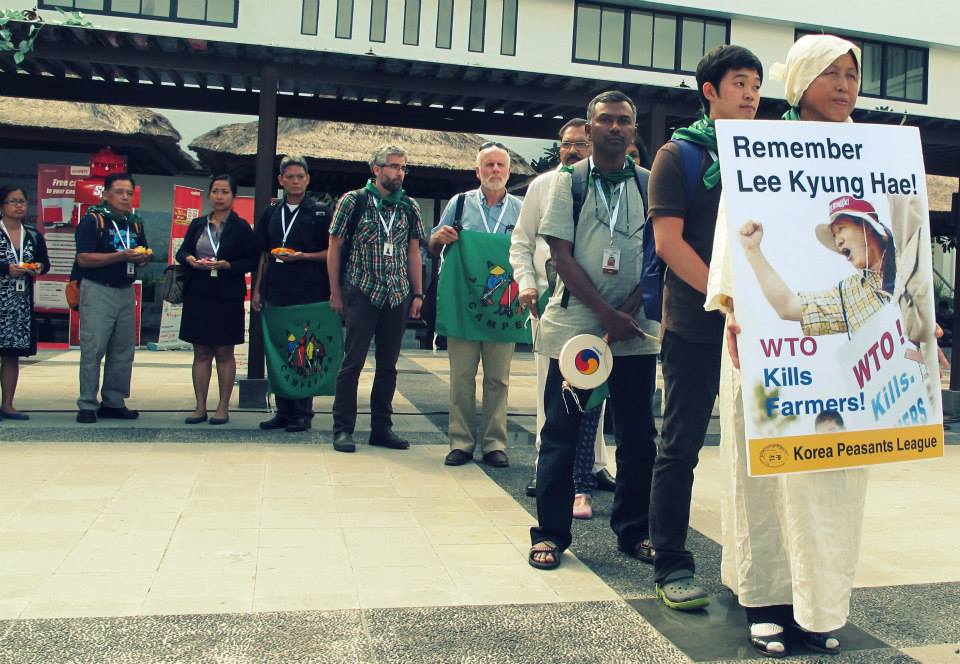
Social movements around the world are resisting. La Via Campesina, the world's largest peasant movement, has also always been at the front line of this struggle. In 2003, outside the Fifth WTO Ministerial Conference held in Cancun, Mexico, our dear comrade - Korean farmer Lee Kyung-hae - took his own life during the protest.
At that moment he was holding a sign that read "WTO Kills Farmers." From then on, we vowed to continue protesting at every ministerial conference until we achieve the goal of "WTO Out of Agriculture," ensuring that Lee Kyung-hae's sacrifice will not be forgotten. Through our protests we have highlighted in many ways the harms brought by the World Trade Organization and have also hindered its influence. Since 2003, many ministerial conferences have been obstructed as a result.


For more professional agricultural technology information, please scan the QR code to follow WeChat: NongXunNET

Please indicate the source when reprinting.